
DevOps and Cloud Skills Employers Want in 2026
DevOps and cloud hiring is about outcomes: faster delivery without breaking reliability or security. Recruiters look for signals that you can automate infrastructure, operate services under failure, and keep deployments safe.
A strong skills section should quickly communicate your cloud platform, infrastructure as code approach, container strategy, and reliability practices. Your Experience bullets should prove those skills with measurable impact such as deployment frequency, mean time to recovery (MTTR), incident rate, and cost efficiency.
This guide provides a modern DevOps skill taxonomy, examples for entry to staff level, proof-bullet patterns, ATS strategy, and formatting that parses cleanly.
High-signal DevOps metrics: deployment frequency, lead time, change failure rate, MTTR, availability or SLO attainment, and infrastructure cost trends.
DevOps and Cloud Skills Taxonomy (5 Clusters Recruiters Scan)
DevOps resumes are scanned as clusters. The question is not how many tools you listed. The question is whether you can build and run reliable systems with automation and good operational hygiene.
Use these five clusters across most DevOps, platform, and cloud engineering roles. Tailor the contents to the job description and your real experience.
- Cloud platform and networking: Signals you can operate real environments. Includes VPC, IAM, load balancing, DNS, and network security fundamentals.
- Infrastructure as Code: The repeatability cluster. Tools like Terraform and CloudFormation indicate you can version, review, and reproduce infrastructure safely.
- Containers and runtime platform: Signals you can run workloads consistently. Kubernetes concepts, service discovery, and deployment strategy are common expectations.
- CI/CD and release engineering: Signals how you ship. Includes build pipelines, artifact promotion, canary releases, and rollback strategy.
- Reliability, observability, and security: The seniority cluster. Includes SLOs and error budgets, monitoring, tracing, incident response, secrets management, and least privilege.
Senior DevOps resumes prove reliability behaviors: safe rollouts, clear SLOs, and measurable incident reduction.
Core DevOps and Cloud Skills to List
Keep categories short and high-signal. List skills you can prove with one bullet in Experience or Projects.
Choose one primary cloud, one IaC tool, one CI system, one observability stack, and one container platform pattern.
- Cloud: AWS (IAM, VPC, EC2, ECS/EKS, Lambda, S3, RDS), GCP, Azure
- Networking: VPC, subnets, route tables, load balancers, DNS, TLS
- Containers: Docker, Kubernetes (EKS, GKE, AKS), Helm
- IaC: Terraform, Pulumi, AWS CDK, CloudFormation
- CI/CD: GitHub Actions, GitLab CI, Jenkins, Argo CD, Flux
- Observability: Prometheus, Grafana, OpenTelemetry basics, Sentry, Datadog
- Security: IAM, RBAC, secrets management (Vault, cloud secrets), SAST basics
- Reliability: SLOs, error budgets, postmortems, runbooks, on-call hygiene
SRE Concepts That Make DevOps Resumes Look Senior
Many DevOps and platform teams use SRE-style concepts. A simple way to show maturity is naming SLOs, defining error budgets, and explaining how they influence release decisions.
You do not need to be an SRE to use these concepts. You do need to show how you measured reliability and what you changed when reliability was not meeting targets.
- Define one or two SLOs (availability, latency, freshness) and measure them consistently
- Use an error budget policy to decide when to slow releases and focus on reliability
- Write postmortems with actionable follow-ups
- Maintain runbooks and on-call playbooks for common failure modes
SLOs are strongest when tied to decisions: release gates, rollback rules, and priority shifts toward reliability work.
Hierarchical Skill Listing by Career Stage
Entry-level skills show foundations and one working project. Mid-level skills show shipping and operational maturity. Senior and staff skills show governance, reliability systems, and safe evolution at scale.
Use the examples below as templates. Avoid vague labels like expert and prove skills with outcomes instead.
Entry-Level Example (Foundations plus One Deployable Project)
Entry-level DevOps skills should show one cloud, basic networking, one CI pipeline, and a deployable service. Keep it realistic and specific.
Prioritize proof: a small app deployed with IaC and a CI pipeline, plus basic logging and monitoring.
- Cloud: AWS basics (IAM, EC2, S3)
- IaC: Terraform basics (modules, variables)
- Containers: Docker
- CI: GitHub Actions (build and deploy)
- Monitoring: CloudWatch basics or Prometheus basics
- Project proof: Deployed a containerized API with Terraform and CI, added logs and alerts for basic health checks
Entry-level tip: list fewer tools and add one project that proves deployment and operations basics.
Mid-Level Example (Shipping plus Operational Maturity)
Mid-level DevOps skills should show you can run production workloads: environments, rollouts, automation, and incident response. Include one cluster runtime, one observability stack, and one release strategy you can explain.
Mention safe rollout patterns such as blue-green or canary when you have used them.
- Cloud: AWS (VPC, EKS, RDS, S3) or GCP equivalents
- IaC: Terraform (modules, state, workspaces)
- Kubernetes: deployments, services, ingress, HPA basics
- CI/CD: GitHub Actions plus Argo CD or Flux
- Observability: Prometheus and Grafana, Sentry, alert routing
- Security: IAM and RBAC, secret rotation basics
- Ops: on-call participation, runbooks, postmortems
Mid-level tip: mention idempotent deployments, rollbacks, and environment parity when you can prove them.
Senior and Staff Example (Reliability Systems plus Governance)
Senior and staff DevOps resumes should show platform ownership. Recruiters want evidence you can reduce incidents, speed delivery safely, and govern infrastructure changes across teams.
List the systems you can design and operate, not every tool you have touched.
- Architecture: multi-account or multi-project layout, network segmentation, disaster recovery planning
- Reliability: SLOs and error budgets, capacity planning, chaos testing basics
- Release: progressive delivery, canary analysis, automated rollback, feature flag governance
- Security: least privilege IAM, secrets management, compliance controls, audit trails
- Platform: reusable IaC modules, golden paths, policy-as-code, cost controls
Senior tip: show that reliability and security are engineered systems, not reactive tasks.
Skills vs Achievements (How to Prove DevOps Skills)
ATS can match keywords in a skills list, but hiring managers trust evidence. List a skill once, then prove it with scope and results.
Use the before and after examples below to turn keywords into proof.
- Before: Terraform. After: Reduced environment provisioning time from 2 days to 25 minutes by standardizing Terraform modules, adding CI validation, and enforcing reviewable infrastructure changes.
- Before: Kubernetes. After: Improved availability by implementing readiness and liveness probes, HPA tuning, and safe rollout policies with automated rollback on error-rate spikes.
- Before: Observability. After: Reduced MTTR from 70 minutes to 20 minutes by adding structured logs, high-signal alerts, and tracing for critical request paths.
If you cannot explain how a tool improved delivery, reliability, or security, do not list it.
DevOps Bullet Examples With Impact (Google XYZ Style)
Senior bullets should be measurable and specific. Use: Accomplished X as measured by Y by doing Z.
Good metrics include deployment frequency, lead time, change failure rate, MTTR, and cost per environment.
- Accomplished a 50% reduction in MTTR by introducing actionable alerting, runbooks, and tracing for high-impact services.
- Accomplished a lower change failure rate by implementing progressive delivery, automated rollback, and release gates for risky changes.
- Accomplished faster delivery by reducing CI time through caching, parallelism, and smaller build artifacts.
- Accomplished higher reliability by defining SLOs and using an error budget policy to guide release cadence.
- Accomplished cost control by implementing tagging, budgets, and scheduled scaling for non-production environments.
- Accomplished safer secrets handling by moving credentials to a secrets manager and rotating them with automation.
ATS Optimization Strategy for DevOps and Cloud Skills
Many ATS workflows rely on keyword search and filters, so exact naming matters. If a job description says EKS, Terraform, or Argo CD, your resume should contain those terms when accurate.
Keyword frequency can help, but contextual relevance prevents keyword stuffing. Place keywords once in Skills, then reinforce the most important ones in Experience bullets where you can prove them.
Keep the skills section plain text with clear headings. Complex tables and text boxes can reduce parser accuracy.
- Mirror exact job description terms for your core stack (AWS, Terraform, Kubernetes)
- Reinforce 2 to 4 top skills in proof bullets
- Use consistent naming (OpenTelemetry, not OTel only)
- Avoid repeating the same keyword in every bullet
- Prefer evidence near the keyword (example: Argo CD in Skills and in one rollout bullet)
ATS finds you by keywords. Humans decide by reliability and engineering judgment.
Certifications That Often Matter
Certifications do not replace experience, but they can help signal baseline knowledge, especially when switching into cloud roles. Choose a certification that matches the platform used by the company.
List certifications only when you have them or are actively preparing with an expected date.
- AWS Certified Solutions Architect Associate or Professional
- AWS Certified DevOps Engineer Professional
- Google Cloud Professional Cloud Architect
- Microsoft Azure Solutions Architect Expert
- Certified Kubernetes Administrator (CKA)
- HashiCorp Terraform Associate
Pick one certification aligned to your target cloud. Avoid collecting many entry-level certs without project proof.
Formatting Best Practices (3 Layout Options)
The best layout is readable and parses cleanly. Avoid complex tables in the Skills section if you apply through strict ATS portals.
Choose one of these layouts based on space and seniority.
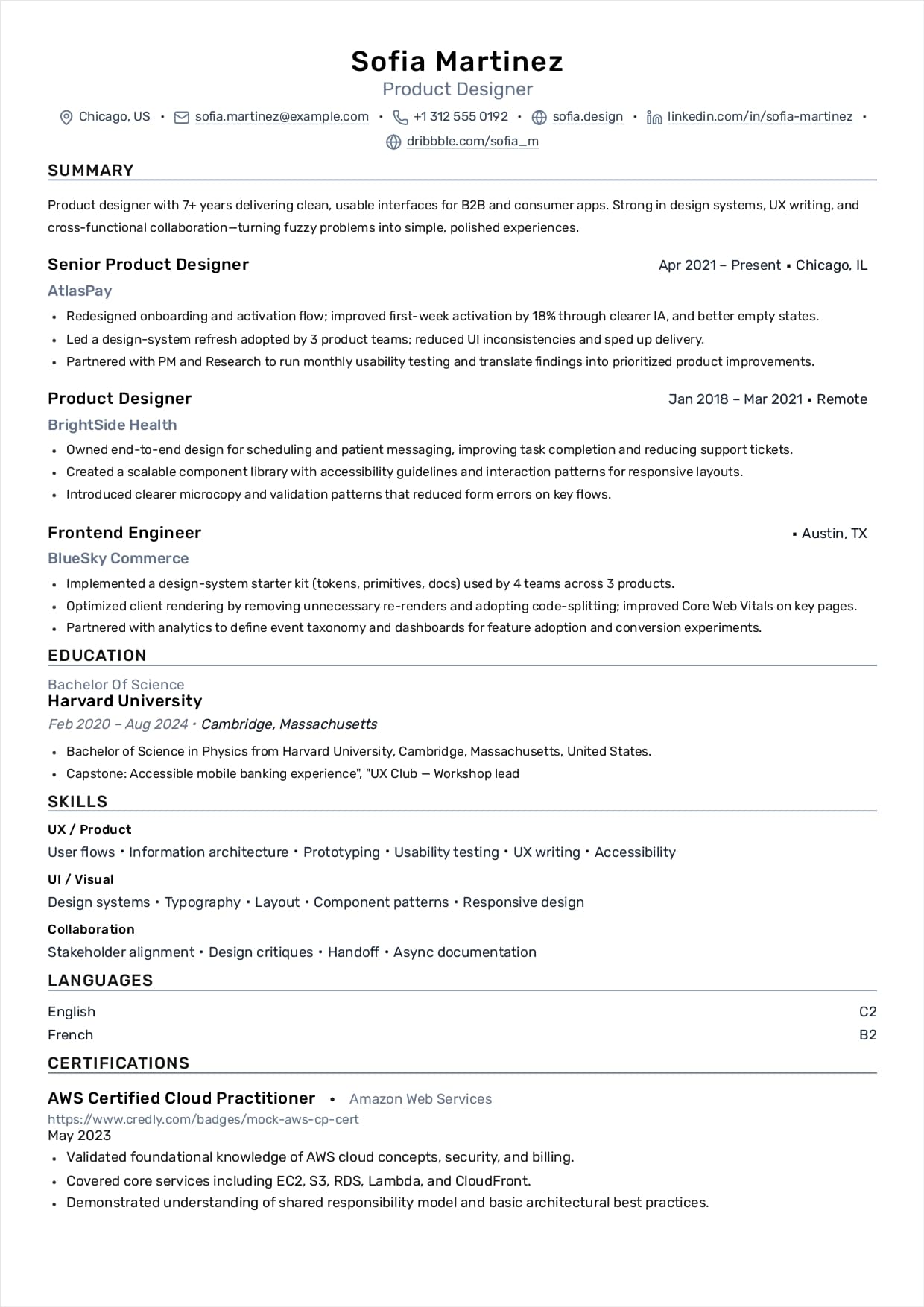
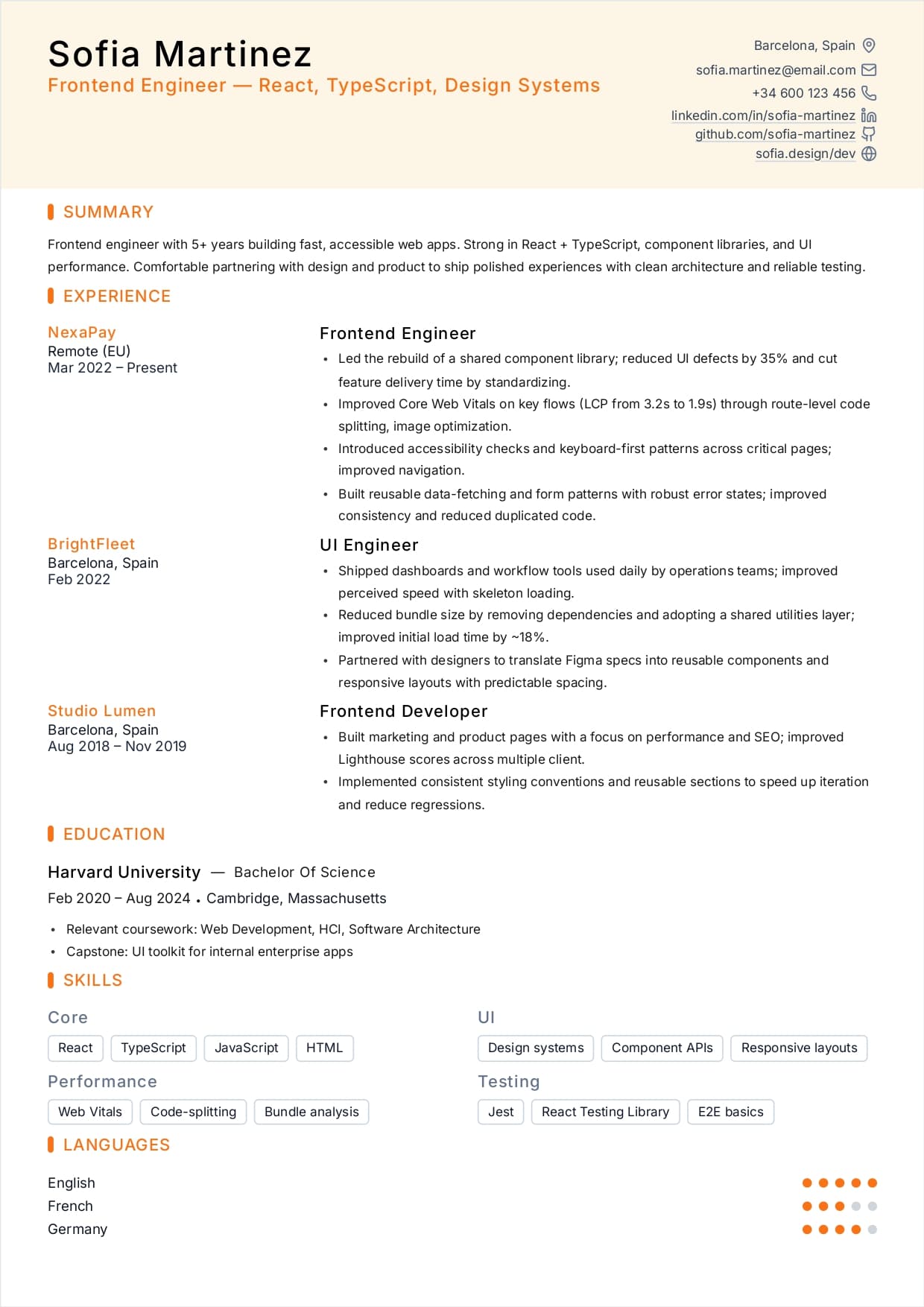
- Cloud or tag layout (space-saving): Short grouped tags per line. Example: Cloud: AWS, Azure. IaC: Terraform. Runtime: Kubernetes. Observability: Prometheus, Grafana.
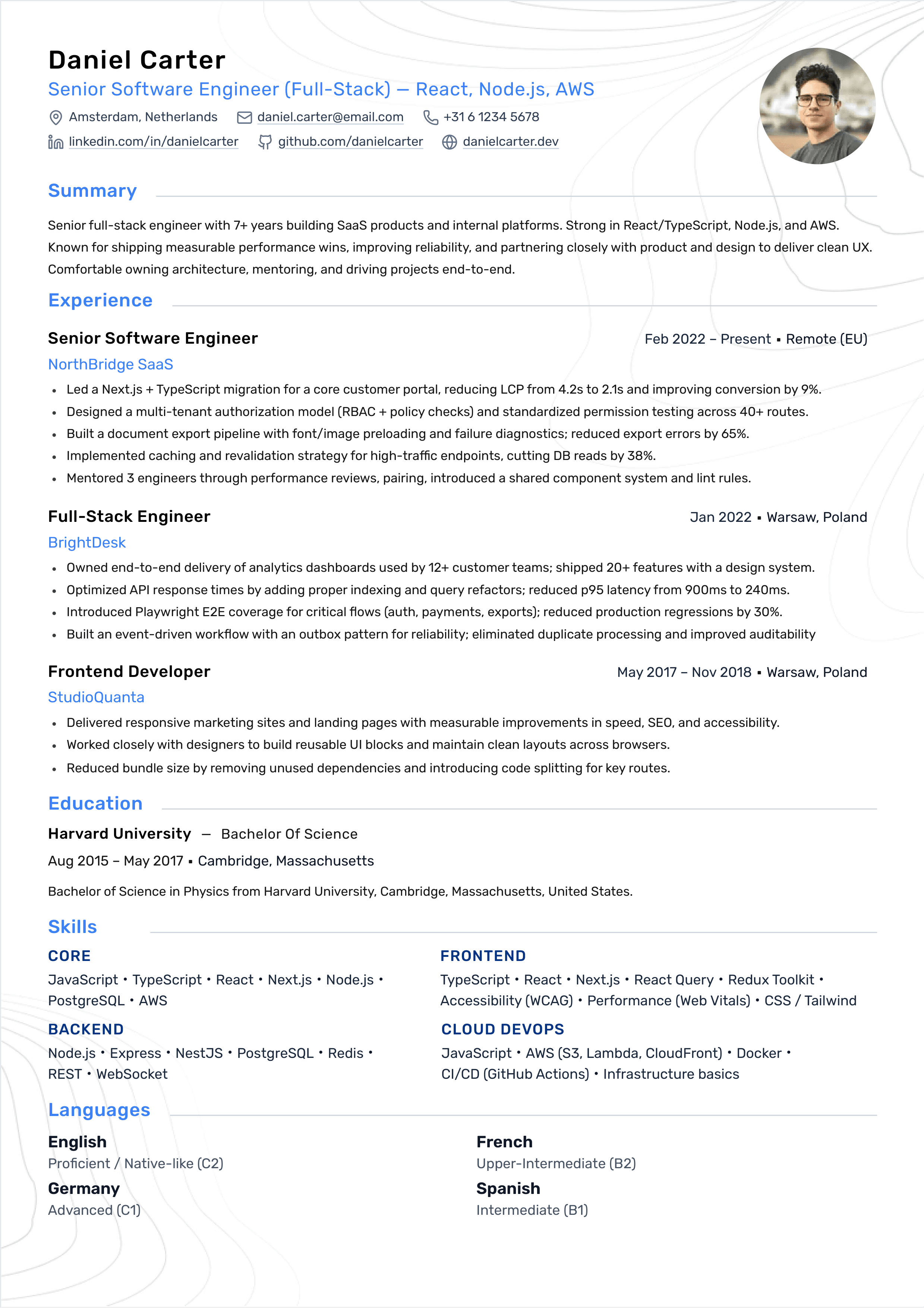
- Categorized list (most readable): 5 to 7 categories with 3 to 6 skills each. This is the safest format for parsing.
- Proficiency matrix (specialists only): Keep it textual. Example: Terraform (advanced), Kubernetes (intermediate), Istio (basic).
Avoid graphical skill bars. They are hard to parse and rarely improve interview rates.
Final Checklist
Use this checklist before you submit your resume.
- Skills are grouped into meaningful clusters
- Skills match the job description wording
- Skills list is short and high signal (10 to 18)
- At least 2 to 4 bullets prove the most important skills
- Bullets include reliability and delivery outcomes (MTTR, change failure rate, SLOs)
- Formatting is plain text and ATS-friendly