
What Makes a Great Senior Frontend Engineer Resume in 2026?
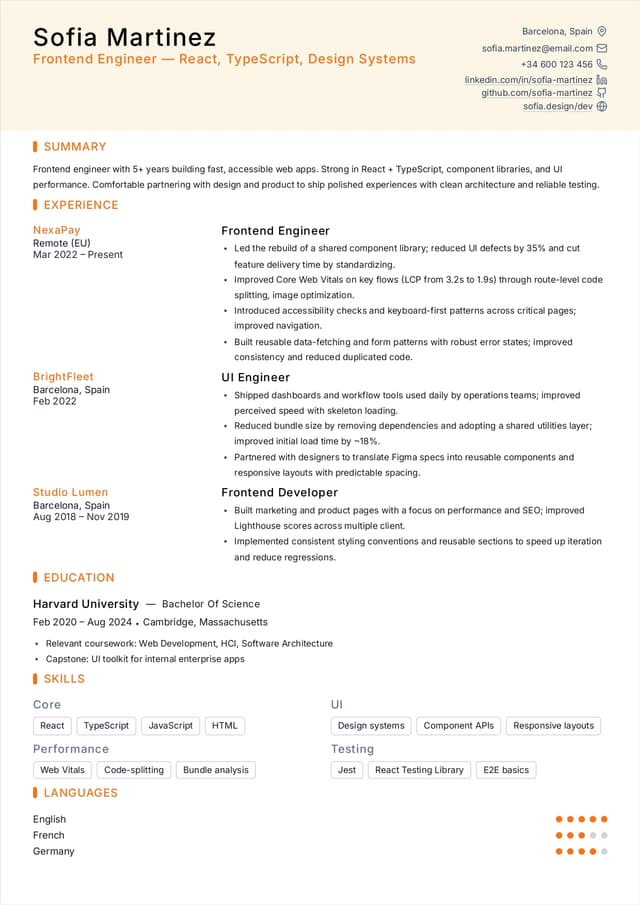
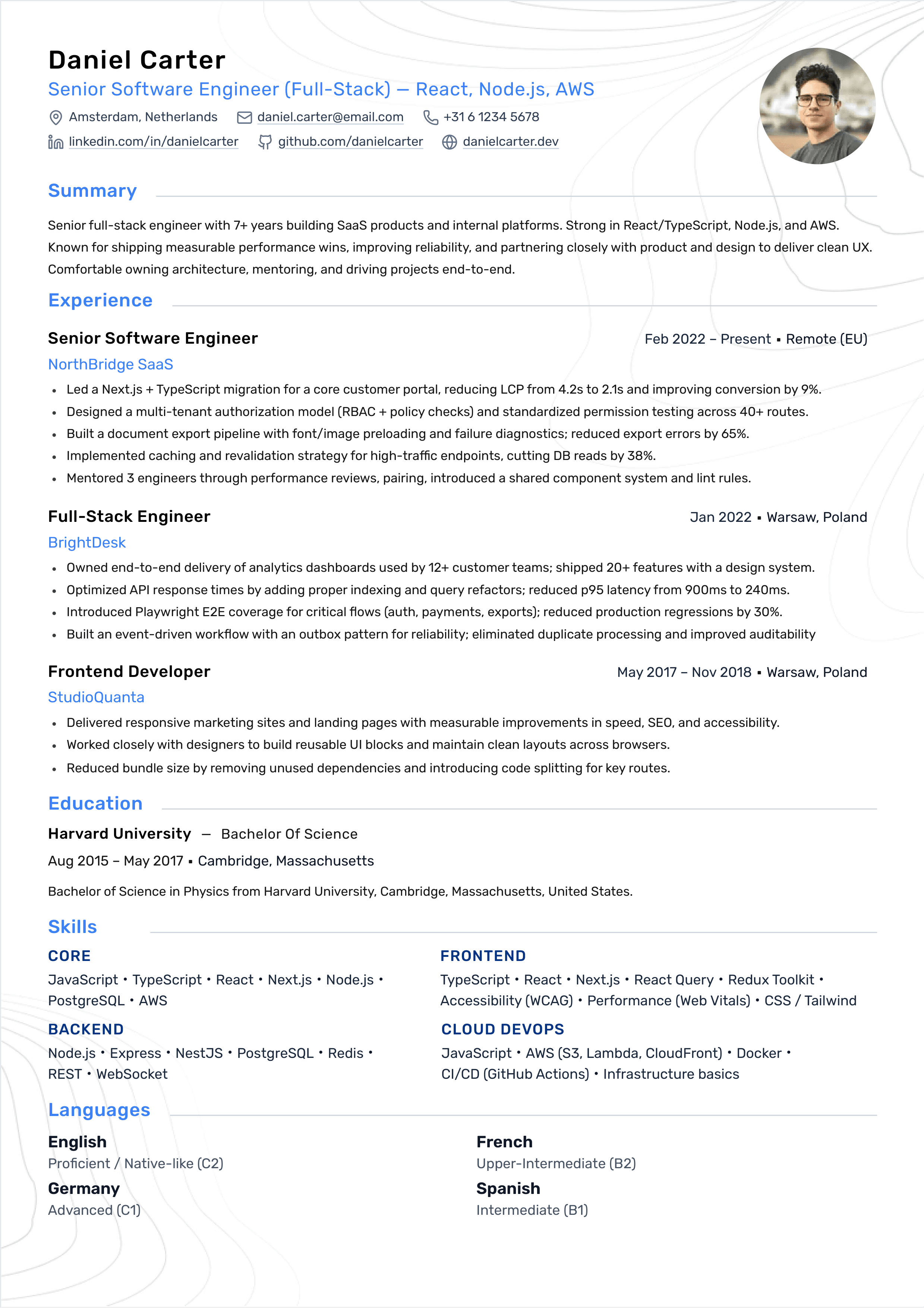
Senior and Staff frontend resumes are evaluated on technical decisions, leverage, and outcomes. Recruiters look for signals of system ownership: architecture tradeoffs, measurable performance wins, and evidence you can raise engineering quality across teams.
A senior resume should read like a set of decisions and results, not a list of tickets. Use metrics, clear scope, and the why behind your approach.
Senior resumes win by showing ownership of outcomes: scaling, performance, reliability, and developer productivity.
Professional Summaries
Executive Summary Strategy (3 Architectural Variations)
Use one summary per application based on the role. Keep it 50 to 70 words. Avoid vague traits and name the system you operate in: distributed systems, platform UI, design system governance, frontend observability.
- Infrastructure Architect: Senior Frontend Engineer building scalable web platforms in a monorepo with typed contracts and CI/CD gates. Optimizes build pipelines, de-risks migrations (App Router, Server Components), and enforces reliability via frontend observability. Strong focus on distributed systems edges: caching, consistency, and safe rollouts.
- Product Engineer: Senior Frontend Engineer shipping high-conversion UI and governing design systems. Improves funnel metrics through accessible UX patterns, experimentation, and performance budgets. Blends product thinking with engineering rigor: predictable state, fast pages, and consistent UI behaviors.
- Platform and DX: Senior Frontend Engineer focused on developer experience and platform leverage. Builds shared tooling, codemods, and contract-driven clients. Establishes standards (RFCs, review rubrics, testing strategy) and removes friction from delivery across teams.
Pick the summary that matches the hiring loop. Product roles care about conversion and UX. Platform roles care about leverage and reliability.
Situation, Action, Result
High-Impact Work History: The Big Three Wins
This is the senior pattern: define the constraint, choose a strategy, then quantify the result. Use $LCP$, $INP$, bundle size, error rates, build minutes, and conversion deltas when available.
Core Web Vitals metrics include LCP, INP, and CLS. Good thresholds are commonly discussed as LCP at most 2.5s, INP at most 200ms, and CLS at most 0.1.
When you present complexity work, use short statements like $O(n)$ or $O(n\,\log n)$ to show you reason about performance, not just implement features.
- Scalability (Monolith to platform architecture): Situation: teams blocked by shared code and slow builds. Action: introduced monorepo boundaries, shared UI packages, and contract-driven API clients. Result: 45% faster builds and fewer integration defects.
- Performance (Core Web Vitals and streaming SSR): Situation: slow landing pages and poor real-user metrics. Action: streaming SSR, cache-aware data fetching, and JS reduction via Server Components. Result: LCP down 42%, JS shipped down 35%.
- Leadership (Process and quality gates): Situation: regressions and inconsistent UI across teams. Action: RFC process, design system governance, and visual regression gates. Result: 55% fewer recurring regressions and faster releases.
Bullet Bank
High-Impact Bullet Points (Google XYZ Formula)
Senior bullets should be measurable and specific. Use: Accomplished X as measured by Y by doing Z.
Avoid vanity metrics. Prefer system metrics that map to user impact: $LCP$, $INP$, conversion, error rate, build time, and release cycle time.
- Accomplished a 40% reduction in $LCP$ by moving critical routes to streaming SSR, optimizing images, and tightening cache invalidation.
- Accomplished a 30% reduction in bundle size by enforcing route-based code splitting, deduplicating dependencies, and converting eligible components to Server Components.
- Accomplished a 25% improvement in $INP$ by profiling long tasks, virtualizing lists, and moving heavy parsing to Web Workers and WebAssembly.
- Accomplished a 2x increase in API reliability as measured by fewer client errors by standardizing typed API clients, retries, and error classification.
- Accomplished a 50% reduction in regressions by adding Playwright coverage for critical flows and visual regression gates in CI.
- Accomplished faster incident triage by adding frontend observability (Sentry tagging, release tracking, performance budgets) and correlating issues to deploys.
- Accomplished safer rollouts by implementing feature flags, canary releases, and backward-compatible contract checks from OpenAPI.
- Accomplished a faster developer workflow by introducing a monorepo build cache, shared tooling, and standardized PR review checklists.
Skills
The 2026 Skills Matrix
Senior roles are assessed on architecture choices and quality systems. Organize skills into categories so recruiters can scan quickly.
Do not list everything. List the skills you can prove with one bullet or a concrete project decision.
- Core Architecture: monorepo boundaries, module federation, rendering strategy (SSR/SSG/streaming), state machines, caching, consistency tradeoffs
- Engineering Excellence: CI/CD pipelines, test strategy (unit, component, E2E), visual regression, frontend observability (Sentry), release gates, security basics
- Modern Stack: Next.js App Router, Server Components, Server Actions, Edge Functions, TypeScript 5+, Tailwind v4, WebAssembly, AI-assisted workflows
A senior skills section is a map of your system thinking, not a toolbox dump.
Avoid These
Common Senior Resume Mistakes That Read Junior
These patterns make a senior resume look junior, even if the candidate is strong.
- Listing basics (HTML/CSS) instead of senior scope (architecture, reliability, performance budgets)
- Bullets that describe tasks but not outcomes (no metrics, no user impact, no system constraints)
- No evidence of ownership (no migrations, no cross-team work, no decision-making)
- No quality system (testing strategy, observability, CI gates not mentioned)
- Vague stack lists with no proof in Experience or Projects
If you claim a skill, prove it once with action and outcome.
Positioning
Senior vs Junior Differentiators
Senior descriptions focus on systems and outcomes. Junior descriptions focus on implementation details. Use these contrasts as an editing checklist.
- Junior: Implemented a feature. Senior: Designed a scalable system and shipped it with safe rollout.
- Junior: Worked on tickets. Senior: Owned a roadmap slice and delivered measurable impact.
- Junior: Used React. Senior: Chose a rendering strategy and reduced shipped JavaScript.
- Junior: Added tests. Senior: Built a testing strategy with E2E gates for critical flows.
- Junior: Fixed bugs. Senior: Reduced defect rate with observability, guardrails, and process improvements.
ATS
ATS Keywords for Senior Frontend Roles in 2026
Use keywords that match the job description and your real experience. Place them in Skills and prove them in one bullet.
If a recruiter searches by exact phrase, your resume should contain that phrase in plain text.
- React Server Components
- Next.js App Router
- Streaming SSR
- Edge Functions
- Server Actions
- Core Web Vitals
- Largest Contentful Paint (LCP)
- Interaction to Next Paint (INP)
- Cumulative Layout Shift (CLS)
- Performance budgets
- Monorepo
- Turborepo
- Micro-frontends
- Module Federation
- Design system governance
- Frontend observability
- Sentry
- Playwright
- TypeScript
- OpenTelemetry
Do not keyword stuff. Add the keyword once, then prove it with evidence.