
What Makes a Great Junior Frontend Engineer Resume?
Junior frontend roles are competitive, so your resume must communicate skills fast: React/TypeScript fundamentals, shipped work (projects count), and clear role keywords.
Recruiters skim in seconds. The goal is not to list everything. It’s to make your fit obvious: stack, scope, and impact.
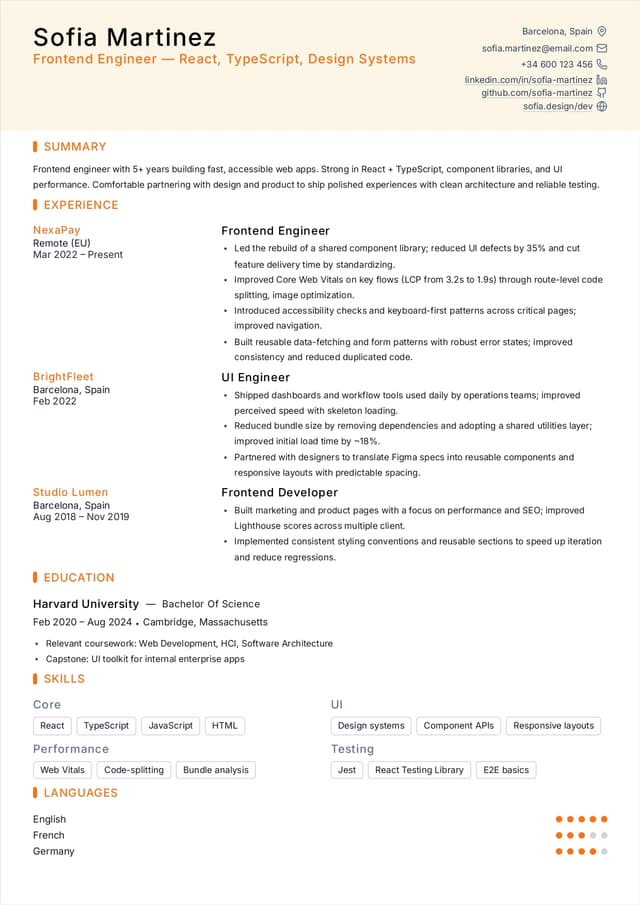
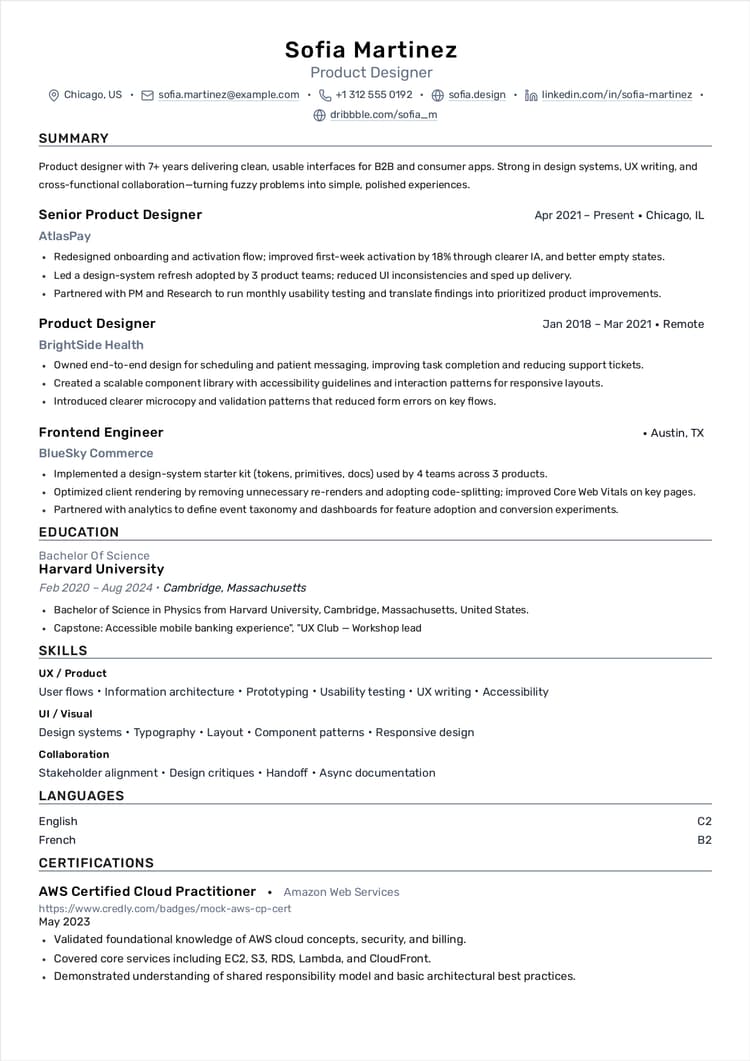
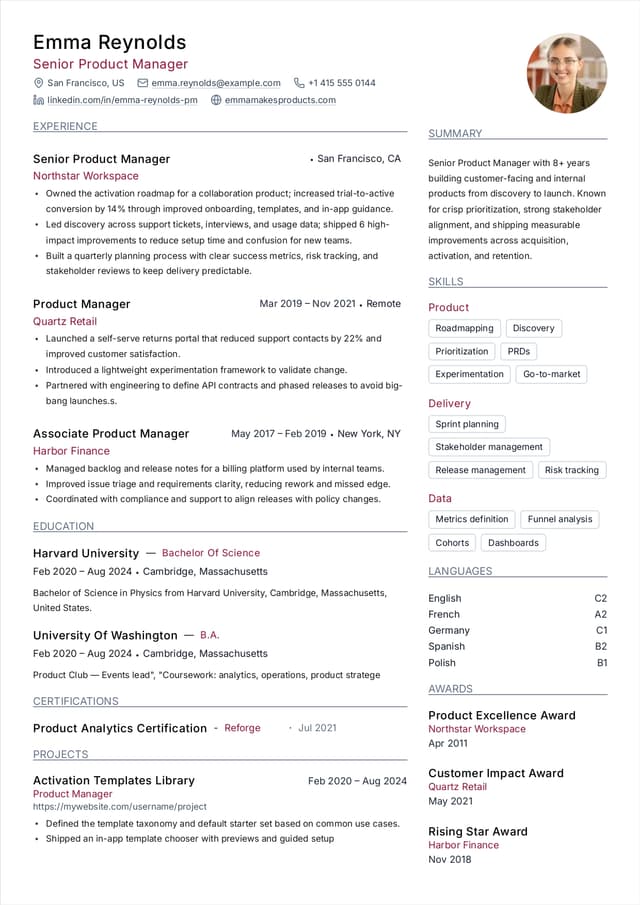
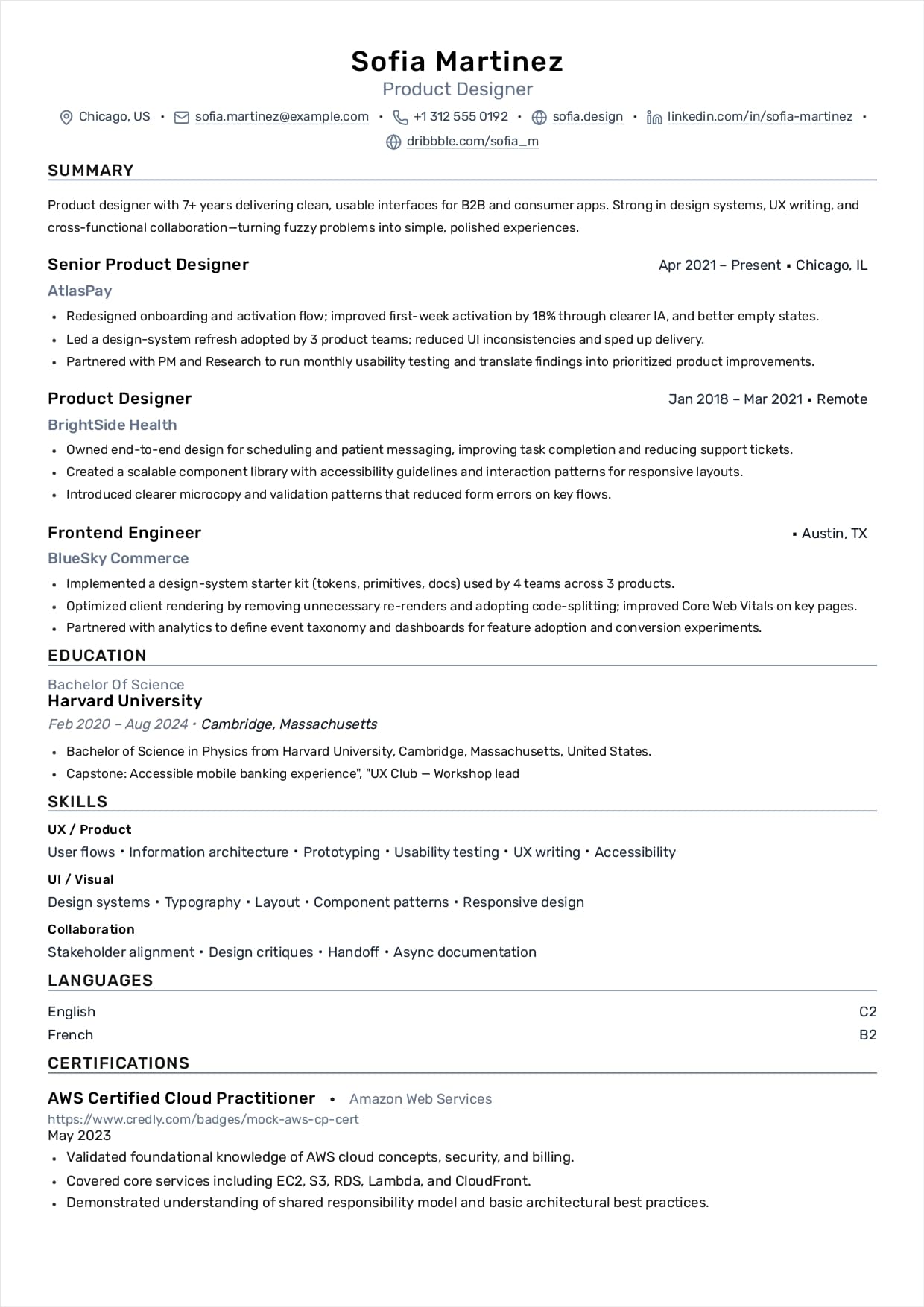
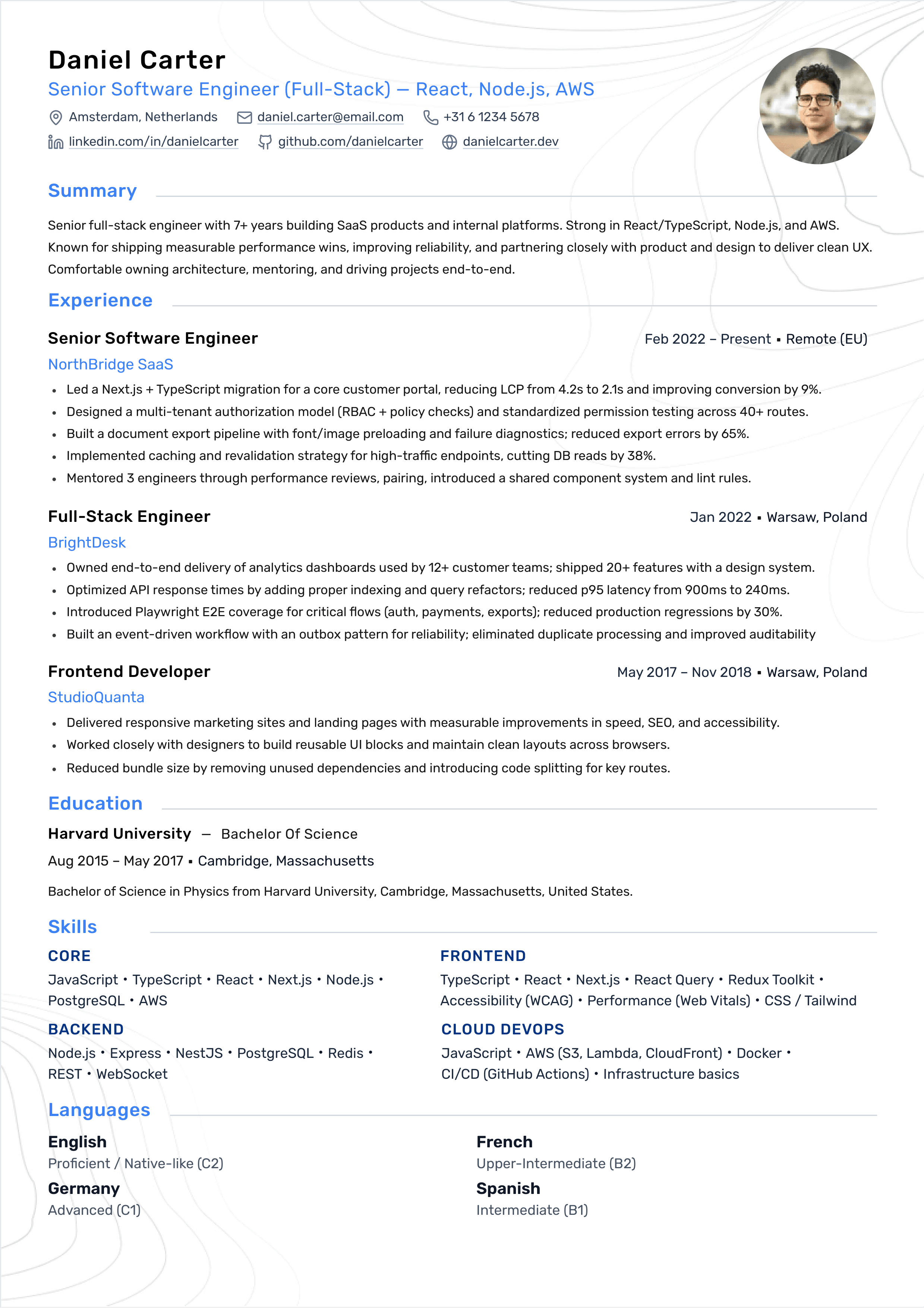
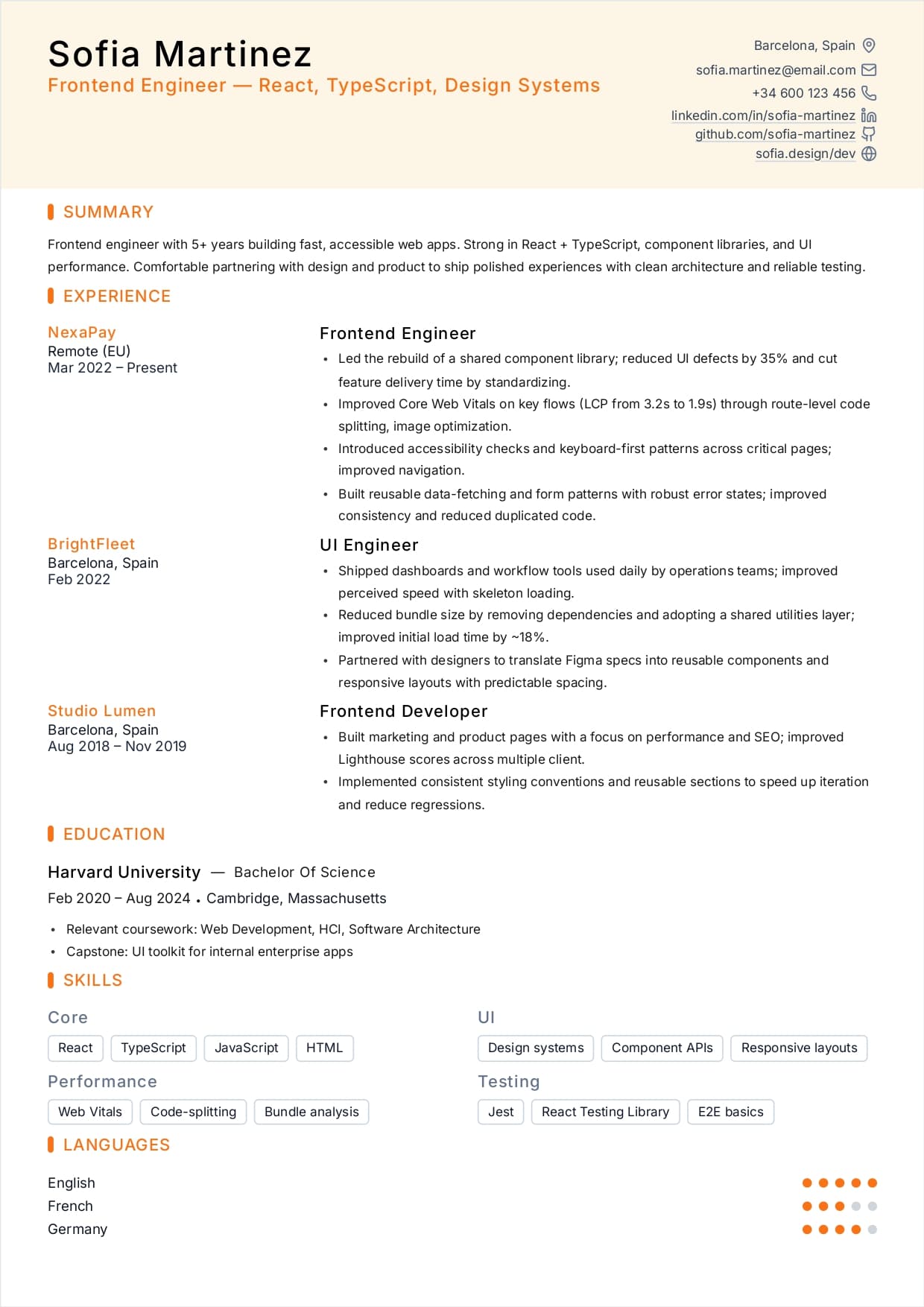
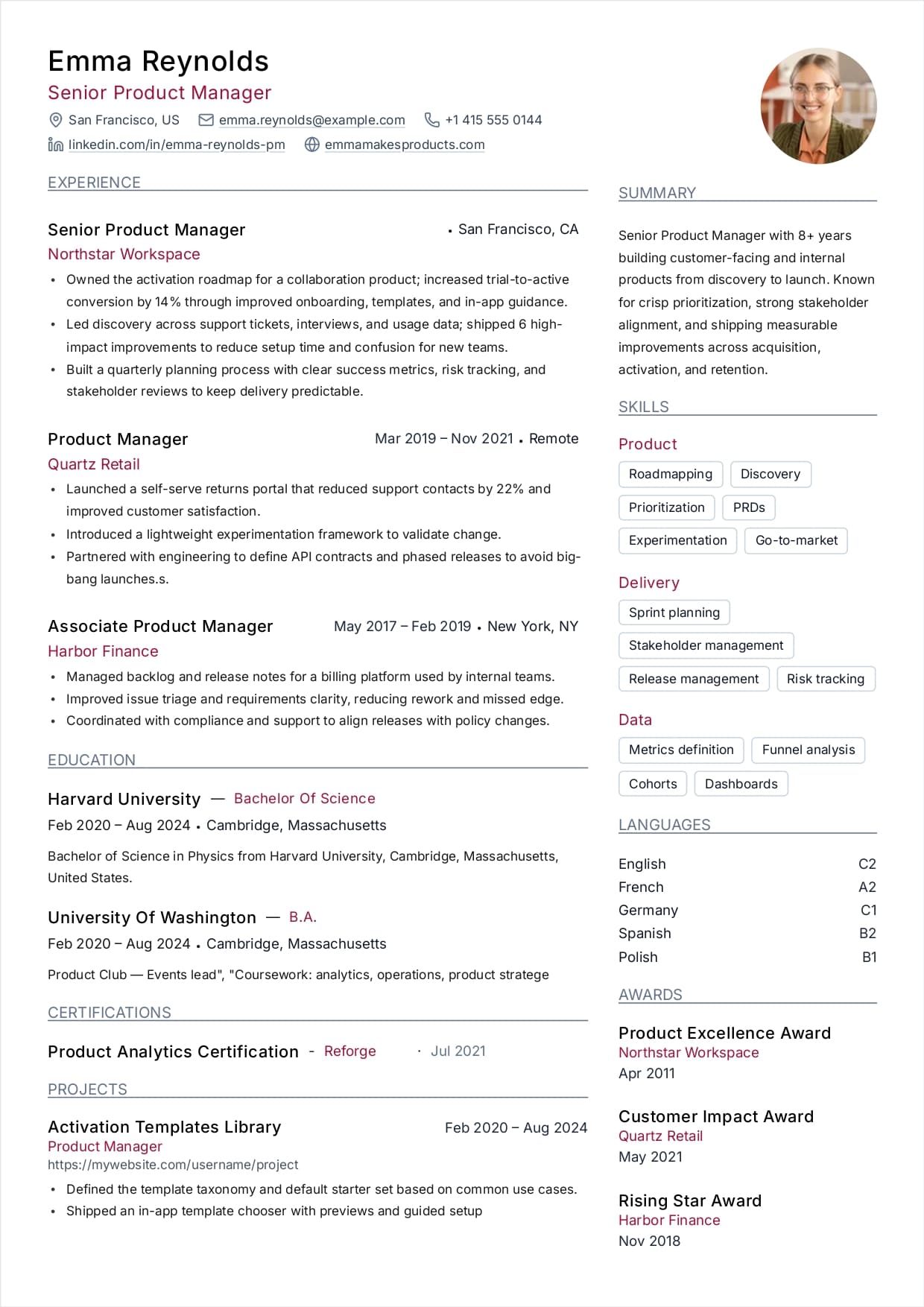
This page includes a junior-friendly resume example plus checklists for skills, projects, and ATS-safe formatting.
A junior resume wins with clarity: a strong project section, role keywords, and bullets that show impact, not just responsibilities.
Skills & Keywords
Top Skills to Include in 2026
In 2026, junior frontend hiring still centers on React + TypeScript, plus basics like accessibility, testing, and performance awareness.
Your skills section should mirror the job description (without stuffing). Include only what you can explain in an interview.
Start with a core stack, then add supporting tools and concepts recruiters commonly search for.
- React / Next.js: components, hooks, routing, data fetching basics
- TypeScript: types for props/state, basic generics, safe refactors
- CSS / Tailwind CSS: responsive layout, design systems, consistent spacing
- Accessibility (a11y): semantic HTML, keyboard navigation, ARIA basics
- Testing: Jest + React Testing Library for key components
- Performance: Core Web Vitals awareness, image optimization, code splitting basics
- APIs: REST + async state (loading/error), basic caching
- Git: branching, PR workflow, code reviews
Pro tip: Copy the exact role keywords from the job description (e.g., React, TypeScript, Next.js, a11y) into Skills and Projects if you can back them up.
ATS Keywords
Keywords Recruiters Search For (React, TypeScript, Next.js)
Many recruiters start with keyword searches. For a junior frontend developer resume, keep it simple: put the right terms in the right places. Focus on Skills, Projects, and the first 1–2 bullets under Experience.
Use the exact wording from the job description when it matches your real experience. Avoid keyword stuffing. Two strong mentions in the right sections beats repeating the same word 10 times.
- Core stack: React, TypeScript, Next.js, JavaScript, HTML, CSS
- UI: responsive design, component library, design system, Tailwind CSS
- Quality: accessibility (a11y), Jest, React Testing Library, code reviews
- Performance: Core Web Vitals, image optimization, bundle size, lazy loading
- APIs: REST API, async state (loading/error), pagination, caching
If you want to rank for ‘react developer resume’ and ‘typescript resume’ in ATS searches, put React/TypeScript in Skills AND in at least one Project bullet.
How to Write Your Experience Section
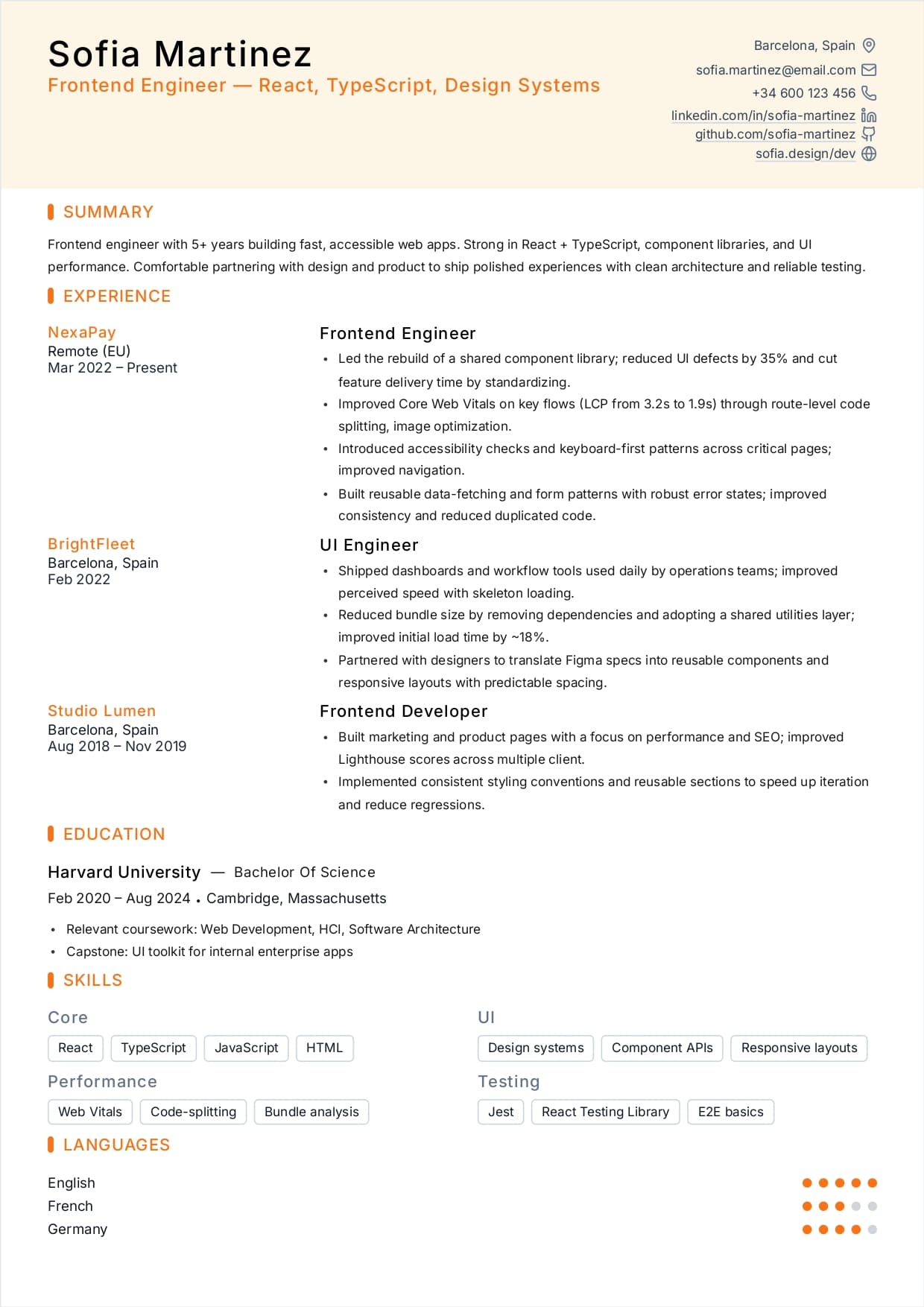
For junior candidates, experience can include internships, freelance work, and serious projects. Recruiters want evidence you can ship: features, fixes, and collaboration.
Use this format: Action + scope + tech + result. If you don’t have metrics, use concrete outcomes (reduced bugs, improved UX, shipped feature).
Example: "Built a reusable form system in React + TypeScript, cutting new page setup time by ~30% and reducing validation bugs."
For a junior frontend developer resume, 3–5 strong bullets with stack + outcome will outperform 10 generic responsibilities.
- Lead with what you shipped (feature/fix), not your responsibilities
- Name the stack (React/TS/Next) where relevant — recruiters scan for it
- Add one outcome per bullet (speed, quality, UX, reliability)
- Prefer 3–5 strong bullets over 10 weak ones
- Tailor bullets to the job: align keywords with the posting
For Junior Candidates
Projects Section: Your Secret Weapon
For juniors, projects are often the deciding factor. A strong projects section proves you can ship UI, integrate APIs, and make product decisions.
Treat each project like experience: what you built, the tech stack, and the most important engineering tradeoff you made.
Always link a live demo and GitHub when possible — it’s the fastest credibility boost.
- Include 2–3 projects max (quality over quantity)
- For each project, include: Problem → Solution → Impact
- Mention the stack explicitly (React/Next/TS, APIs, testing)
- Add 1–2 bullets that show engineering depth (a11y, perf, state management)
- Link to GitHub + live demo (Vercel/Netlify)
A small but polished Next.js project with great UX and clean code beats five half-finished repos.
Project Ideas
Best Projects for a Junior Front End CV
For junior candidates, projects often decide the interview. The best projects are not the biggest. They are the most complete: clear UX, working features, and production-like polish.
Choose projects that let you demonstrate React fundamentals, API integration, and at least one ‘depth’ area (testing, accessibility, or performance).
- Job board UI: filters, pagination, saved jobs, responsive layout
- Dashboard: charts, mock data, loading states, error handling
- CRUD app: forms + validation, optimistic updates, empty states
- Next.js blog: dynamic routes, SEO meta, image optimization
- UI component set: buttons/forms/modals with consistent spacing tokens
One polished Next.js project with great UX, accessibility, and clean code beats five unfinished repos.
Making Your Resume ATS-Friendly
Most companies use an Applicant Tracking System (ATS) before a human sees your resume. If the parser can’t read your content reliably, you lose the interview.
For juniors, the biggest mistakes are fancy layouts (tables/columns), icons as text, and inconsistent headings or dates.
Use a clean structure, standard section titles, and export a readable PDF.
- Use standard section headings: Summary, Experience, Education, Skills
- Avoid tables, text boxes, or graphics for key information
- Use 10–12pt font size and standard fonts (Calibri, Arial, Georgia)
- Include the job title in your summary and possibly skills
- Save and submit as PDF unless the job posting specifically asks for .docx
Avoid These
Common Mistakes on Junior Frontend Resumes
Most junior resumes fail for predictable reasons: vague bullets, missing keywords, and layouts that don’t parse cleanly. Fixing these is often enough to move from ‘no replies’ to interviews.
Use this quick checklist before you apply.
- Using generic bullets like ‘worked on features’ instead of specific shipped outcomes
- Listing too many skills you can’t explain (or leaving out React/TypeScript when you do use them)
- Projects without links (GitHub + live demo) or without describing your impact
- Fancy layouts (tables/columns/icons) that break ATS parsing
- No mention of testing/a11y/performance at all — even basic awareness helps
Before submitting, make sure your resume literally contains: React, TypeScript, and one of Next.js / Testing / Accessibility — if you actually use them.
Writing a Strong Professional Summary
For junior candidates, the summary section is often the hardest to write — but it's some of the most valuable real estate on your resume. It's the first thing a recruiter reads.
Your summary should be 2–3 sentences that answer: Who are you? What can you do? What are you looking for?
Avoid generic phrases like 'hardworking team player'. Use specific technologies, your current role/status, and the type of position you're targeting.
Junior Frontend Engineer building React/TypeScript interfaces with a focus on accessibility and performance. Shipped projects in Next.js, integrated REST APIs, and wrote component tests. Seeking a product team to grow from feature delivery to ownership.