
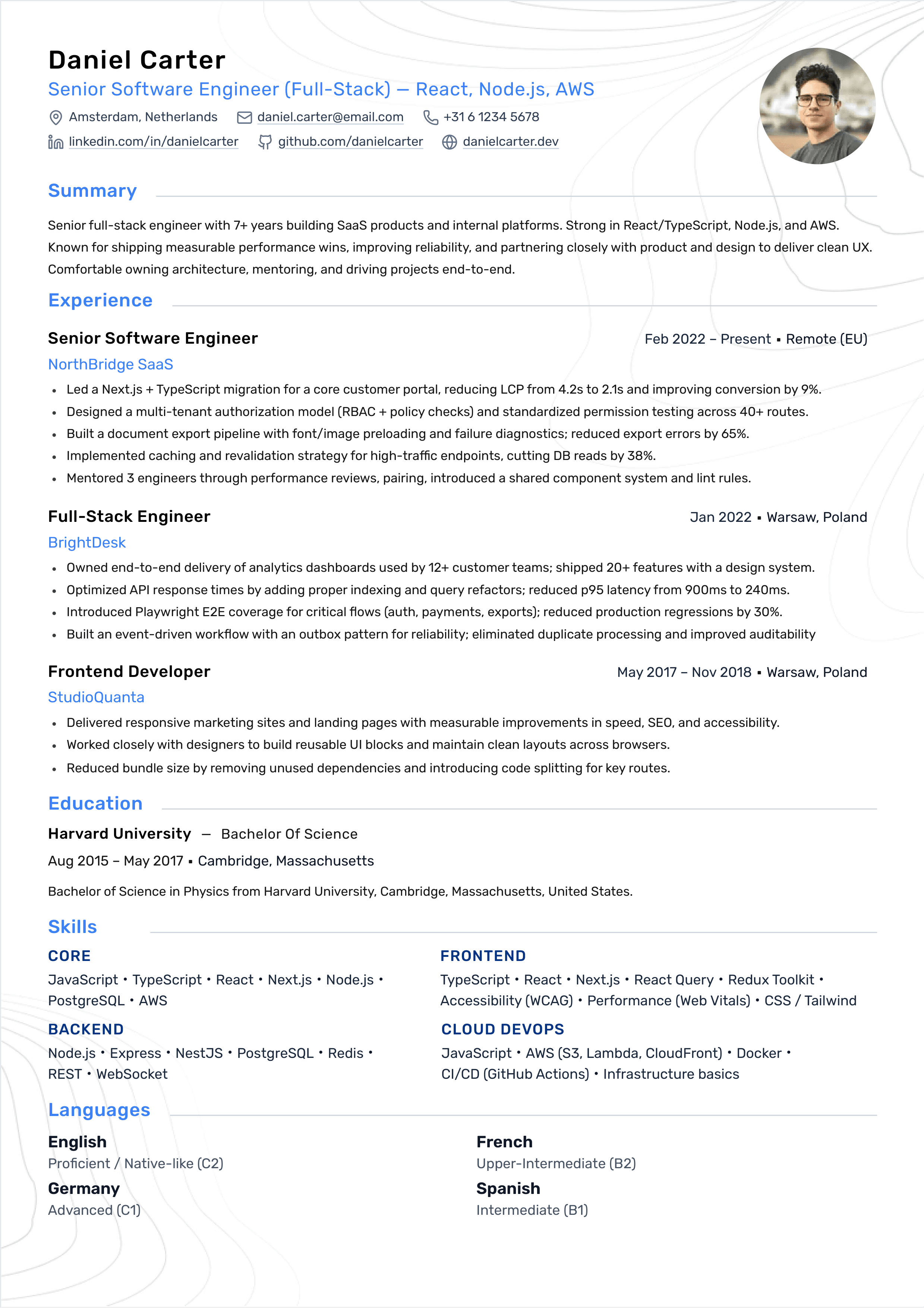
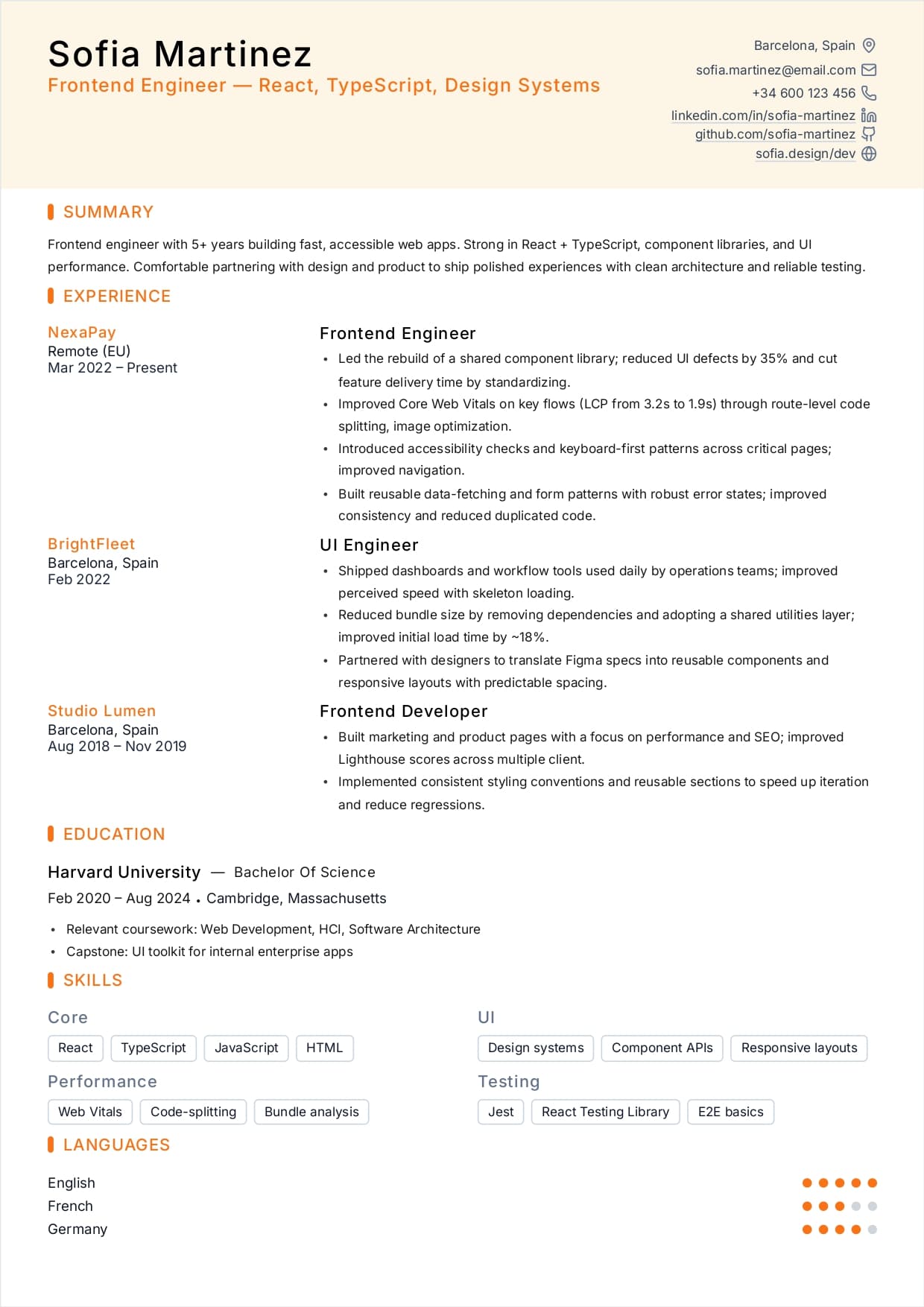
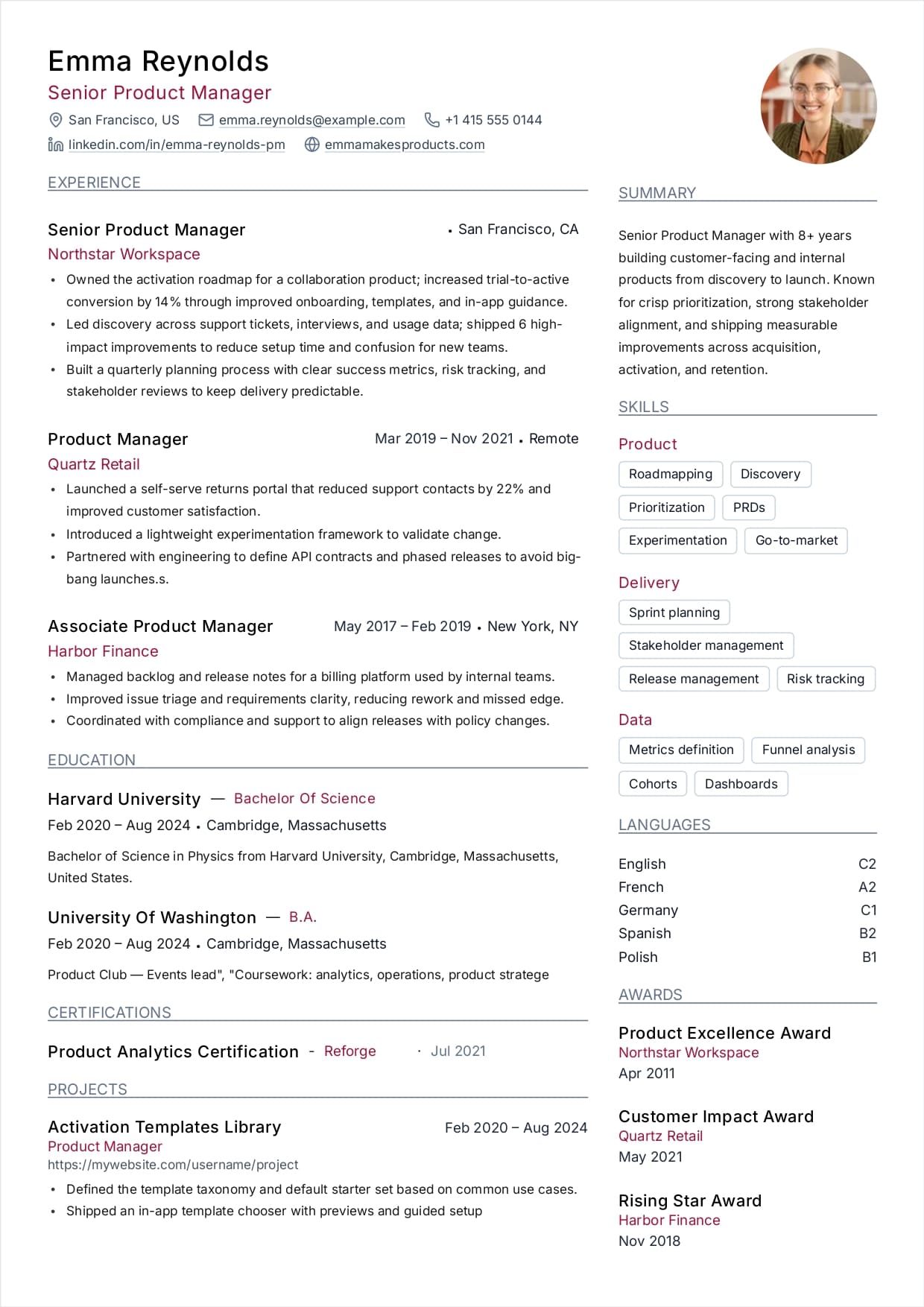
What Makes a Great Mid-Level Frontend Developer Resume?
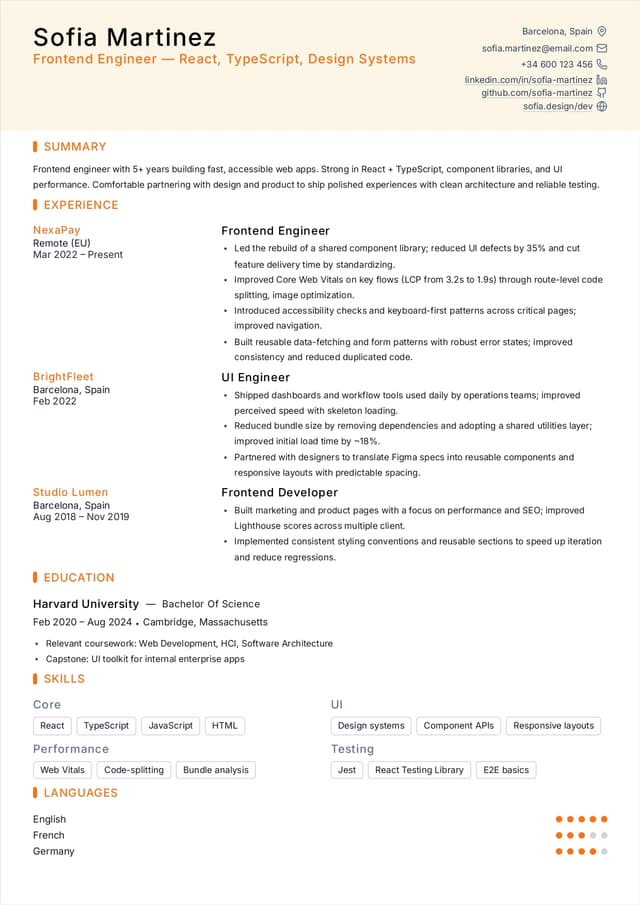
Mid-level frontend roles are about impact and ownership. Your resume should show you can ship production features, collaborate across teams, and improve quality over time.
Recruiters scan for clear role keywords (React, TypeScript, Next.js) and for signals of reliability: testing, performance awareness, accessibility, and clean delivery.
This page includes a mid-level resume example plus practical checklists for skills, projects, and ATS-safe formatting.
A mid-level resume wins with proof: shipped features, measurable improvements, and ownership signals, not a long list of responsibilities.
Skills & Keywords
Top Skills to Include in 2026
In 2026, mid-level frontend hiring still centers on React + TypeScript, but teams also look for production habits: testing, performance, accessibility, and clear collaboration.
Mirror the job description in a natural way. Include only skills you can explain and demonstrate in projects or experience.
Lead with your core stack, then add the tools you use day-to-day in real product work.
- React / Next.js: production components, routing, data fetching patterns
- TypeScript: safe refactors, typing components, shared types across API/UI
- State management: Redux/Zustand patterns, derived state, selectors
- Data fetching: React Query/SWR, caching, retries, pagination
- Testing: RTL/Jest for components, E2E with Cypress/Playwright for critical flows
- Accessibility: semantic HTML, keyboard navigation, ARIA basics
- Performance: Core Web Vitals, image optimization, reducing re-renders
- Collaboration: PR reviews, readable code, consistent UI conventions
If the role is React/TypeScript, those words should appear in Skills and in at least one Experience or Project bullet.
ATS Keywords
Keywords Recruiters Search For (React, TypeScript, Next.js)
Recruiters often start with keyword searches. For a mid-level frontend developer resume, put the right terms in the right places: Skills, Projects, and your first bullets under Experience.
Use exact wording from the job description when it matches your experience. Avoid keyword stuffing. A couple of strong mentions in the right sections beats repeating the same word everywhere.
- Core stack: React, TypeScript, Next.js, JavaScript, HTML, CSS
- UI: responsive design, component library, design system, Tailwind CSS
- Quality: accessibility (a11y), Jest, React Testing Library, code reviews
- Performance: Core Web Vitals, image optimization, bundle size, lazy loading
- APIs: REST API, async state (loading/error), pagination, caching
To match searches for “react developer resume” and “typescript resume”, include React/TypeScript in Skills and show them in at least one real bullet under Experience or Projects.
How to Write Your Experience Section
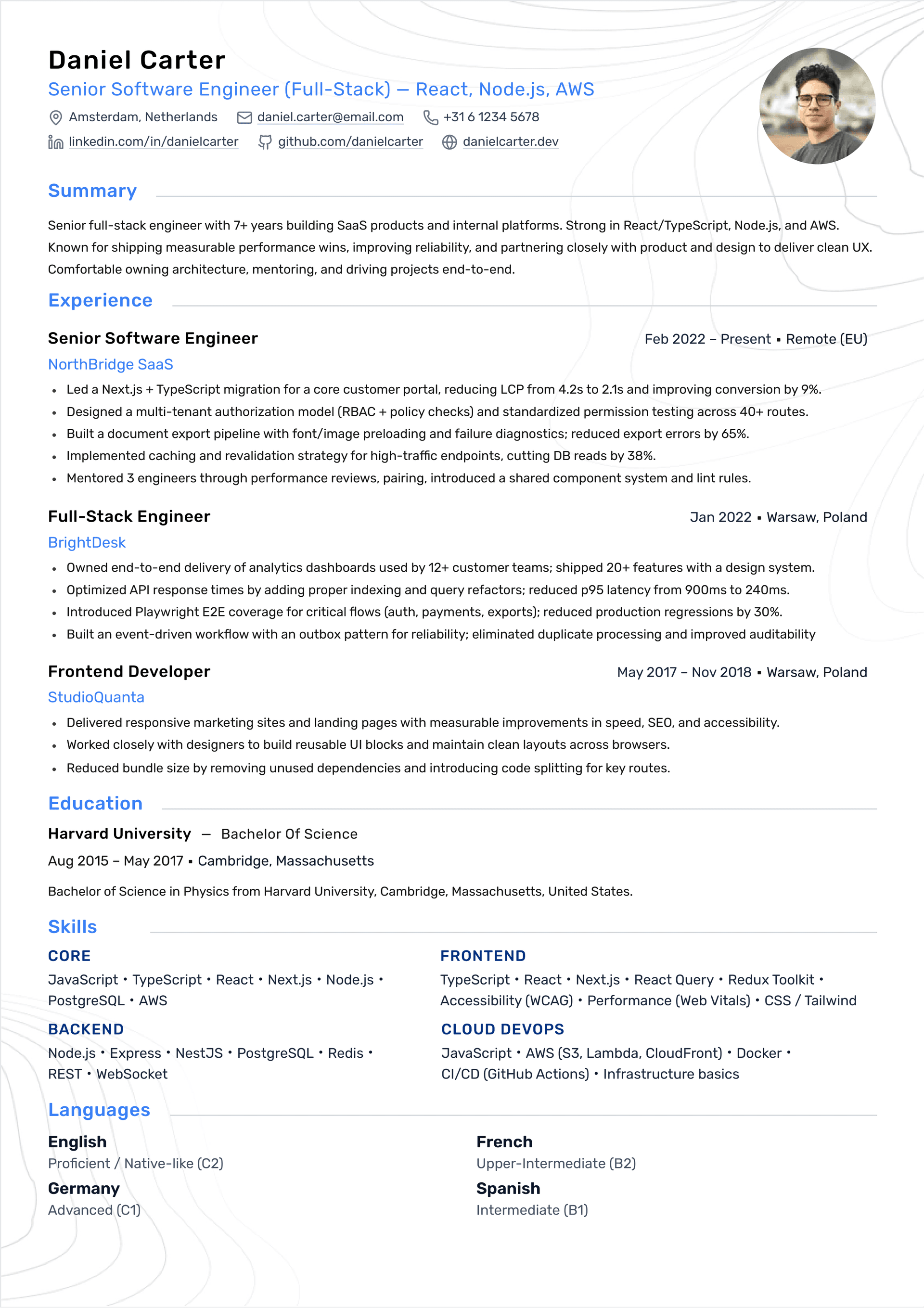
For mid-level candidates, experience should communicate ownership. Show what you shipped, how you worked with others, and the outcomes you improved (speed, reliability, UX).
Use this format: Action + scope + tech + result. If you do not have metrics, use concrete outcomes (reduced regressions, improved UX, simplified workflow).
Example: "Improved Core Web Vitals by optimizing images and reducing re-renders, lowering LCP by ~20% across key pages."
For a mid-level frontend developer resume, 3–6 strong bullets with stack and outcome will beat a long list of vague tasks.
- Lead with what you shipped (feature/fix), not your responsibilities
- Name the stack (React/TS/Next) where relevant, recruiters scan for it
- Include one outcome per bullet (speed, quality, UX, reliability)
- Show collaboration (worked with design/backend, reviewed PRs, improved conventions)
- Prefer 4–6 strong bullets over 12 weak ones
For Mid-Level Candidates
Projects Section: Your Proof of Depth
For mid-level roles, projects are useful when they show depth. Pick projects that demonstrate production-like thinking: API integration, edge cases, testing, accessibility, and performance.
Treat each project like experience: what you built, the stack, and the most important engineering decision you made.
Link a live demo and GitHub when possible. It is the fastest credibility boost.
- Include 1–3 projects max (quality over quantity)
- For each project, include: Problem → Solution → Impact
- Mention the stack explicitly (React/Next/TS, APIs, testing)
- Add one bullet that shows depth (a11y, perf, state management, caching)
- Link to GitHub + live demo (Vercel/Netlify)
A mid-level project should show decision-making, not just features.
Project Ideas
Project Ideas That Fit Mid-Level Frontend Roles
If you include projects, make them look like real product work. Recruiters want to see ownership, edge cases, and polish, not just a UI screenshot.
Choose projects that show you can ship a complete flow: UX, data, and reliability.
- Analytics dashboard: tables + filters, caching, export, error handling
- Checkout flow: validation, optimistic UX, accessibility, E2E tests
- Admin CRUD: forms, permissions, pagination, empty states
- Next.js content site: dynamic routes, SEO meta, image optimization
- Component library: tokens, docs, RTL tests, a11y patterns
If you say “Next.js”, show at least one concrete Next.js feature you used, such as dynamic routes or image optimization.
Making Your Resume ATS-Friendly
Most companies use an Applicant Tracking System (ATS) before a human sees your resume. If the parser cannot read your content reliably, you lose the interview.
The biggest mistakes are layouts that do not parse cleanly (tables/columns), icons that replace text, and inconsistent headings or dates.
Use a clean structure, standard section titles, and export a readable PDF.
- Use standard section headings: Summary, Experience, Education, Skills
- Avoid tables, text boxes, or graphics for key information
- Use 10–12pt font size and standard fonts (Calibri, Arial, Georgia)
- Include the target title in your summary and/or skills when accurate
- Save and submit as PDF unless the job posting specifically asks for .docx
Avoid These
Common Mistakes on Mid-Level Frontend Resumes
Most mid-level resumes fail because they read like a task list. Hiring managers want impact, ownership, and proof you can ship reliably in a team.
Use this checklist before you apply.
- Bullets that describe tasks but do not show outcomes (speed, UX, reliability)
- No ownership signals (no features shipped end-to-end, no improvements, no responsibility)
- Missing quality habits (no testing, no performance awareness, no accessibility mention)
- Vague collaboration (no cross-team work, no PR/review process, no shared conventions)
- Projects that are not production-like (no links, no edge cases, no real UX)
Mid-level is where details matter. Show what you shipped and what got better because of your work.
Writing a Strong Professional Summary
For mid-level candidates, the summary should quickly state your stack, your scope, and the kind of team you work well in.
Keep it short and specific. Avoid generic traits and focus on what you ship and how you improve outcomes.
Include 1–2 focus areas such as performance, accessibility, testing, or product UI.
Mid-level Frontend Developer building React/TypeScript product UI with a focus on accessibility and performance. Shipped production features end-to-end, integrated REST APIs, improved Core Web Vitals, and added tests for critical flows. Looking for a product team where I can take ownership of features and raise UI quality.