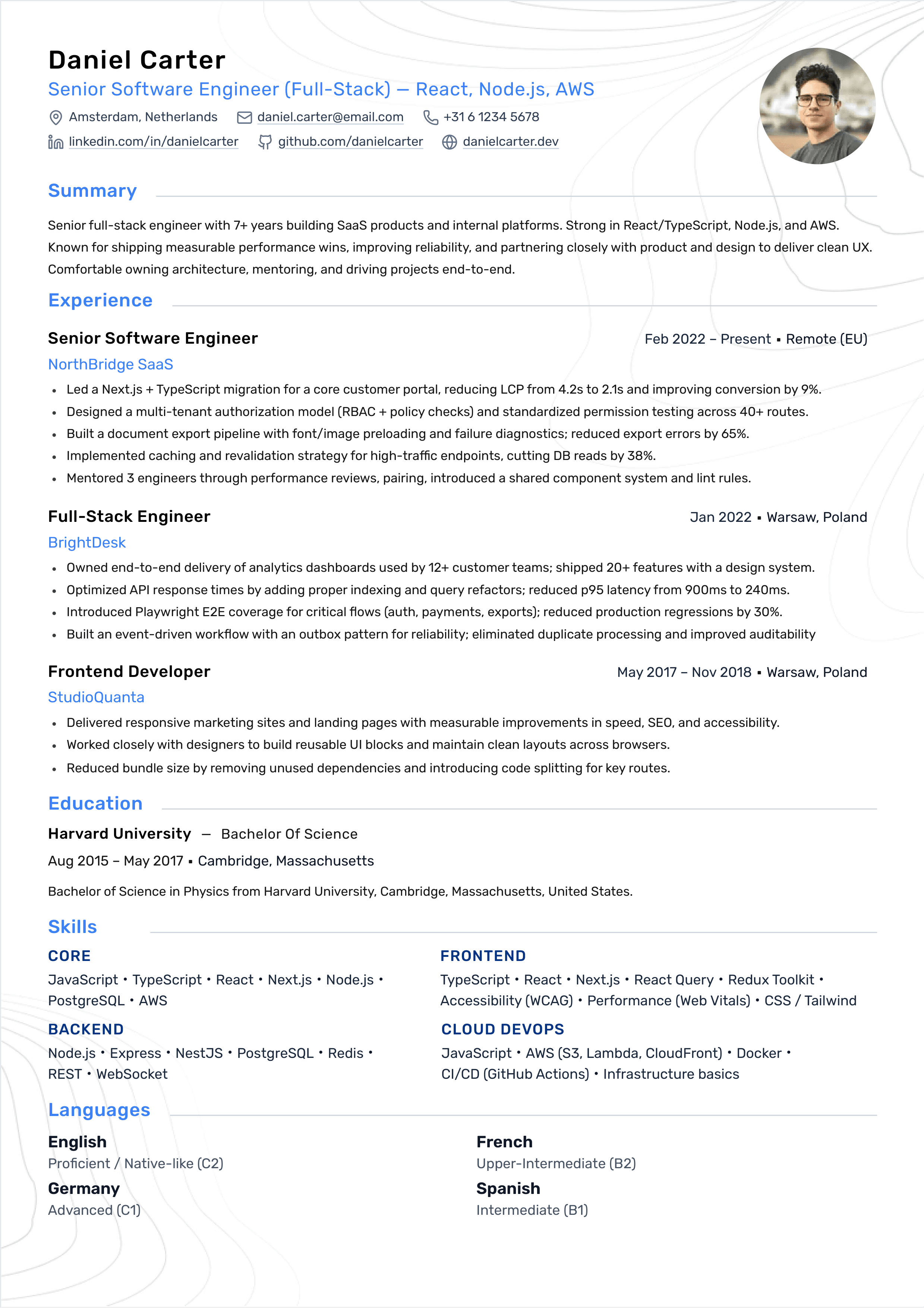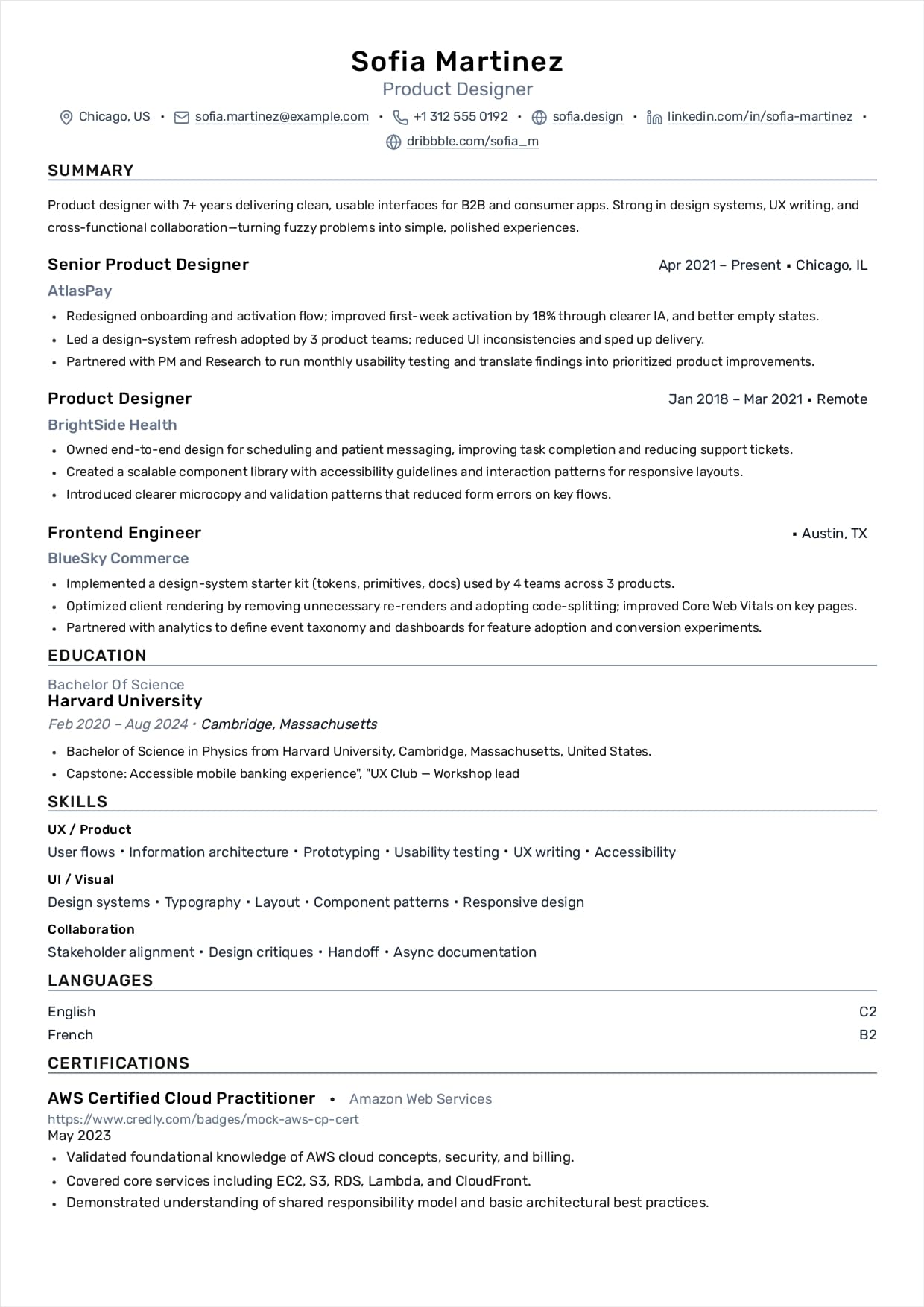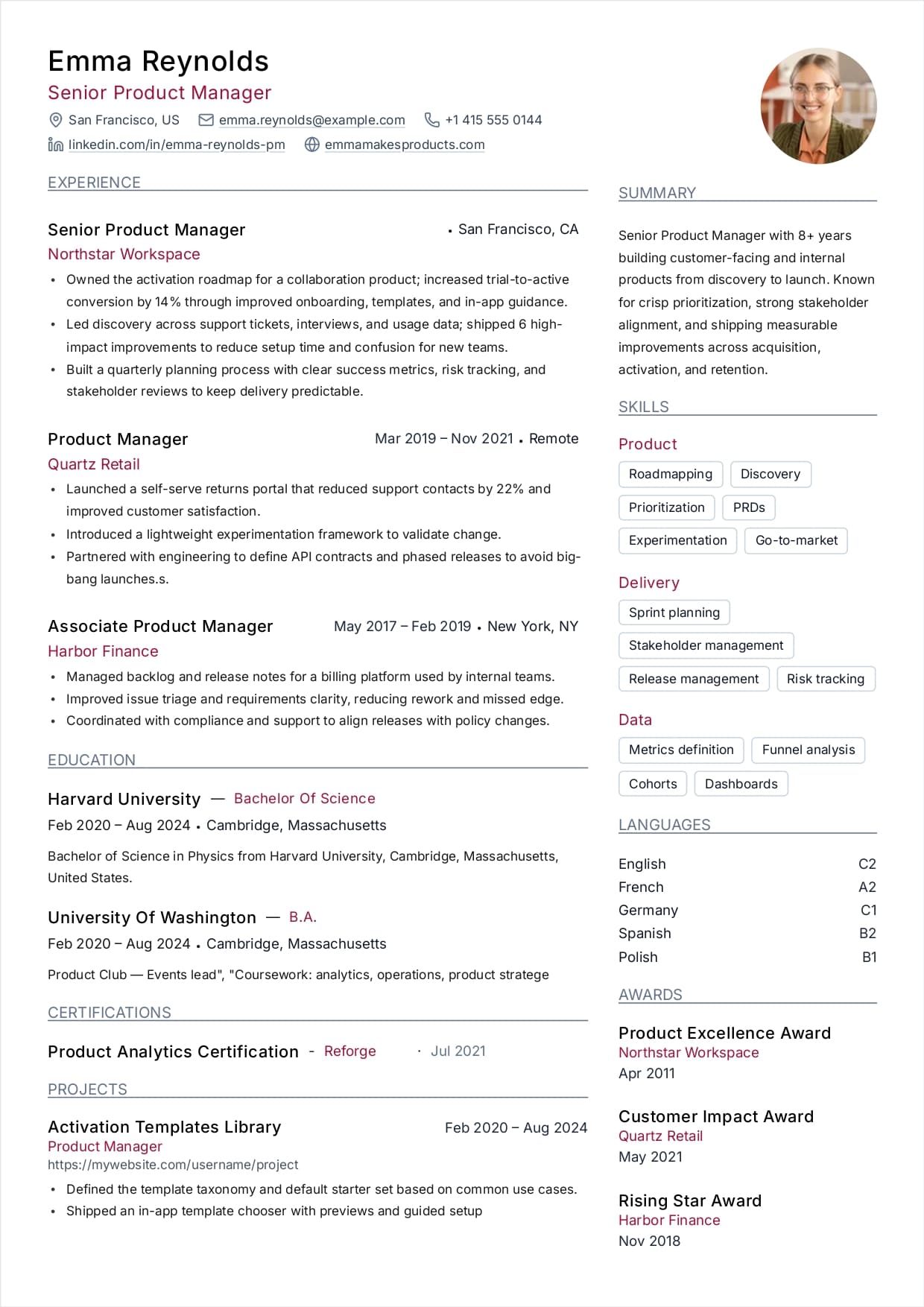
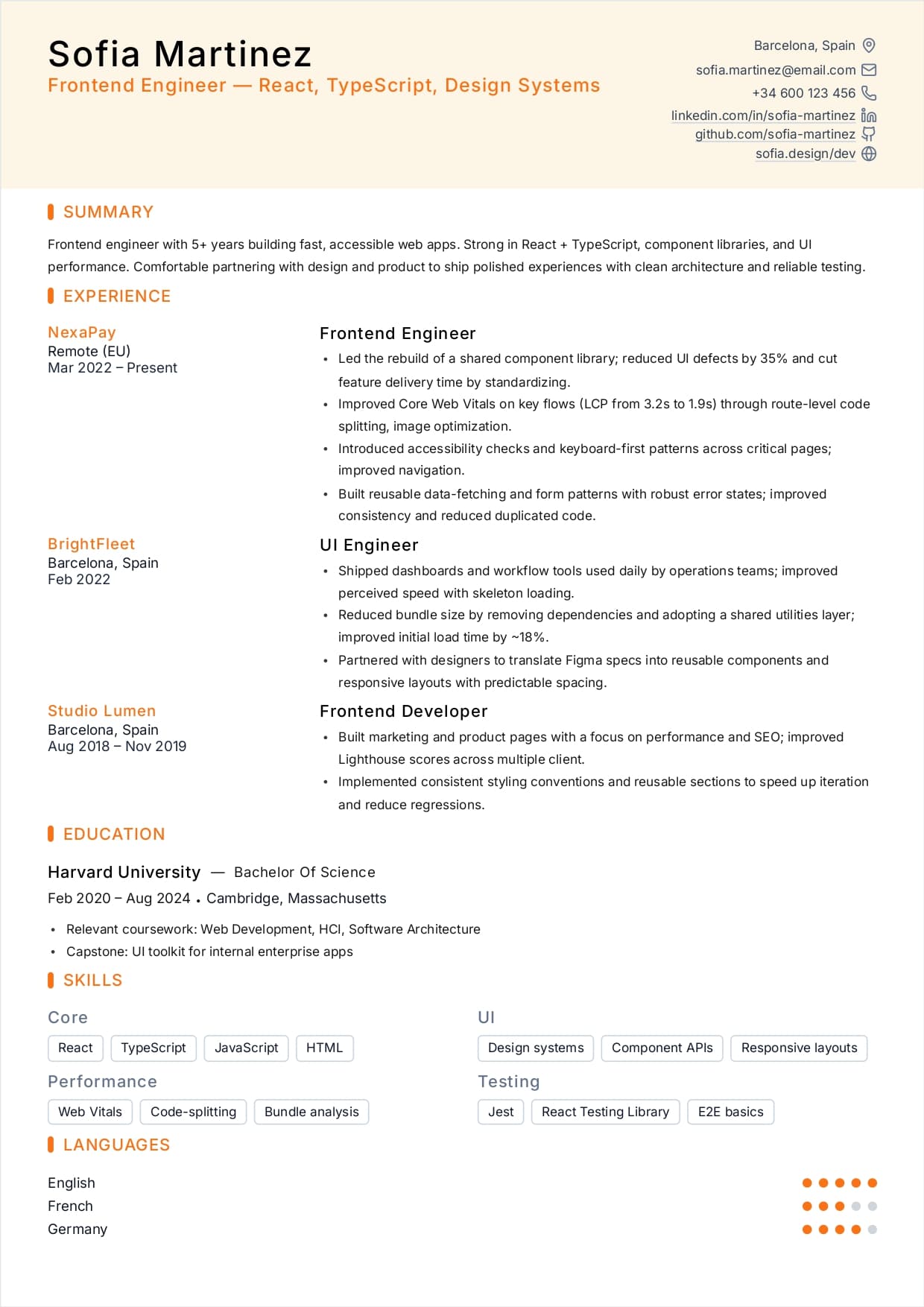

How to Write a Frontend Engineer Resume That Gets Interviews
Frontend roles are competitive because many candidates know the same visible tools. What separates strong resumes is not whether they mention React or TypeScript, but whether they prove they can ship real user-facing product work with quality, accessibility, and performance in mind.
A good frontend resume should quickly answer a hiring manager’s main questions: What stack are you strongest in? What kinds of interfaces have you built? Have you improved user experience in measurable ways? Can you work across design, API integration, performance, testing, and production delivery without creating brittle UI?
This guide shows how to structure a frontend resume so it reads like shipped engineering work instead of a list of technologies or ticket-level tasks.
The fastest way to strengthen a frontend resume is to replace generic UI bullets with proof of product impact, performance work, accessibility, and architecture decisions.
Skills & Keywords
Top Frontend Engineer Skills Recruiters Look for in 2026
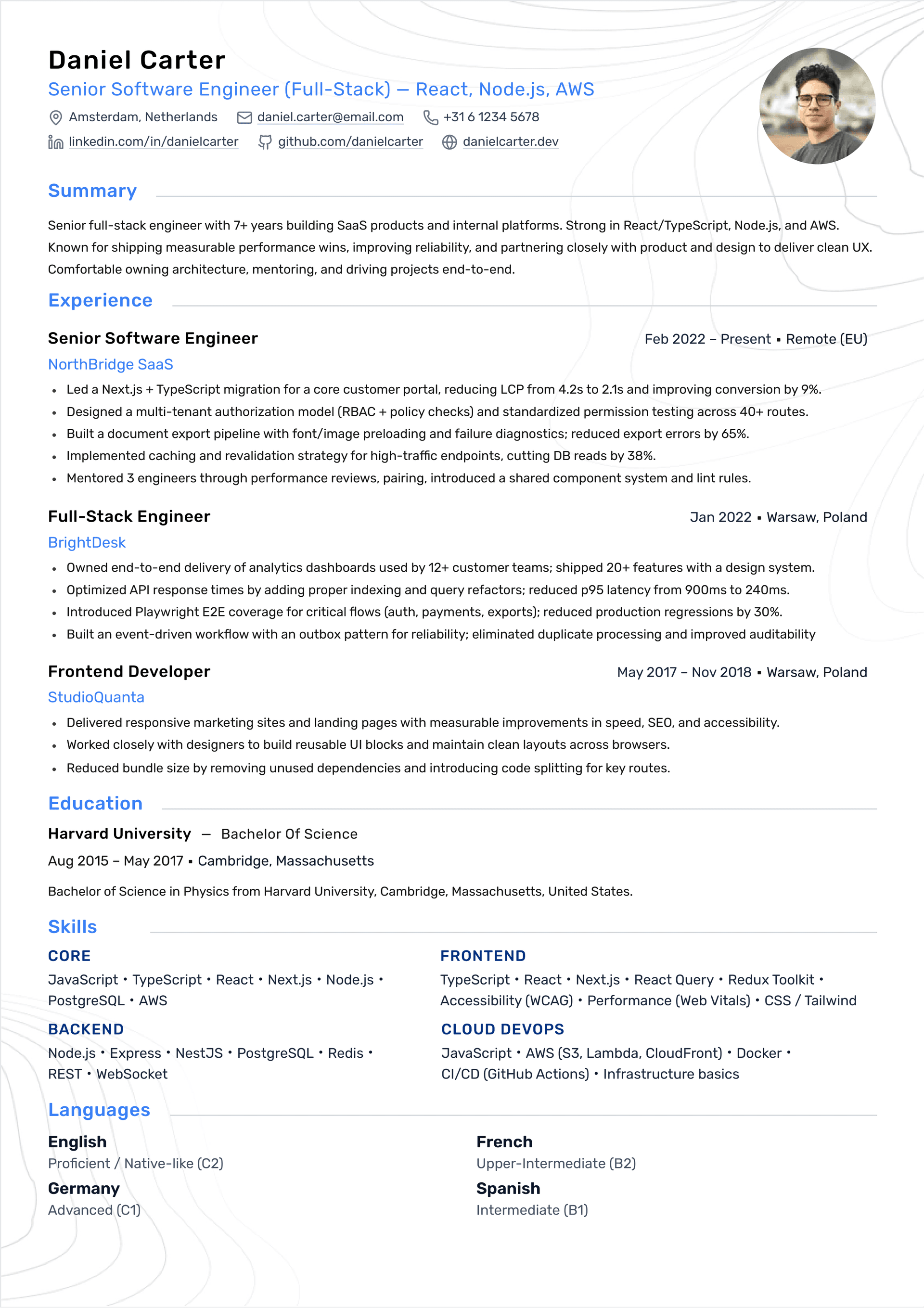
A strong frontend resume starts with a clear technical center of gravity. Most employers first want to know your core language setup, your main framework, how you handle state and rendering, and whether you understand the fundamentals of accessible, maintainable UI architecture.
Modern frontend roles increasingly include more than component building. Teams often expect frontend engineers to reason about server and client boundaries, caching, data fetching, design systems, Core Web Vitals, testing, and production debugging. That is especially true for React and Next.js-based product teams.
Organize your skills into meaningful groups instead of using a long alphabetized list. This makes the section easier to scan and helps ATS systems read your stack more accurately.
- Core: HTML5, CSS3, JavaScript (ES6+), TypeScript, semantic markup
- Frameworks: React, Next.js, Vue, Angular
- Rendering: SSR, SSG, hydration awareness, server/client boundaries
- Styling: Tailwind CSS, CSS Modules, design systems, reusable UI patterns
- State & Data: local state, global state when needed, API integration, caching, pagination
- Accessibility: WCAG awareness, keyboard navigation, ARIA basics, focus handling
- Performance: Core Web Vitals, code splitting, image optimization, bundle awareness
- Testing: Jest or Vitest, React Testing Library, Playwright or Cypress
- Tooling: Git, Vite or Webpack, CI basics, environment configuration
Frontend recruiters are not just hiring for React syntax. They are hiring for UI quality, product thinking, and engineering discipline.
React, Next.js, and Modern Frontend Architecture
React remains one of the clearest frontend hiring signals because many product teams still build around reusable components, composable state, and predictable UI logic. A strong frontend resume should show that you can do more than create screens. It should show that you can structure interfaces in ways that stay maintainable as products grow.
Next.js also matters more now because many modern frontend roles sit closer to product delivery across rendering, routing, data loading, caching, and deployment. That means your resume gets stronger when it reflects integrated UI work rather than static page-building alone.
If you have used React and Next.js in real projects, highlight the things that show engineering depth: shared components, rendering strategy, caching or revalidation choices, route architecture, developer experience improvements, or reduced client-side complexity.
A modern frontend resume should prove you can build maintainable UI architecture, not just individual pages.
Accessibility Is a Serious Frontend Signal, Not Just a Nice-to-Have
Accessibility is one of the clearest markers of frontend maturity. Many resumes still ignore it completely, which is a mistake. If you can show that you built keyboard-friendly interfaces, improved focus management, used semantic HTML, or aligned product flows with WCAG principles, you immediately look more credible as a frontend engineer.
This matters because frontend work is not only about how an interface looks. It is about whether real users can operate it reliably across devices, assistive technology, and different interaction patterns.
You do not need to present yourself as an accessibility specialist. But even one or two concrete bullets about accessibility work can raise the level of your resume significantly.
- Keyboard navigation and logical tab order
- Focus states and focus management in dialogs or menus
- Semantic HTML and proper form labeling
- Accessible error messaging and validation behavior
- Reducing accessibility regressions through component standards
Accessibility on a frontend resume should sound practical: what users could not do before, and what became usable after your work.
Performance and Core Web Vitals: Frontend Metrics That Matter
Performance is now one of the strongest frontend resume differentiators because teams care about real product speed, not only visual polish. Core Web Vitals remain highly relevant because they measure loading performance, responsiveness, and visual stability through metrics like LCP, INP, and CLS.
If you improved performance, be specific about what changed. Stronger bullets mention route-level code splitting, image strategy, rendering choices, bundle reductions, caching improvements, or DOM and layout work that reduced user-visible delay.
Do not settle for a vague line like 'improved performance.' Frontend performance bullets become much stronger when they connect the technical change to a user outcome such as faster rendering, smoother interaction, or a better conversion path.
- Largest Contentful Paint (LCP) improvements
- Interaction to Next Paint (INP) improvements
- Cumulative Layout Shift (CLS) reductions
- Code splitting and route-based loading strategy
- Image optimization and reduced client-side JavaScript
- Caching or rendering changes that improved responsiveness
A strong performance bullet shows what you changed technically and what the user felt as a result.
Design Systems and Reusable UI Work
A lot of frontend value comes from reducing inconsistency and duplication. That is why design systems, shared component libraries, and reusable UI patterns are such strong resume signals. They show that you think beyond a single page and care about long-term product maintainability.
If you built or extended shared components, documented usage patterns, aligned UI with design tokens, or improved consistency across teams, include that work. This matters especially in growing products where many engineers touch the same interface layer.
Good frontend resumes often stand out because they show how one engineer reduced chaos, not just how they added more screens.
Reusable UI work is strong signal because it shows system thinking at the frontend layer.
How to Write Frontend Experience Bullets That Sound Real
Weak frontend bullets usually read like job descriptions. They say you built components, used React, or collaborated with designers, but they do not explain what changed for users or the product. Stronger bullets show what interface or system you improved, what technical decisions mattered, and what measurable result followed.
A useful formula is: Action verb → interface or UI system → technical context → measurable product or engineering outcome. Even when you do not have exact numbers, concrete scope is better than vague language.
If your work touched multiple parts of the frontend stack, make that visible: UI, API integration, validation, performance, accessibility, testing, or shared architecture.
- ❌ "Built UI components using React"
- ✅ "Architected a shared React component system used across multiple product surfaces, reducing duplicated UI work and improving visual consistency across teams"
- ❌ "Improved site performance"
- ✅ "Reduced LCP and INP on high-traffic pages by improving route-level loading, image delivery, and client-side bundle size, resulting in a faster and more stable user experience"
- ❌ "Integrated APIs into the frontend"
- ✅ "Built resilient frontend data flows with loading, retry, and validation states for API-driven product dashboards, improving user trust during slow or partial backend responses"
Good frontend bullets sound like shipped product improvements, not isolated UI tasks.
Frontend Engineers Also Need Strong Data and API Integration Signal
Frontend work is tightly connected to backend behavior, so hiring teams often look for evidence that you can integrate APIs cleanly and handle real-world product states well. That means loading, validation, retries, error handling, partial data, optimistic UI when appropriate, and safe assumptions around user sessions or permissions.
A frontend resume gets stronger when it shows that you understand how data flows through the interface instead of assuming the network is always fast and the payload is always perfect.
This is especially important for dashboard products, account settings, forms, checkout flows, search experiences, and admin tools.
Frontend engineers who handle real API states well usually look much more production-ready than those who only show static UI work.
Testing and Frontend Quality
Testing is one of the easiest ways to separate a production frontend engineer from someone who only knows the framework. Strong resumes mention the right testing level for the work: component tests for UI logic, integration tests for workflows, and end-to-end tests for critical product journeys.
This matters because many frontend failures happen at boundaries: forms, navigation, permissions, asynchronous states, or browser-specific behavior. If you improved release safety or reduced regressions through testing, include it explicitly.
You do not need a huge testing section. One or two good bullets tied to workflow protection can add a lot of credibility.
Frontend testing signal is strongest when it protects real user journeys, not just isolated helper functions.
Tooling, Delivery, and Production Readiness
Frontend roles increasingly include delivery awareness. Many teams expect engineers to understand build tooling, environment configuration, CI checks, deployment behavior, and how frontend code behaves once it reaches production.
You do not need deep DevOps ownership to benefit from including this work. But if you improved build setup, reduced flaky deployments, standardized environments, or made releases safer, that belongs on the resume because it proves you can help ship real product code.
This is especially relevant in teams using frameworks like Next.js where rendering, data, deployment, and performance are more tightly connected than in older frontend stacks.
- Vite or Webpack build improvements
- CI checks for linting, tests, and type safety
- Environment-specific configuration handling
- Cloud or platform deployment workflows
- Release safety and rollback awareness
Shipping code is not enough. Strong frontend engineers also care about how safely that code reaches production.
For Junior & Mid-Level
Projects Section: How to Prove Frontend Depth Without Years of Experience
A strong frontend project can carry a lot of weight if it proves more than styling. The best projects show UI architecture, accessibility, performance, state or data complexity, and enough polish that the result feels product-ready instead of tutorial-like.
Good frontend projects often involve dashboards, editors, SaaS account flows, e-commerce, booking interfaces, internal tools, or other systems with realistic user behavior. What matters is not novelty but the depth of execution.
Treat projects like shipped case studies. Show the problem, the stack, the architecture, the UX challenges, the data flow, and how the project was deployed.
- Include 2 to 3 strong projects maximum
- Prefer deployed applications over local-only demos
- Show accessibility, performance, and responsive behavior when possible
- Mention testing, API integration, or design system reuse if present
- Link GitHub and live demo when available
A smaller but polished frontend product is stronger than a dozen shallow clones.
Writing a Strong Frontend Engineer Summary
Your summary should position you in two or three lines. The reader should quickly understand your frontend scope, your strongest stack, and one proof point about the kind of interfaces or product work you have done.
Avoid empty filler like passionate developer, results-driven engineer, or team player. Strong frontend summaries are specific enough to feel credible and short enough to scan fast.
A good summary usually names your main framework, your strongest quality signal such as performance or accessibility, and one real proof point such as design-system ownership, product scale, or shipped workflows.
- Open with your level and role: Frontend Engineer, Senior Frontend Engineer, or Software Engineer (Frontend)
- Name your strongest stack: for example React + Next.js + TypeScript
- Add one proof point: performance work, design-system ownership, or shipped SaaS product experience
- Optionally mention your product environment: SaaS, e-commerce, dashboards, internal tools, or editor experiences
Example: 'Frontend Engineer with 4+ years building React and Next.js interfaces for SaaS products. Shipped reusable UI systems, improved Core Web Vitals, and delivered accessible product flows with strong frontend testing and production quality.'
ATS Optimization for Frontend Engineers
Applicant Tracking Systems still matter for frontend roles, especially at larger companies and recruiting-heavy pipelines. Your resume needs to parse cleanly before a human even evaluates whether your work is strong.
Use a simple one-column structure with standard headings. Avoid tables, text boxes, heavy sidebars, and visual skill ratings. Frontend candidates sometimes overdesign resumes because they work in UI, but engineering readers care more about signal than decoration.
The safest ATS strategy is simple: use clear titles, grouped skills, and bullets that naturally include relevant frontend keywords without forcing them.
- Use standard headings: Summary, Experience, Projects, Skills, Education
- Mirror the target title when accurate: Frontend Engineer, Software Engineer (Frontend), UI Engineer
- Spell out important acronyms once when helpful: SSR, SSG, WCAG
- Avoid charts, proficiency bars, and icon-only skill labels
- Use a clear file name such as FirstName-LastName-Frontend-Engineer-Resume.pdf
ATS optimization is not about hacks. It is about making your real frontend strengths easy to extract and easy to trust.
Common Frontend Resume Mistakes
Frontend resumes often undersell strong work because they focus on tools instead of outcomes. Others go in the opposite direction and sound polished but technically empty. The strongest resumes balance concrete technical detail with product relevance.
Your goal is not to sound flashy. It is to sound like someone who can ship real UI with quality, speed, and reliability.
- Listing too many tools without proving ownership or depth
- Describing only responsibilities instead of user or product outcomes
- Ignoring accessibility completely
- Mentioning performance without naming what improved
- Failing to show reusable architecture or system thinking
- Using generic bullets like 'built components' or 'worked with designers'
The best frontend resumes feel concrete. They name real interfaces, real constraints, and real improvements users actually felt.