
How to Write a Cloud Engineer Resume That Gets Interviews
Cloud engineering resumes are strongest when they prove systems ownership. Hiring teams are not only looking for someone who can launch resources in AWS, Azure, or Google Cloud. They want evidence that you can automate infrastructure safely, secure access correctly, operate reliable environments, and keep spend under control over time.
That means your resume should reflect real cloud work: infrastructure as code, IAM, networking, deployment automation, backup and disaster recovery, observability, and cost-aware decisions. Generic service lists are weak signal. Real architecture, operational discipline, and measurable improvements are strong signal.
This guide explains what recruiters look for, which cloud keywords matter, how to write stronger bullets, and how to position projects so your resume reads like production engineering instead of certification prep.
The biggest upgrade for most cloud resumes is replacing tool lists with evidence of automation, reliability, security, and cost impact.
Skills & Keywords
Top Cloud Engineer Skills Recruiters Look for in 2026
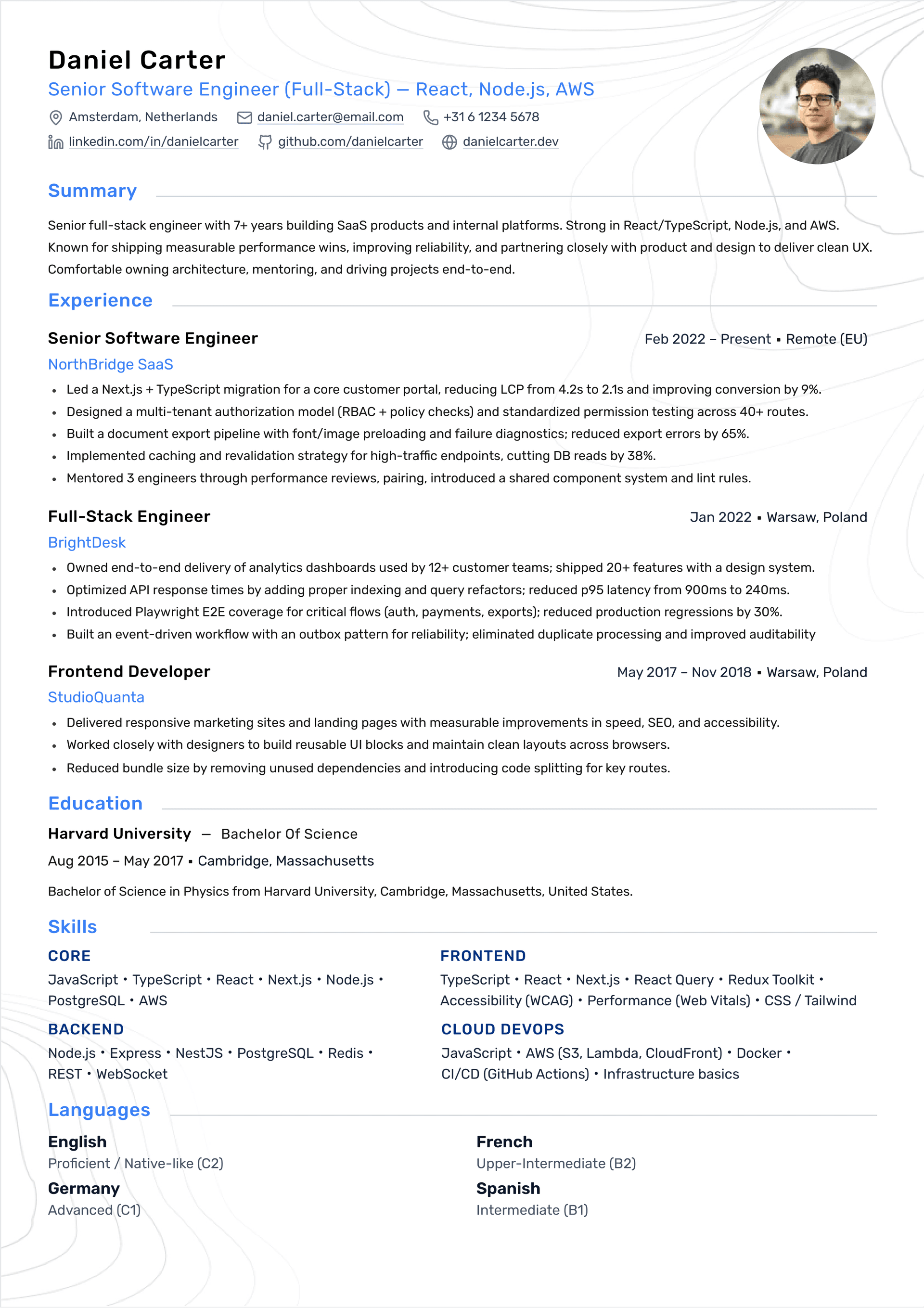
A modern cloud engineer is usually expected to understand far more than a single provider console. Employers increasingly want engineers who can automate infrastructure with code, design resilient environments, secure identities correctly, operate containers or serverless workloads, and make informed tradeoffs around performance and cost.
The official well-architected guidance from AWS, Google Cloud, and Azure all centers on similar themes: operational excellence, security, reliability, performance efficiency, and cost optimization. That overlap is useful for resumes because it tells you what hiring teams consistently care about across platforms.
Your skills section should reflect that reality. Organize cloud services into meaningful groups, keep the list readable, and only include tools you can discuss confidently in an interview.
- Cloud Platforms: AWS, Microsoft Azure, Google Cloud
- Infrastructure as Code: Terraform, reusable modules, remote state, environment promotion
- Containers & Orchestration: Docker, Kubernetes, Helm, cluster operations
- Networking: VPC/VNet design, subnets, routing, DNS, load balancers, CDN
- Security: IAM, RBAC, federation, MFA, secrets, encryption, least privilege
- Compute Patterns: virtual machines, autoscaling groups, serverless, managed services
- Observability: logging, metrics, traces, dashboards, alerting
- Reliability: backups, disaster recovery, multi-zone design, health checks, rollout safety
- Cost Optimization: resource right-sizing, storage lifecycle rules, reserved usage, FinOps collaboration
- Delivery: CI/CD pipelines, policy checks, automated rollbacks, environment consistency
The best cloud resumes show platform depth plus operational maturity, not just brand-name cloud keywords.
Infrastructure as Code: One of the Strongest Signals on a Cloud Resume
Infrastructure as code is now baseline cloud-engineering signal. If your resume says AWS, Azure, or GCP but says nothing about automation, it looks incomplete. Employers want reproducible environments, versioned infrastructure changes, safer reviews, and a clear deployment workflow — not click-ops hidden in dashboards.
Terraform remains one of the clearest cross-cloud signals because it maps directly to how many teams provision and manage infrastructure. A strong bullet names what you automated, how broadly it was reused, and what manual work or risk it removed.
The best cloud bullets do not stop at 'used Terraform.' They explain module design, environment consistency, policy checks, provisioning speed, or reduced drift between staging and production.
- Reusable Terraform modules for shared infrastructure patterns
- Remote state management and environment isolation
- Code review workflows for infrastructure changes
- Policy enforcement or validation before apply
- Faster and more consistent environment provisioning
If you mention Terraform, prove it with reusable modules, safer rollouts, environment consistency, or reduced manual provisioning time.
Networking and Traffic Management: Core Cloud Engineering Proof
Cloud engineers are often judged by how well they understand network boundaries and traffic flow. That includes VPC or VNet design, public and private subnets, routing, ingress and egress controls, load balancing, DNS, CDN placement, and how services communicate across environments or regions.
This is the area where many resumes stay too shallow. Listing 'VPC' or 'DNS' in the skills section is not enough. Stronger resumes show how you segmented workloads, improved availability behind load balancers, reduced exposure of internal systems, or simplified routing and name resolution for applications.
When relevant, mention zero-downtime cutovers, multi-region routing, CDN optimization, or internal networking choices that improved reliability and security.
Networking on a cloud resume should sound operational: what traffic needed to go where, what risk existed, and what architecture improved it.
Cloud Security: IAM, Least Privilege, and Access Control
Security is not optional cloud-resume filler. It is one of the clearest differentiators between someone who can launch infrastructure and someone who can operate it responsibly. Cloud platforms all emphasize identity, access control, and secure workload operation because bad access patterns create large blast radiuses quickly.
Strong cloud resumes mention IAM roles, federation, temporary credentials, least-privilege policies, secret handling, and workload-level authorization controls when relevant. AWS guidance, for example, explicitly recommends temporary credentials, roles, and stronger authentication practices rather than relying on long-lived user credentials.
Do not just say 'worked on security.' Explain what you secured: admin access, CI/CD roles, cross-account automation, secrets in pipelines, cluster permissions, or public-facing services.
- IAM roles and least-privilege policy design
- Federated access and MFA for human users
- Temporary credentials for workloads and automation
- Secrets storage and rotation strategy
- Kubernetes RBAC and service-account discipline
- Encryption at rest and in transit where relevant
A good security bullet names the access risk, the control you introduced, and the operational result.
Kubernetes, Containers, and Cloud-Native Platform Work
For many cloud roles, Kubernetes is still one of the strongest production signals because it sits at the intersection of infrastructure, delivery, networking, and operations. CNCF continues to anchor the cloud-native ecosystem around projects like Kubernetes, Prometheus, and Envoy, and employers often expect cloud engineers to understand how these systems are deployed and operated in practice.
That does not mean you need to claim deep platform-engineer expertise if you do not have it. But if you worked on cluster provisioning, ingress, secrets, RBAC, deployment controllers, Helm charts, autoscaling, or production rollout patterns, those are high-value resume signals.
Kubernetes experience is strongest when tied to reliability and delivery outcomes: safer deployments, stronger rollback paths, better workload isolation, or fewer manual operational steps.
- Cluster setup and environment standardization
- Deployments, Jobs, and workload controller usage
- Helm charts and configuration management
- Ingress and service exposure patterns
- Resource requests, limits, and autoscaling awareness
- Operational improvements around rollout, rollback, and debugging
Kubernetes on a resume should sound like production operations, not just 'deployed containers.'
Monitoring, Observability, and Incident Readiness
Cloud engineering includes keeping systems understandable under stress. That means logs, metrics, traces, dashboards, alerting, and enough visibility to detect, diagnose, and recover from failures quickly. As cloud-native environments grow more distributed, observability becomes more important, not less.
If you instrumented workloads, improved dashboards, reduced alert noise, or helped shrink incident recovery time, put that on the resume. This is the kind of operational signal that raises a candidate’s level immediately because it shows they think beyond deployment success and care about ongoing system behavior.
Cloud resumes often improve substantially when they include one or two bullets about what became easier to detect, diagnose, or recover after observability work was added.
Monitoring tools matter, but the stronger signal is what operational visibility improved and how it changed incident response.
Reliability, Backups, and Disaster Recovery
Reliability is one of the most universal cloud-hiring expectations. AWS, Azure, and Google Cloud all frame well-architected workloads around resilience, recovery, and the ability to handle failure gracefully. That makes reliability work one of the best content areas for your resume.
Mention backup design, restore testing, multi-zone or multi-region thinking, failover workflows, health checks, deployment safety, and the operational discipline required to maintain availability. A cloud engineer who has thought about recovery is more credible than one who only talks about provisioning.
Do not overclaim formal disaster-recovery ownership if you did not have it. But if you improved recovery time, validated backups, or introduced safer deployment patterns, that is valuable signal.
- Multi-AZ or zone-redundant architecture
- Backup schedules and restore validation
- Disaster recovery planning and runbooks
- Health checks and automated recovery paths
- Deployment rollback and blast-radius reduction
A cloud engineer who can explain recovery is usually trusted more than one who only knows provisioning commands.
Cost Optimization and FinOps: A Major Cloud Resume Advantage
Cloud cost is no longer a side concern. The FinOps Foundation describes FinOps as an operational framework focused on maximizing business value from technology spend through timely, data-driven decisions and collaboration across engineering, finance, and business teams. That is exactly why cost awareness has become a strong hiring signal for cloud engineers.
Your resume should show whether you made practical cost decisions: right-sizing, storage lifecycle policies, auto-scaling improvements, eliminating idle resources, choosing managed services intentionally, or helping teams understand spend visibility. Cloud engineers who can save money without weakening reliability stand out quickly.
Do not reduce this section to 'optimized cost.' Explain what changed and what was protected: performance, uptime, team velocity, or operational simplicity.
Cloud cost work is strongest when it shows a tradeoff decision, not just a savings number by itself.
CI/CD and Safe Infrastructure Delivery
A cloud engineer is often part of the path from code to production. That means CI/CD experience is highly relevant, especially when it covers infrastructure changes, policy checks, environment consistency, rollout safety, and rollback discipline.
Resumes become much stronger when they show how pipelines reduced manual work, caught misconfigurations earlier, standardized releases, or improved deployment reliability. Delivery is not just a developer concern — in cloud roles it directly affects infrastructure safety and operational confidence.
If you worked with GitHub Actions, GitLab CI, Azure DevOps, Argo CD, or similar tools, tie them to outcomes rather than merely naming them.
A pipeline bullet is good. A pipeline bullet tied to safer cloud changes, faster rollbacks, or fewer manual steps is much better.
How to Write Strong Cloud Engineer Experience Bullets
The most common weak cloud bullet says what service you touched but not what problem you solved. A line like "Worked with AWS and Kubernetes" gives almost no signal. Strong bullets show architecture, automation, risk reduction, or business impact.
Use this formula: Action verb → cloud system or workflow → technical context → reliability, security, speed, or cost result. Even if you do not have exact metrics, concrete scope is still much stronger than generic phrasing.
- ❌ "Managed AWS infrastructure"
- ✅ "Provisioned multi-environment AWS infrastructure with Terraform modules, reducing manual configuration drift and cutting setup time from 2 days to under 1 hour"
- ❌ "Improved security"
- ✅ "Replaced long-lived cloud credentials with role-based temporary access and tightened IAM policies, lowering standing privilege exposure across engineering workflows"
- ❌ "Worked on Kubernetes deployments"
- ✅ "Built Kubernetes deployment workflows with health checks, rollout controls, and rollback paths, improving release reliability for customer-facing services"
Cloud resumes get stronger when the reader can see what became safer, faster, cheaper, or more reliable because of your work.
For Junior & Mid-Level
Projects Section: How to Prove Cloud Depth Without a Big Cloud Job Title
A strong cloud project can absolutely carry a resume, especially if your official title did not say Cloud Engineer yet. The key is building something that demonstrates platform thinking rather than just spinning up a VM and calling it done.
Good project ideas include a multi-environment Terraform setup, a Kubernetes-based service with CI/CD and monitoring, a secure serverless workflow with IAM boundaries, or a small but real cloud migration with DNS, load balancing, backup, and observability considerations.
Treat cloud projects like production case studies. Document the architecture, explain the tradeoffs, include diagrams if needed in your portfolio, and make the resume bullets specific about what you automated, secured, or optimized.
- Use 2 to 3 strong projects maximum
- Prefer deployed, documented projects over sandbox exercises
- Include Terraform, CI/CD, IAM, monitoring, and networking when possible
- Link to GitHub, architecture notes, and live demo or docs if available
- Explain tradeoffs and recovery plans, not just setup steps
A small but well-automated cloud platform is stronger than ten screenshots of service consoles.
Writing a Strong Cloud Engineer Summary
Your summary should position you in two or three lines. The reader should quickly understand your cloud focus, your strongest platform or tooling area, and one proof point about the scale or quality of the systems you worked on.
Avoid generic lines like passionate cloud professional or results-driven engineer. Strong cloud summaries are specific without becoming a list of acronyms. Mention your main platform, your automation or operations strength, and one piece of real proof.
A good summary often includes your primary cloud, your IaC or platform specialty, and your strongest production signal such as cost work, reliability, migration, or security hardening.
- Open with your role and level: Cloud Engineer, Senior Cloud Engineer, or Cloud Engineer focused on AWS platform automation
- Name your strongest cloud and tooling combination: for example AWS + Terraform + Kubernetes
- Add one proof point: migration ownership, reliability improvement, cost optimization, or CI/CD scale
- Optionally mention your target environment: SaaS, fintech, internal platform, or cloud migration
Example: 'Cloud Engineer with 4+ years building AWS infrastructure using Terraform, Kubernetes, and CI/CD automation. Designed secure multi-environment platforms, improved deployment reliability, and reduced cloud spend through rightsizing and operational visibility.'
ATS Optimization for Cloud Engineers
Cloud roles still pass through Applicant Tracking Systems in many companies, especially larger organizations and consultancies. That means your resume needs to parse cleanly before a recruiter or engineering manager sees the substance.
Use a straightforward one-column layout with standard section headings. Avoid tables, text boxes, heavy sidebars, and visual skill bars. Cloud resumes sometimes become cluttered with provider logos and certification badges; those add less value than a clean structure and strong wording.
The safest ATS strategy is simple: use recognizable role titles, clear skill groups, and bullets that naturally include real cloud keywords without stuffing them.
- Use standard headings: Summary, Experience, Projects, Skills, Education, Certifications
- Mirror target titles accurately: Cloud Engineer, Platform Engineer, DevOps Engineer, Infrastructure Engineer
- Spell out important acronyms once when helpful: IAM, VPC, CI/CD, RBAC
- Avoid decorative cloud icons as substitutes for actual skill text
- Use a clear file name such as FirstName-LastName-Cloud-Engineer-Resume.pdf
ATS optimization is mostly about clear structure and real cloud wording, not hacks.
Common Cloud Engineer Resume Mistakes
Cloud resumes often become weaker than they should be because candidates either list services with no proof or over-index on certifications without enough production evidence. A hiring manager wants to know what systems you improved, how safely you operated them, and what changed because of your work.
The best fix is to make the resume more concrete: architecture scope, automation depth, access control decisions, reliability outcomes, and cost improvements.
- Listing dozens of cloud services without proving hands-on ownership
- Saying 'migrated to cloud' without naming architecture, scale, or outcome
- Ignoring IAM, networking, and security work
- Treating Kubernetes as a keyword instead of proving operational experience
- Omitting cost optimization and spend-awareness entirely
- Writing bullets that describe tasks instead of safer, faster, or more reliable results
A strong cloud resume reads like someone trusted to run production infrastructure, not someone who only passed exams.