
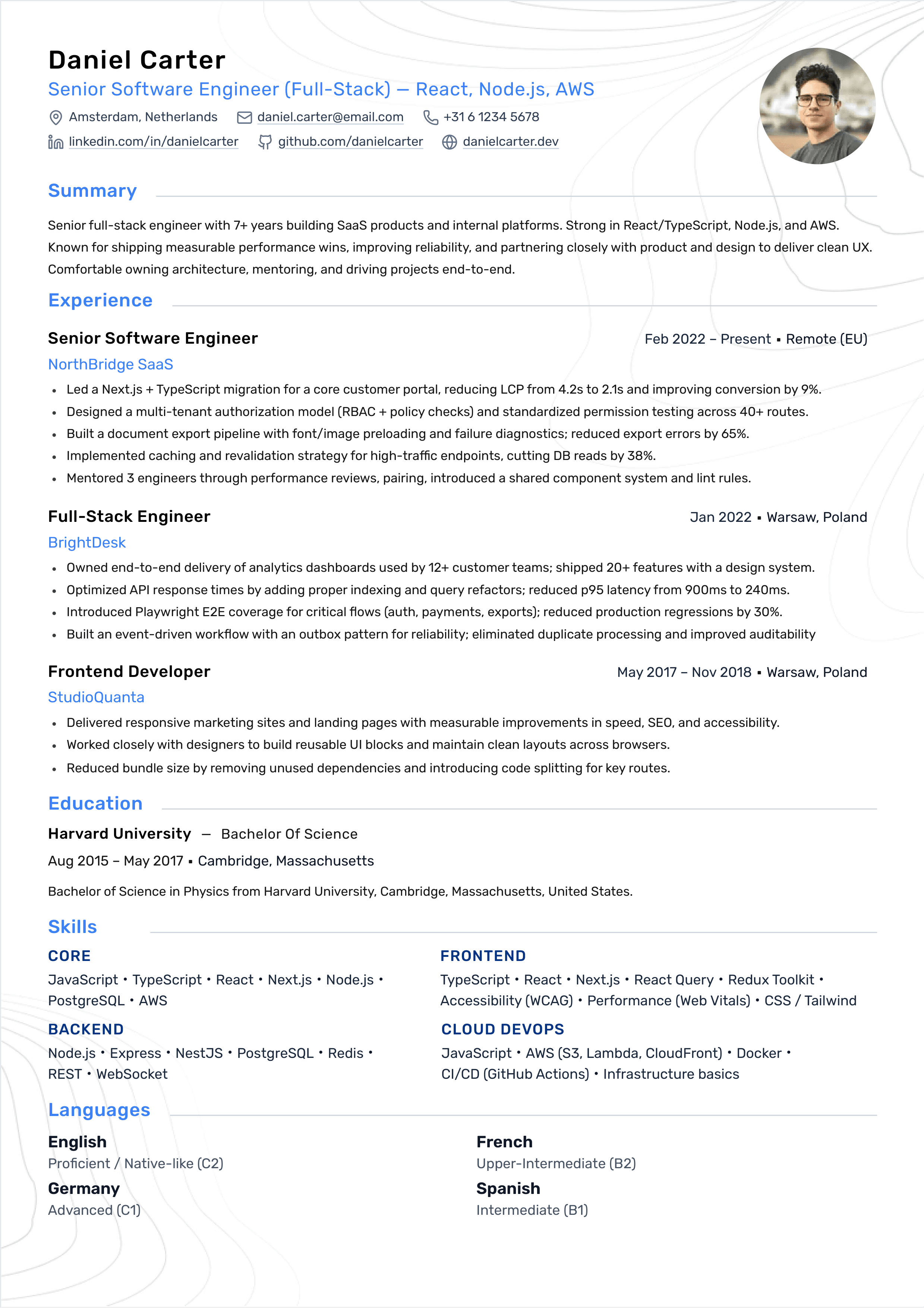
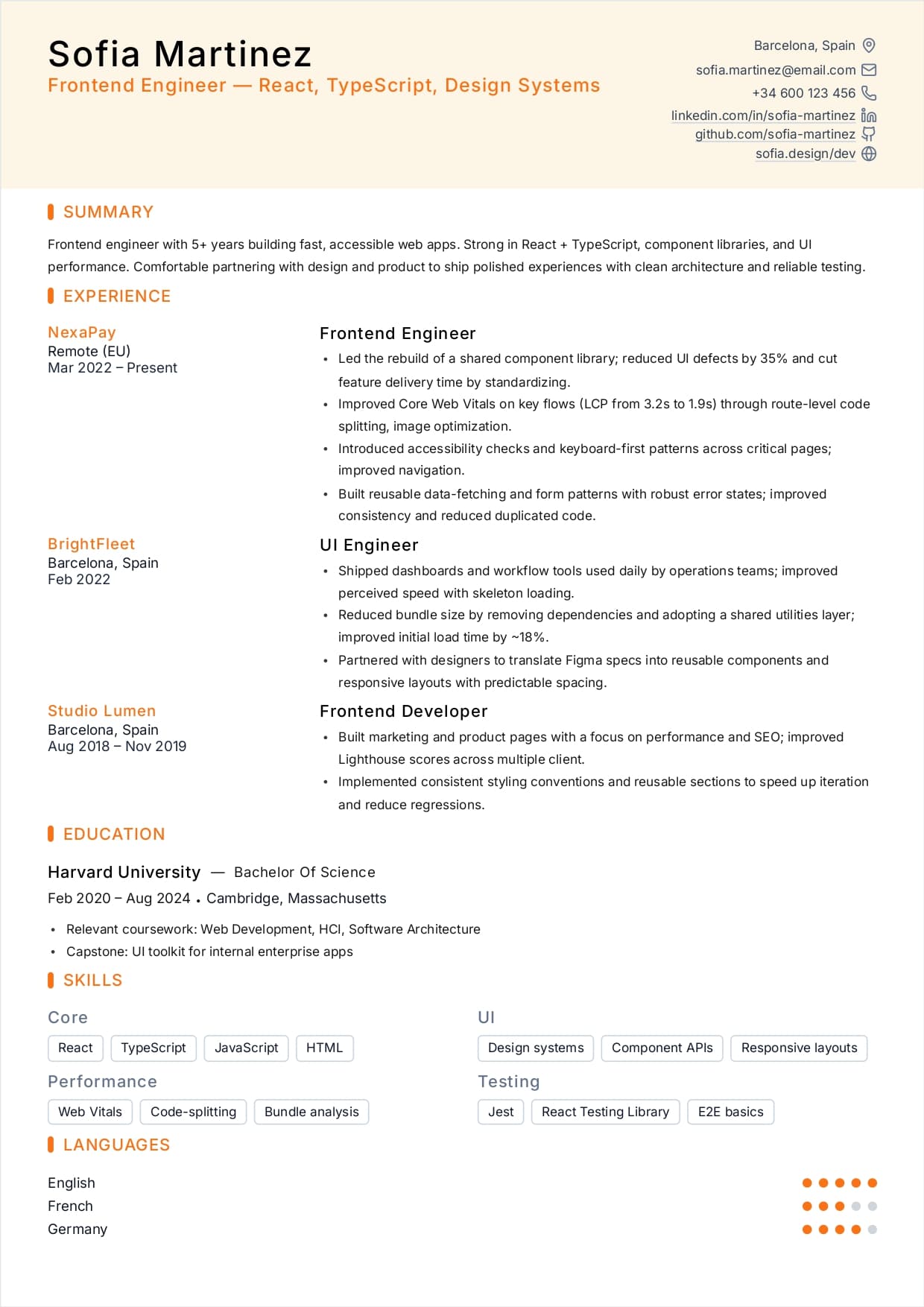
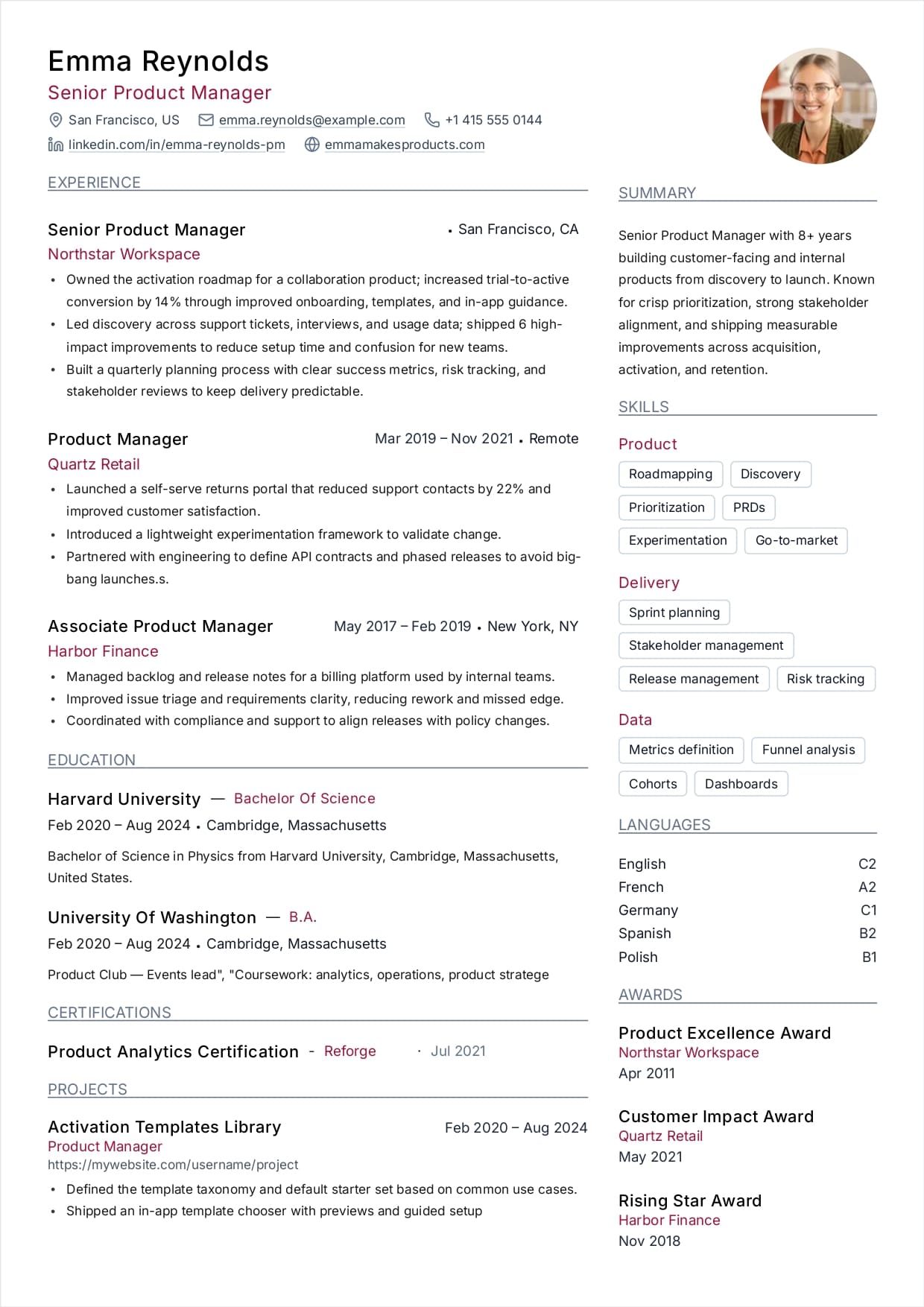
What Makes a Great Cloud Architect Resume?
A strong Cloud Architect resume shows far more than familiarity with AWS, Azure, or Google Cloud. It should prove that you can turn business requirements into architecture decisions across networking, security, resilience, cost, observability, and delivery. That is what separates an architect from someone who simply launches infrastructure.
The best Cloud Architect resumes communicate architectural judgment quickly. Recruiters and hiring managers want to see that you can design secure, high-performing, and cost-aware systems, review tradeoffs, and guide implementation across teams without losing sight of production reliability.
This page covers the top cloud architect skills, high-value ATS keywords, example bullets, project ideas, and resume-writing patterns that help senior cloud candidates stand out.
A Cloud Architect resume wins when it shows architecture ownership, not just cloud service exposure.
Skills & Keywords
Top Cloud Architect Skills to Include in 2026
Cloud architecture hiring still centers on a consistent set of themes across AWS, Azure, and Google Cloud: security, reliability, performance, operational excellence, and cost optimization. That overlap is not accidental. The official well-architected guidance from all three major providers emphasizes those same design pillars, which makes them strong resume signals for architecture roles.
Your skills section should reflect what architects actually do: design secure network boundaries, standardize infrastructure with code, enforce IAM controls, support disaster recovery, improve delivery safety, and balance cost with business requirements. Listing dozens of cloud services without those architecture themes is weak signal.
Organize your skills around architecture responsibilities instead of provider-specific service dumps. That makes the page stronger for both ATS parsing and search intent.
- Platforms: AWS, Azure, Google Cloud
- Architecture: solution design, workload reviews, high availability, fault tolerance, DR planning
- Infrastructure as Code: Terraform, reusable modules, environment promotion, policy checks
- Networking: VPC/VNet design, subnets, routing, load balancing, DNS, ingress and segmentation
- Security: IAM, least privilege, secrets, encryption, governance, policy controls
- Containers & Compute: Kubernetes, Docker, autoscaling, serverless, managed services
- Observability: logs, metrics, alerts, traces, operational dashboards
- Delivery: CI/CD, rollout safety, environment consistency, automated validation
- Cost: rightsizing, lifecycle policies, waste reduction, FinOps collaboration
Strong Cloud Architect skills should describe systems thinking, not just product menus from a cloud console.
ATS Keywords
Cloud Architect Resume Keywords Recruiters and ATS Search For
Cloud architecture resumes often pass through ATS filters before a human reads them. That means your document should include the terms recruiters actually search for, but in natural places like Skills, Summary, Projects, and Experience. Good keyword use helps both ATS visibility and page relevance for search engines.
The most valuable keywords are usually role-aligned phrases tied to architecture quality: high availability, infrastructure as code, IAM, cloud migration, disaster recovery, Kubernetes, cost optimization, and well-architected reviews. Use the exact wording when it matches your real experience.
Do not stuff the page with every cloud acronym you know. A smaller set of high-value terms used in meaningful context is much stronger.
- Core role terms: Cloud Architect, Solutions Architect, Cloud Solution Architecture, Cloud Infrastructure Design
- Provider terms: AWS architecture, Azure architecture, Google Cloud architecture
- Reliability terms: high availability, disaster recovery, business continuity, fault tolerance
- Security terms: IAM, least privilege, policy controls, secrets management, encryption
- Automation terms: Terraform, infrastructure as code, CI/CD, automated provisioning
- Operations terms: observability, monitoring, alerting, logs, metrics
- Cost terms: cloud cost optimization, FinOps, rightsizing, lifecycle policies
If you want ATS and Google relevance, use cloud-architecture keywords in Summary, Skills, and at least one strong Experience bullet.
Architecture Signal
Why Well-Architected Framework Knowledge Matters on a Cloud Architect Resume
One of the strongest ways to position a Cloud Architect resume is to show alignment with well-architected principles. AWS frames architectural quality around operational excellence, security, reliability, performance efficiency, cost optimization, and sustainability. Google Cloud’s framework similarly focuses on secure, resilient, efficient, high-performing, cost-effective, and sustainable workloads, while Azure’s framework emphasizes reliability, security, cost optimization, operational excellence, and performance efficiency.
That matters because these are not just certification topics. They are the real lens many hiring managers use to evaluate architecture judgment. A good Cloud Architect resume should sound like someone who has made decisions across these dimensions, not someone who only memorized service names.
You do not need to mention every framework by name on the resume itself. But your bullets should reflect the same principles: secure access, resilient topology, cost-aware design, operational readiness, and measurable architecture improvements.
Cloud Architect resumes rank higher with recruiters when they sound aligned to real architecture review criteria, not just tooling lists.
Infrastructure as Code Is One of the Strongest Cloud Architect Signals
If a Cloud Architect resume mentions AWS, Azure, or Google Cloud but says nothing about infrastructure as code, it usually looks incomplete. Modern architecture teams expect reproducible environments, versioned infrastructure changes, safe reviews, and less dependence on manual console work.
Terraform is especially valuable signal because it maps directly to how many organizations standardize provisioning across environments and sometimes across providers. A strong architect bullet should explain what you standardized, how widely it was reused, and what manual risk or inconsistency it removed.
Good IaC signal includes reusable modules, remote state patterns, environment separation, review workflows, and safer promotion of infrastructure changes into production.
- Reusable Terraform modules for networking, compute, IAM, and platform standards
- Environment consistency across dev, staging, and production
- Reduced manual configuration drift
- Safer review and approval workflows for infrastructure changes
- Faster provisioning and repeatable recovery
On a Cloud Architect resume, Terraform is strongest when tied to standardization, safety, and speed.
Cloud Networking and Security Architecture
Networking and IAM are two of the clearest architecture differentiators because they define trust boundaries and traffic behavior. Strong Cloud Architect resumes should show that you understand VPC or VNet design, subnet segmentation, routing, DNS, ingress, load balancing, private service communication, and how these decisions support both reliability and security.
Security should be framed as architecture, not as a compliance checkbox. That means IAM roles, least-privilege access, federation, temporary credentials, encryption, secrets handling, and policy-based controls that reduce operational risk without blocking delivery.
The strongest bullets connect the design choice to the risk reduced: less public exposure, cleaner network boundaries, safer cross-account access, tighter admin permissions, or lower blast radius during incidents.
Cloud security bullets should explain what boundary or access risk existed, and how your architecture reduced it.
High Availability, Disaster Recovery, and Business Continuity
Reliability is one of the most important architecture signals because cloud architects are often trusted with decisions that affect uptime and recovery. Good resumes should show that you designed for fault tolerance, backup and restore, multi-zone or multi-region resilience, health checks, and recovery planning.
Disaster recovery content is especially valuable because it proves you think beyond deployment. Many cloud resumes talk about provisioning, but fewer candidates show that they understand recovery objectives, dependency mapping, backup validation, and failover planning.
Even if you did not own formal DR policy, you can still show relevant signal through safer backup strategy, restore testing, resilience reviews, or architecture improvements that reduced single points of failure.
- Multi-AZ or zone-redundant design
- Backup scheduling and restore validation
- Failover planning and reduced single points of failure
- Runbooks and recovery readiness
- Deployment safety and rollback awareness
A Cloud Architect who can explain recovery strategy usually stands out more than one who only explains provisioning.
Kubernetes, Containers, and Serverless Tradeoffs
Cloud Architect roles often require choosing the right execution model, not blindly preferring one. That is why Kubernetes and serverless architecture are strong resume topics when framed as tradeoff decisions. Hiring managers want architects who can explain why a workload belongs on managed containers, VMs, or serverless services based on complexity, operations, latency, scaling, and team capability.
Kubernetes is strong signal because it touches orchestration, networking, rollout safety, isolation, scaling, and observability. Serverless is strong signal when you can explain event-driven architectures, reduced ops overhead, and where that model helps or hurts.
A Cloud Architect resume gets stronger when it shows decision quality, not just tool familiarity.
Cost Optimization and FinOps on a Cloud Architect Resume
Cloud cost has become a major architecture concern, not a side issue. A strong Cloud Architect resume should show that you can make design decisions that support business value without undermining reliability or security. That includes rightsizing, storage lifecycle rules, reserved usage strategy, environment control, and avoiding waste from idle or oversized resources.
Cost work is especially valuable because it signals maturity. Engineers who can reduce spend while preserving architecture quality tend to stand out quickly in senior cloud hiring.
The best cost bullets do not just say money was saved. They explain what architecture choice changed and what quality was preserved.
How to Write the Experience Section for a Cloud Architect Resume
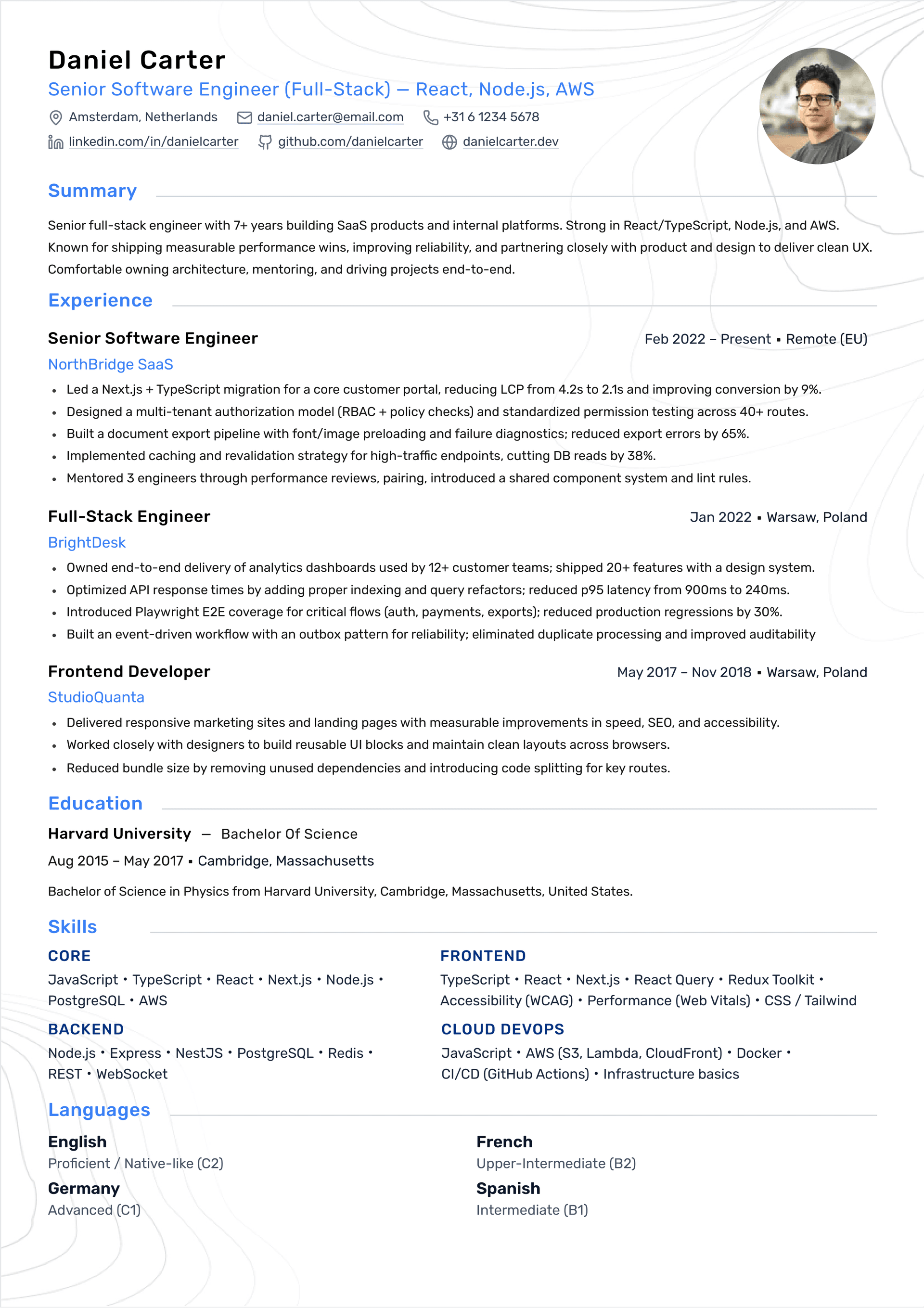
Your experience section should read like architecture ownership, not cloud administration task lists. Focus on systems designed, tradeoffs evaluated, infrastructure standardized, risks reduced, and outcomes delivered.
A strong Cloud Architect bullet usually follows this pattern: Action + architecture scope + cloud or platform context + measurable reliability, security, speed, or cost outcome.
Example: "Designed a multi-environment AWS platform with Terraform, standardized IAM and networking patterns, and reduced provisioning time from multiple days to under one hour while improving environment consistency."
For senior cloud resumes, 4 to 6 strong bullets showing architecture depth are usually better than long lists of daily responsibilities.
- Lead with architecture scope: migration, platform, workload, or review ownership
- Name the environment and core technologies when relevant
- Add one real architecture dimension: security, reliability, cost, observability, or delivery
- Show a business or engineering outcome for each major bullet
- Use clear verbs: designed, standardized, automated, hardened, optimized, reviewed
Project Ideas
Cloud Architect Projects That Strengthen a Senior Resume
Projects can strengthen even senior Cloud Architect resumes when they demonstrate architecture depth clearly. The best projects are not just labs. They feel like production case studies: multi-environment design, network boundaries, IAM, monitoring, backups, and cost-aware decisions.
Good cloud architecture projects include multi-region SaaS reference platforms, Terraform-based landing zones, secure Kubernetes platforms, DR-ready application topologies, or migration blueprints that compare tradeoffs across deployment models.
Treat projects like architecture reviews in miniature. Describe the business problem, the chosen architecture, the major constraints, and the reasons behind your design decisions.
- Multi-environment Terraform platform
- Kubernetes architecture with ingress, observability, and rollout controls
- Serverless event-driven solution with IAM boundaries and monitoring
- Cloud migration case study with backup, DR, and cost tradeoffs
- Reference architecture documentation with diagrams and review notes
A documented architecture project is much stronger than screenshots of cloud consoles.
Making a Cloud Architect Resume ATS-Friendly
Most enterprise and consulting hiring pipelines still use ATS tools before a human sees the resume. If your architecture content is buried in a hard-to-parse layout, the system may not extract the right signals clearly.
Use a simple one-column layout with standard headings, readable dates, and plain text for tools, platforms, and architecture topics. Avoid tables, text boxes, heavy visual sidebars, and icon-only skill rows.
For cloud architecture roles, ATS readability matters because the resume often needs to surface high-value terms like Cloud Architect, AWS, Azure, Terraform, IAM, high availability, disaster recovery, Kubernetes, and cost optimization cleanly.
- Use standard headings: Summary, Experience, Skills, Projects, Education, Certifications
- Include the exact target title when accurate: Cloud Architect, Solutions Architect, Cloud Solutions Architect
- Spell out key acronyms once where helpful: IAM, VPC, DR, CI/CD
- Avoid graphics that replace real skill text
- Save the file with a clear name like FirstName-LastName-Cloud-Architect-Resume.pdf
Avoid These
Common Cloud Architect Resume Mistakes
Most Cloud Architect resumes fail for predictable reasons. They either read like certification cram sheets or they list services with no evidence of architecture judgment. A hiring manager needs to see design responsibility, tradeoff thinking, and operational maturity.
Use this checklist before you publish or apply.
- Listing too many cloud services without showing architecture outcomes
- Saying 'migrated to cloud' without describing scope, tradeoffs, or results
- Ignoring IAM, networking, DR, or cost entirely
- Treating Kubernetes or Terraform as keywords instead of proving real usage
- Using generic bullets like 'worked on AWS infrastructure'
- Overdesigning the resume and weakening ATS parsing
A strong Cloud Architect resume should read like someone trusted to review and design production systems, not someone who only passed exams.
Writing a Strong Cloud Architect Summary
Your summary is prime real estate because recruiters usually read it first. In two or three sentences, they should understand your architecture focus, strongest cloud context, and one proof point tied to business value.
Avoid filler like passionate, results-driven, or team player. A better summary names your platform depth, your architectural strengths, and the kind of systems you design.
A strong cloud architect summary might mention cloud platform depth, infrastructure-as-code, resilience, migration, cost work, or architecture governance depending on your background.
Senior Cloud Architect designing secure, resilient, and cost-optimized cloud platforms across AWS and Azure. Experienced in Terraform, IAM, Kubernetes, disaster recovery planning, and architecture reviews that improve reliability, delivery speed, and operational confidence.