
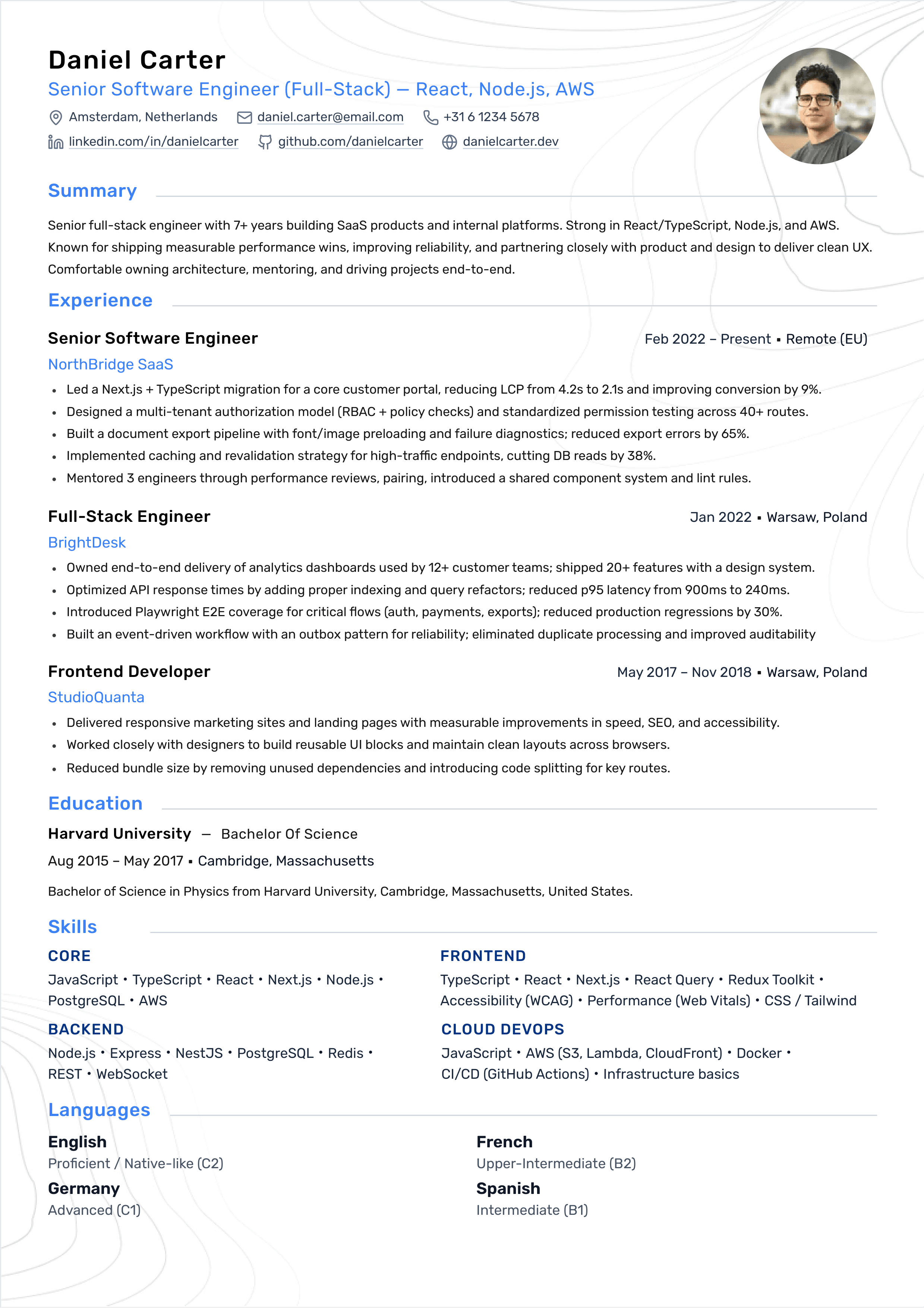
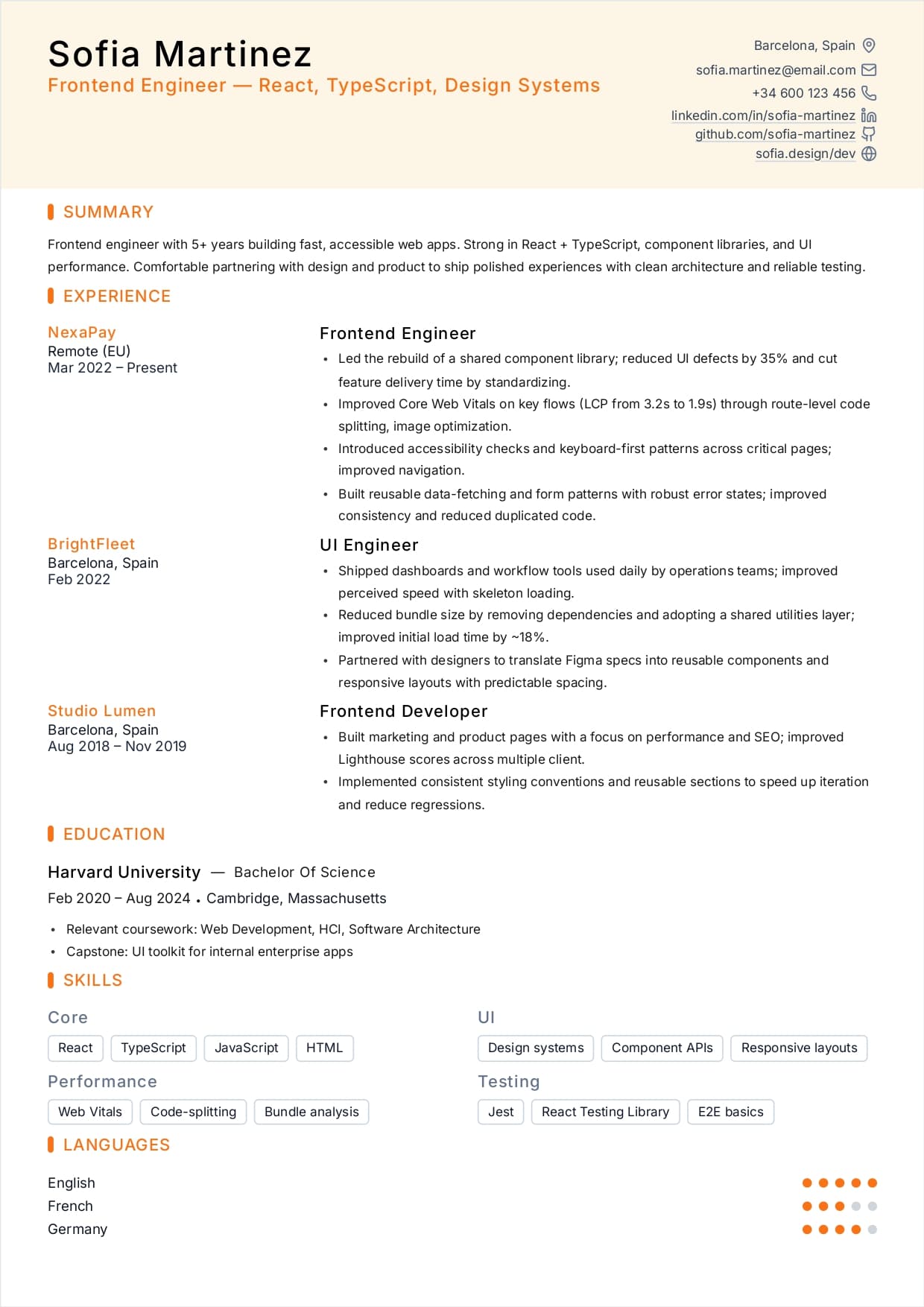
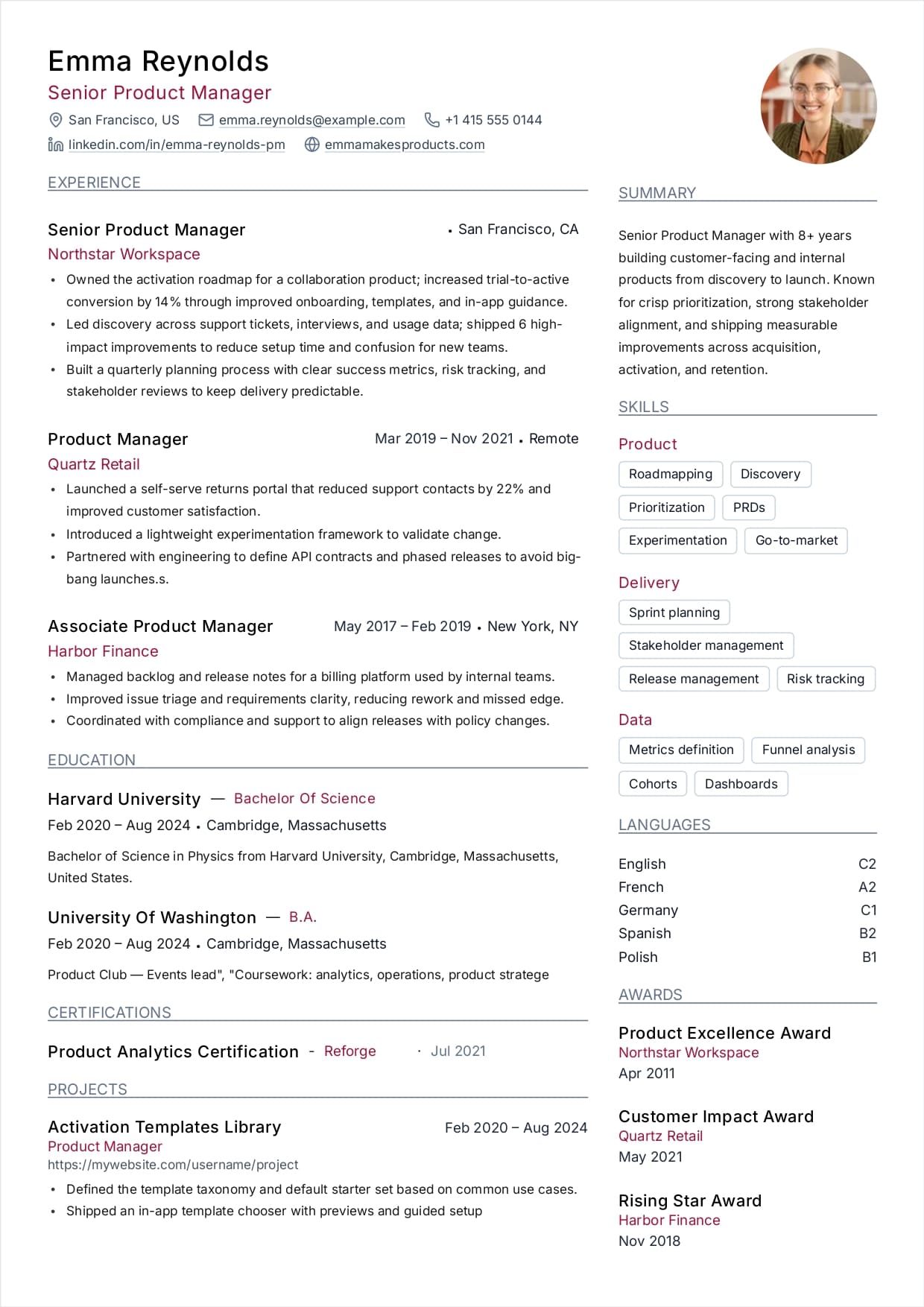
What Makes a Great Senior Fullstack Engineer Resume?
A strong Senior Fullstack Engineer resume proves that you can do more than work on both frontend and backend code. It should show that you can take product requirements and turn them into secure, performant, maintainable, and production-ready systems across the entire stack.
The best fullstack resumes communicate end-to-end ownership quickly. Hiring managers want to see UI architecture, API design, data modeling, auth, testing, deployment, and the business or engineering outcomes those decisions produced.
This page covers the top fullstack engineer skills, ATS keywords, bullet examples, project ideas, and resume writing strategies that help senior fullstack candidates stand out.
A Senior Fullstack Engineer resume wins when it shows complete workflow ownership, not just broad framework exposure.
Skills & Keywords
Top Senior Fullstack Engineer Skills to Include in 2026
Modern fullstack hiring still centers on a few consistent themes: strong UI architecture, reliable backend and API design, good data modeling, safe authentication, testing across layers, production observability, and delivery discipline. The strongest resumes group these skills around real responsibilities instead of dumping a giant list of tools.
For many product teams, React and Next.js remain central frontend signals because they sit at the boundary between interface delivery, server and client composition, data loading, caching, and deployment. On the backend side, fullstack candidates are often evaluated on APIs, auth, databases, background jobs, and how well they reason about product behavior under real production constraints.
Your skills section should reflect the reality of fullstack work: not just touching both sides, but shipping them together well.
- Frontend: React, Next.js, TypeScript, component architecture, design systems, accessibility, responsive design
- Rendering & Data: server and client components, SSR, caching, data fetching, route architecture
- Backend: Node.js, API design, validation, authentication, authorization, background jobs
- Data: PostgreSQL, schema design, migrations, query optimization, caching
- Testing: unit, integration, component, and end-to-end testing across full workflows
- Delivery: Docker, CI/CD, cloud deployment, environment configuration, rollback awareness
- Observability: logs, metrics, traces, release visibility, production debugging
- Performance: Core Web Vitals, API efficiency, bundle strategy, database and cache performance
The best fullstack skills sections show breadth, but the resume still needs bullets that prove depth.
ATS Keywords
Senior Fullstack Engineer Resume Keywords Recruiters and ATS Search For
Fullstack resumes often go through ATS filters before a human reads them, so the document needs to include the right keywords in the right places. Strong keyword use means natural inclusion of real role terms inside your Summary, Skills, Experience, and Projects sections.
The highest-value keywords are usually the ones that map directly to end-to-end delivery: Fullstack Engineer, React, Next.js, TypeScript, Node.js, PostgreSQL, authentication, CI/CD, Docker, testing, observability, and performance optimization.
Do not keyword-stuff the page. A smaller set of high-value phrases used in meaningful context is much better for both ATS and human readers.
- Core role terms: Fullstack Engineer, Full Stack Developer, Product Engineer, Software Engineer
- Frontend terms: React, Next.js, TypeScript, accessibility, Core Web Vitals, design systems
- Backend terms: Node.js, REST APIs, authentication, authorization, PostgreSQL, Redis
- Delivery terms: Docker, CI/CD, cloud deployment, environment configuration
- Quality terms: testing, end-to-end testing, observability, tracing, structured logs
- Outcome terms: performance optimization, feature ownership, release safety, product workflows
If you want ATS and Google relevance, use fullstack keywords in Summary, Skills, and at least one strong Experience bullet.
Frontend Architecture Matters on a Fullstack Resume
A fullstack engineer still needs credible frontend signal. That means more than building screens. It means showing that you can structure maintainable UI, use reusable components, handle state and data correctly, and deliver accessible and responsive product experiences.
React and Next.js are especially valuable resume topics because they now cover more than interface rendering alone. Fullstack product teams often expect engineers to understand server and client boundaries, route structure, data fetching, caching behavior, and deployment implications.
Strong frontend bullets on a fullstack resume usually mention component reuse, rendering or caching decisions, design-system consistency, form behavior, accessibility, or API-driven UI workflows.
A good fullstack resume shows that the frontend is engineered, not just styled.
Backend, APIs, and Data Modeling: The Other Half of the Story
The backend half of a fullstack role is usually where hiring managers test depth. They want to know whether you can support real product behavior through reliable APIs, validation, auth, database design, and backend workflows that do more than return basic JSON.
Strong backend signal includes API contracts, role-based access, server-side validation, database schema design, query improvements, caching, and any asynchronous work required to support product features cleanly.
Your resume should make it clear that you understand the product consequences of backend decisions: consistency, latency, permissions, retries, and data correctness.
- REST APIs used by web clients or internal product tools
- Validation and business rule enforcement on the server
- Authentication and authorization across routes and APIs
- PostgreSQL schema design, migrations, and query optimization
- Caching and background jobs when synchronous requests are not enough
A fullstack resume gets stronger when it proves you can support product behavior safely across both UI and backend layers.
What Fullstack Hiring Teams Really Want: End-to-End Workflow Ownership
The highest-value fullstack bullets usually describe a user workflow from start to finish. Examples include onboarding, billing, document editing, notifications, checkout, admin moderation, dashboards, or account management. These are strong signals because they show that you can think across user experience, backend behavior, and operational consequences.
That is why fullstack resumes often improve dramatically when they describe how a single feature touched UI state, APIs, database persistence, authentication, validation, testing, and deployment. This reads much stronger than splitting each layer into separate vague bullets.
If you owned a workflow end to end, make that ownership unmistakable.
Fullstack hiring is often less about knowing both sides in theory and more about proving you can ship a whole user journey.
Testing and Quality Across the Stack
Testing is one of the clearest signs that a fullstack engineer understands product quality beyond happy-path code. Strong fullstack resumes mention the kinds of tests that match real systems: component tests for UI behavior, integration tests for APIs and databases, and end-to-end tests for important product workflows.
This matters because many fullstack failures happen at the boundaries between systems. A form passes in the browser but fails against API validation. A backend change breaks a reporting screen. An auth rule blocks a route only in production. Testing across these boundaries is valuable signal.
You do not need a giant testing section. Even one or two strong bullets about workflow protection, reduced regressions, or safer releases can raise your resume level noticeably.
Good fullstack testing signal shows you protect workflows, not just functions.
Observability and Production Debugging Across Layers
Fullstack engineers increasingly need to debug problems that cross browser state, network requests, APIs, databases, and infrastructure. That is why observability is no longer just a backend or SRE concern. It is a real fullstack skill when your role includes production ownership.
Strong fullstack resumes mention logs, metrics, traces, release visibility, and the ability to connect user-facing failures to backend or deployment causes. If you improved monitoring, added tracing, structured logs more clearly, or shortened time to diagnose production issues, that is high-value signal.
The strongest observability bullets describe what became easier to detect, debug, or recover.
The real signal is not the tool name. It is what became easier to understand or fix in production because of your work.
Delivery, Docker, and Production Readiness
Many fullstack roles now include delivery awareness. Teams increasingly expect engineers to understand how code is built, tested, configured, deployed, and monitored once it leaves local development. That includes Docker, CI/CD, environment configuration, rollout safety, and cloud deployment basics.
You do not need deep platform-engineer credentials to include this work. But if you containerized services, improved release workflows, standardized environments, or made deployments safer, that belongs on the resume because it proves you can help ship real product systems.
The strongest delivery bullets connect process improvements to outcomes such as fewer manual steps, safer releases, faster rollback, or better consistency across environments.
- Dockerized application services or local environments
- CI/CD checks for linting, tests, builds, and deployment safety
- Cloud deployment on Vercel, AWS, Azure, GCP, or similar platforms
- Environment-specific configuration and secrets handling
- Release confidence, rollback awareness, and production readiness
Shipping code is not the finish line. Strong fullstack engineers also care about how safely that code reaches production.
How to Write the Experience Section for a Senior Fullstack Engineer Resume
Your experience section should read like product and systems ownership, not a mixed list of frontend and backend tasks. Focus on complete workflows, architecture decisions, risks reduced, and measurable user or engineering outcomes.
A strong fullstack bullet usually follows this pattern: Action + end-to-end feature or system + stack context + measurable product or engineering outcome.
Example: "Owned an end-to-end account-management workflow across React UI, authenticated Node.js APIs, and PostgreSQL, improving customer self-service while reducing manual support operations."
For senior fullstack resumes, 4 to 6 strong bullets that show ownership and outcomes are usually better than long responsibility lists.
- Lead with the workflow or system you owned
- Name the stack when it helps recruiters scan quickly
- Add one architecture or quality dimension such as auth, performance, testing, or deployment
- Show a business or engineering result for each major bullet
- Use strong verbs: built, designed, standardized, optimized, secured, automated, shipped
Project Ideas
Projects That Strengthen a Senior Fullstack Resume
Projects can still strengthen a senior fullstack resume when they demonstrate architecture and product depth clearly. The best projects are not just clones. They feel like small production systems with real workflows, auth, data persistence, testing, deployment, and clear technical tradeoffs.
Good fullstack project themes include SaaS dashboards, collaborative editors, internal admin platforms, e-commerce systems, booking flows, or AI-assisted product features that require UI, API, and data decisions across the full stack.
Treat projects like case studies. Describe the problem, the chosen architecture, the stack, the major workflow, and the reasons behind your design decisions.
- Collaborative SaaS dashboard with auth, role-based access, and persistent data
- Document editor or workflow product with API-backed state and autosave
- Admin system with secure roles, audit history, and API-driven reporting
- E-commerce or billing workflow with validation, retries, and integration safety
- Reference architecture documentation with diagrams and deployment notes
A real end-to-end product project is far stronger than a disconnected stack demo.
Making a Senior Fullstack Engineer Resume ATS-Friendly
Most larger hiring pipelines still use ATS software before a recruiter or engineering manager reads the resume. If your strongest experience is buried in a hard-to-parse layout, the system may not surface the right signals clearly.
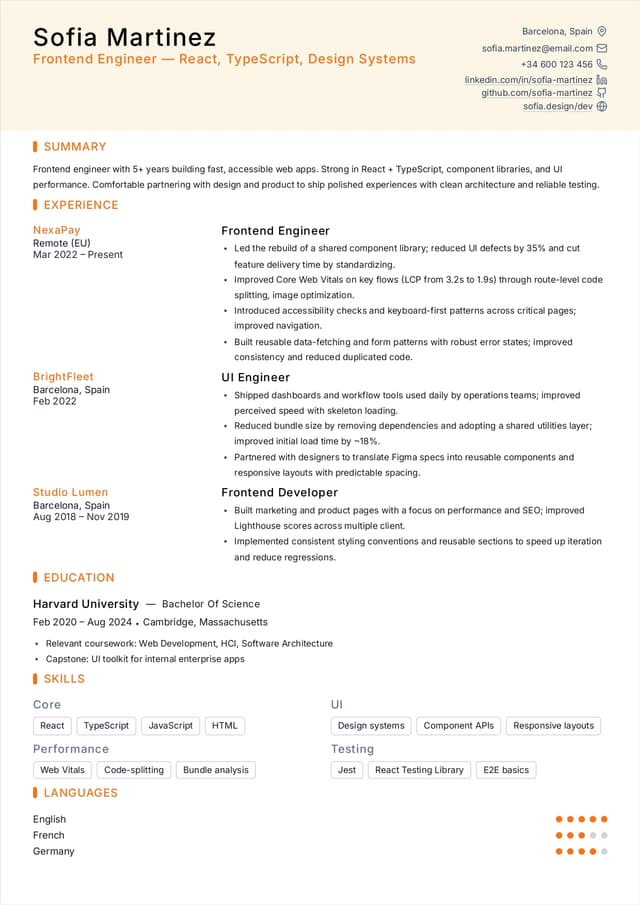
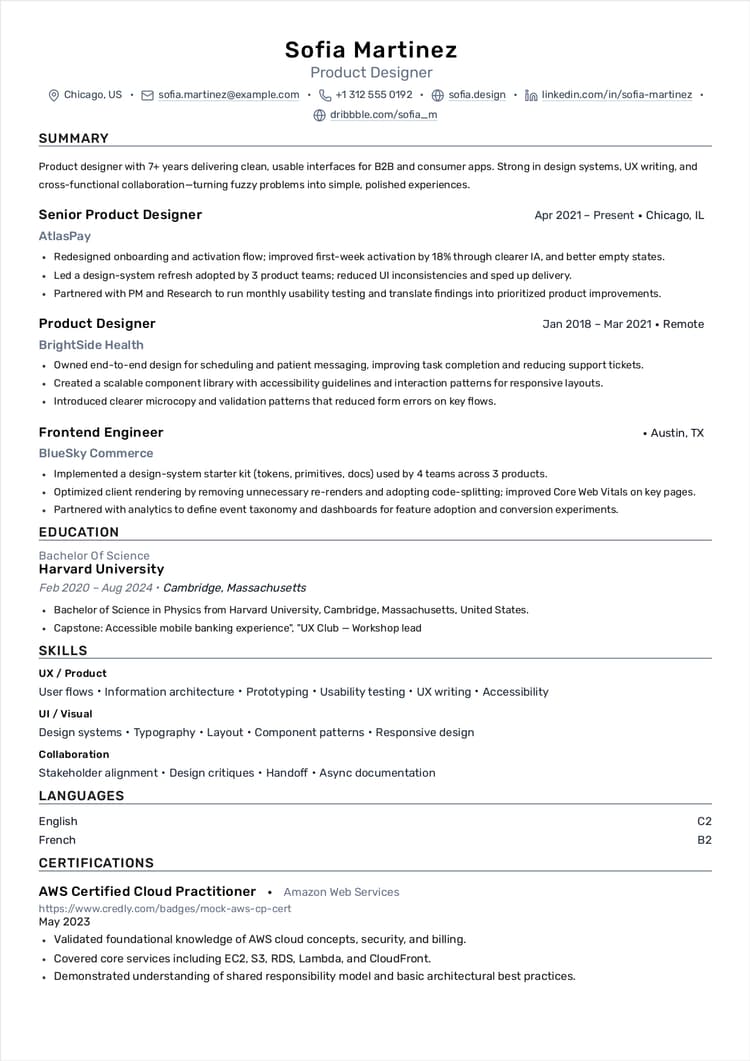
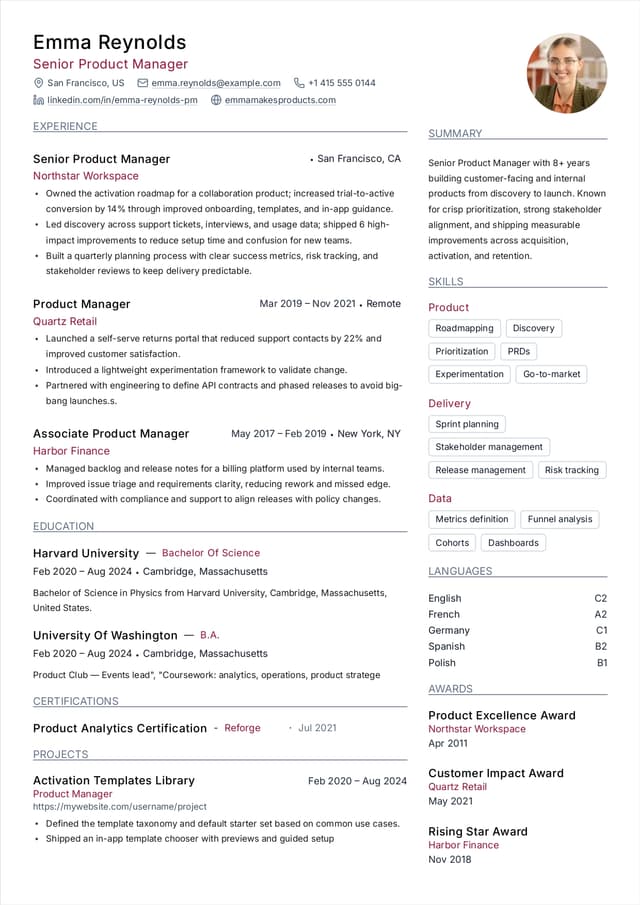
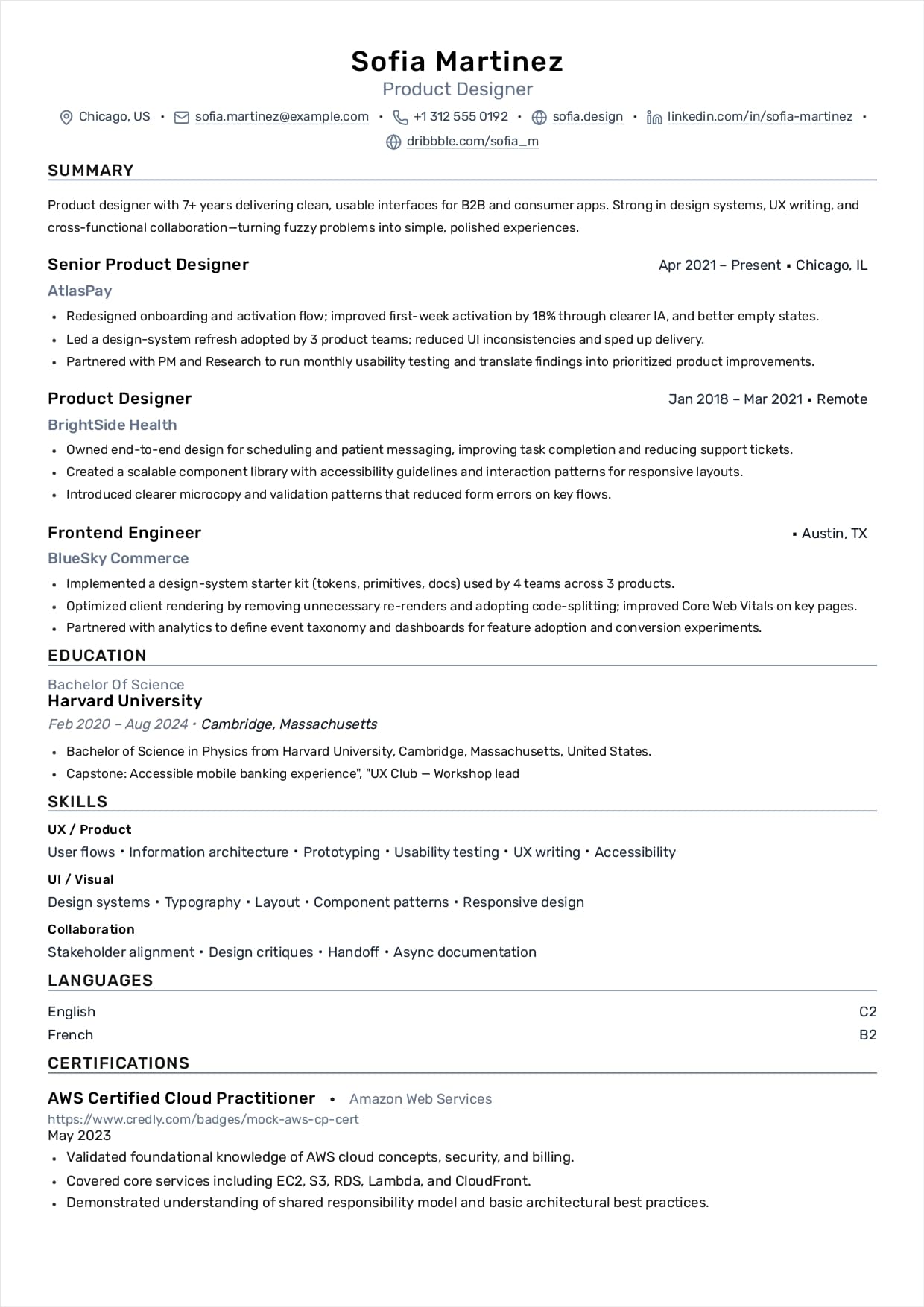
Use a simple one-column layout with standard headings, readable dates, and plain text for your stack, tools, and architecture topics. Avoid tables, text boxes, heavy sidebars, and visual skill bars that replace real words.
For fullstack roles, ATS readability matters because the resume often needs to surface high-value terms like Fullstack Engineer, React, Next.js, Node.js, PostgreSQL, testing, Docker, CI/CD, and observability clearly.
- Use standard headings: Summary, Experience, Skills, Projects, Education
- Include the exact target title when accurate: Fullstack Engineer, Full Stack Developer, Product Engineer
- Spell out key acronyms once where useful: CI/CD, RBAC, SSR
- Avoid graphics that replace actual skill text
- Save the file with a clear name like FirstName-LastName-Fullstack-Engineer-Resume.pdf
Avoid These
Common Senior Fullstack Resume Mistakes
Most Senior Fullstack Engineer resumes fail for predictable reasons. They either read like a broad stack inventory with no ownership, or they separate frontend and backend work so much that the reader never sees a full workflow delivered.
Use this checklist before you publish or apply.
- Listing too many tools without proving depth or ownership
- Describing frontend and backend work separately instead of as complete product workflows
- Ignoring testing, deployment, or production debugging completely
- Using vague bullets like 'worked on features' or 'built APIs'
- Failing to show your strongest side of the stack clearly
- Overdesigning the resume and weakening ATS readability
A strong Senior Fullstack Engineer resume should read like someone trusted to take product requirements from interface to production.
Writing a Strong Senior Fullstack Engineer Summary
Your summary is prime real estate because recruiters usually read it first. In two or three sentences, they should understand your fullstack scope, strongest stack, and one proof point tied to product delivery or engineering quality.
Avoid filler like passionate, results-driven, or team player. A better summary names your main frontend and backend technologies, your strongest architecture or delivery strengths, and the kind of product systems you build.
A strong fullstack summary might mention React and Next.js on the frontend, Node.js and PostgreSQL on the backend, and one major quality signal such as performance, testing, observability, or end-to-end ownership.
Senior Fullstack Engineer building end-to-end product systems with React, Next.js, Node.js, and PostgreSQL. Experienced in shipping complete user workflows across UI, APIs, auth, testing, and deployment, with a strong focus on maintainability, performance, and production quality.