
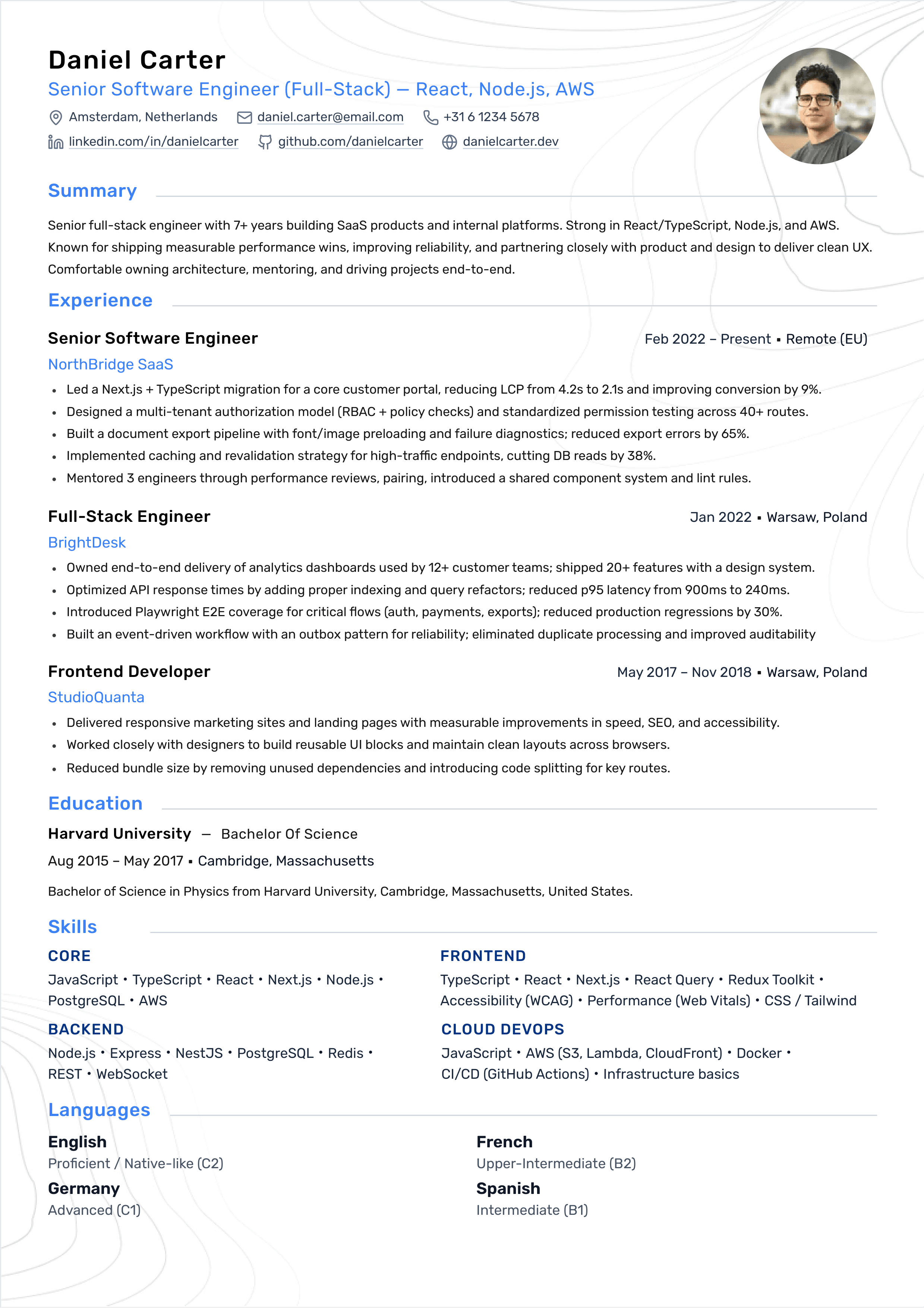
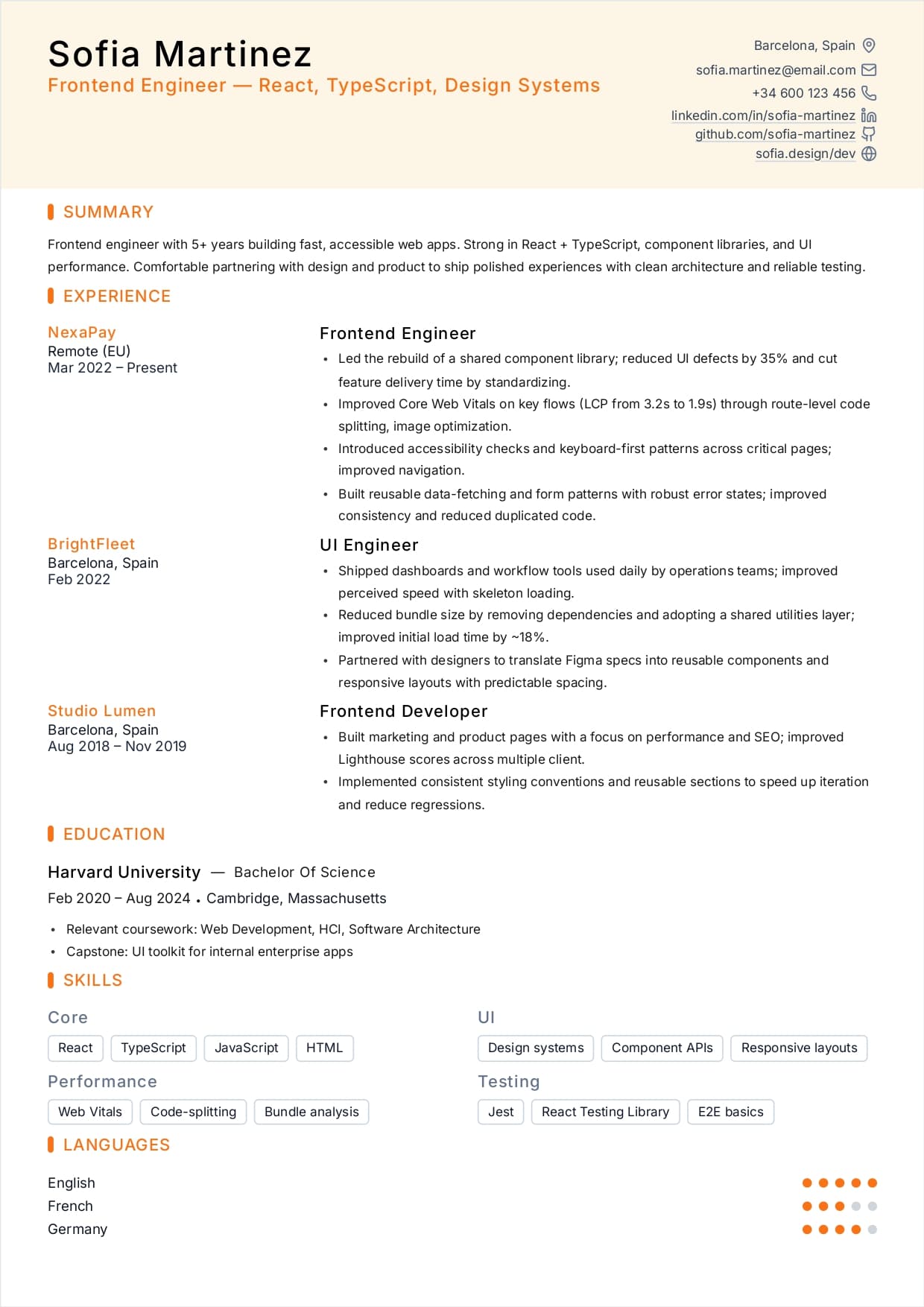
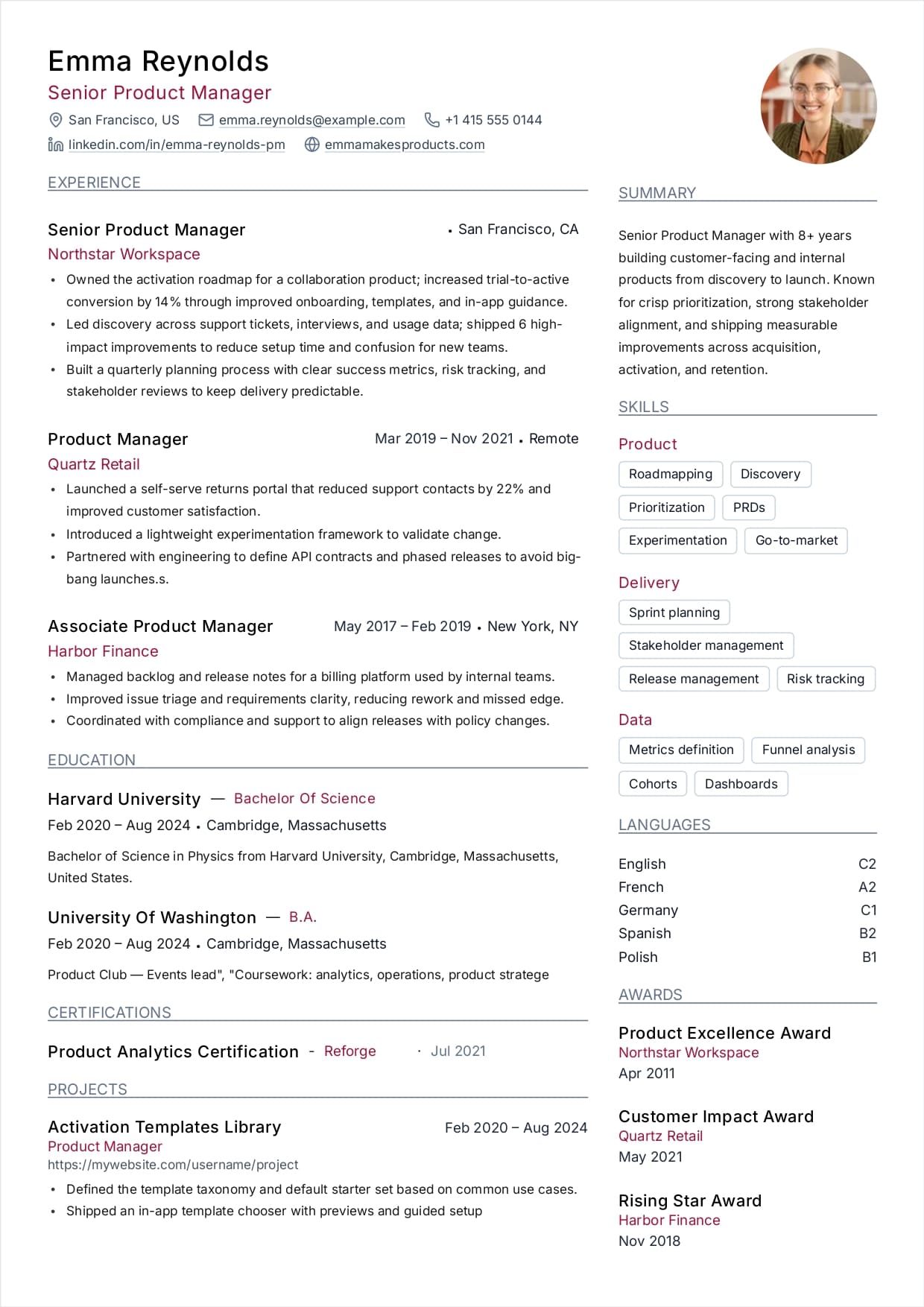
What Makes a Great Mid-Level Fullstack Engineer Resume?
A strong Mid-Level Fullstack Engineer resume should prove that you can do more than contribute to both frontend and backend tickets. It should show that you can take ownership of real product workflows, make sound implementation decisions across the stack, and ship features that feel production-ready rather than incomplete or fragile.
The best mid-level fullstack resumes communicate independence, reliability, and delivery scope quickly. Recruiters and hiring managers want to see that you can handle modern UI work, backend feature logic, database-backed flows, testing, and practical deployment concerns without being limited to one part of the system.
This page covers the top mid-level fullstack engineer skills, ATS keywords, project ideas, and resume-writing patterns that help growth-stage fullstack candidates stand out.
A mid-level fullstack resume wins when it shows ownership of real product workflows, not just broad tool exposure.
Skills & Keywords
Top Mid-Level Fullstack Engineer Skills to Include in 2026
Modern mid-level fullstack hiring still centers on a few core signals: strong UI development, reliable API and backend work, database understanding, testing, performance awareness, and the ability to deliver complete features with less supervision. At this level, companies expect more than curiosity. They expect consistent execution across real product surfaces.
React remains one of the strongest frontend signals because it is built around reusable components and Hooks, while Next.js remains highly relevant because its App Router model brings together layouts, navigation, server and client components, and modern rendering patterns in one fullstack-friendly framework. Node.js is still a common backend foundation for fullstack roles because it supports API development and product logic in the same JavaScript and TypeScript ecosystem used on the frontend. TypeScript also remains a strong signal because it gives teams a structured type system for building and maintaining larger codebases.
Your skills section should reflect what mid-level fullstack work actually looks like: shipping complete user flows, not simply touching multiple technologies.
- Frontend: React, Next.js, TypeScript, responsive UI, reusable components, form handling, accessibility
- Rendering & Routing: layouts, navigation, server and client components, data fetching, caching awareness
- Backend: Node.js, REST APIs, validation, authentication, authorization, backend feature development
- Data: PostgreSQL, schema design, migrations, CRUD workflows, query and data integrity awareness
- Testing: unit tests, component tests, integration tests, end-to-end coverage for key workflows
- Delivery: Git, Docker, CI/CD basics, deployment awareness, environment configuration
- Quality: accessibility, performance, debugging, structured logging, clean code organization
The best mid-level skills sections balance breadth with believable depth.
ATS Keywords
Mid-Level Fullstack Engineer Resume Keywords Recruiters and ATS Search For
Mid-level resumes still pass through ATS systems before a human reads them, so the document needs the right keywords in the right places. Strong keyword use means putting role and stack terms naturally inside your Summary, Skills, Projects, and Experience sections instead of dumping them in one long list.
The highest-value keywords for mid-level fullstack roles usually map to real end-to-end delivery: Fullstack Engineer, Full Stack Developer, React, Next.js, TypeScript, Node.js, REST APIs, PostgreSQL, testing, authentication, performance, and deployment.
Do not stuff every library or buzzword you have touched into the page. A smaller set of accurate role and stack keywords used in meaningful context is much stronger for both ATS systems and human readers.
- Core role terms: Mid-Level Fullstack Engineer, Full Stack Developer, Software Engineer, Product Engineer
- Frontend terms: React, Next.js, TypeScript, responsive design, component-based UI, accessibility
- Backend terms: Node.js, REST APIs, authentication, authorization, validation, PostgreSQL
- Quality terms: testing, debugging, performance optimization, Core Web Vitals, structured logging
- Delivery terms: Git, Docker, CI/CD, deployment, cloud basics
If you want ATS and Google relevance, use your core fullstack keywords in the summary, skills, and at least one strong experience or project bullet.
Frontend Signal Still Matters on a Mid-Level Fullstack Resume
A mid-level fullstack engineer still needs strong frontend signal. That means more than styling pages. It means showing that you can design reusable UI patterns, handle async data states, structure routes and layouts well, and create user experiences that feel consistent, accessible, and maintainable under real product conditions.
React remains a high-value resume keyword because it is centered on reusable components and Hooks, which are still core to modern frontend architecture. Next.js matters more than ever because many product teams now expect fullstack engineers to understand server and client component boundaries, layouts, route structure, rendering choices, and caching behavior as part of everyday delivery.
Strong mid-level frontend bullets mention reusable component systems, route or layout design, form-heavy workflows, API-driven UI states, accessibility, or feature work tied to real product outcomes.
A good mid-level fullstack resume shows that the frontend is engineered for real product use, not just assembled screen by screen.
Backend, APIs, and Database Work You Should Show at Mid-Level
The backend part of a mid-level fullstack role is where hiring managers look for technical maturity. They want evidence that you can work confidently with API design, backend validation, auth, database-backed product logic, and feature implementation that goes beyond the browser.
You do not need to sound like a distributed-systems specialist. But you should show that you have built real backend endpoints, connected them to meaningful data models, and supported end-to-end product features with validation, authentication, persistence, and reasonable reliability.
Mid-level backend signal becomes stronger when it includes schema decisions, migration awareness, query tuning basics, caching awareness, or backend workflows tied directly to product outcomes rather than generic CRUD phrasing.
- REST APIs used by product interfaces or internal tools
- Backend validation and request handling
- Authentication, protected routes, and authorization awareness
- PostgreSQL-backed persistence and workflow modeling
- Schema changes and migrations
- Basic query performance and indexing awareness
- Structured logging or debugging support for backend workflows
At mid-level, the goal is proving you can support real product behavior safely across frontend, backend, and data.
What Mid-Level Fullstack Hiring Teams Really Want: Complete Workflow Ownership
The strongest mid-level fullstack bullets usually describe a user workflow from start to finish: onboarding, billing, account settings, dashboard reporting, document editing, booking, admin tooling, or collaboration features. These are stronger than disconnected frontend and backend bullets because they show how you think across the full product experience.
That is why a strong mid-level resume often improves when it shows how a single feature touched UI state, API design, validation, authentication, data persistence, testing, and deployment. This reads far better than a stack list with no clear delivery story.
If you owned a workflow end to end, make that unmistakable. That is one of the clearest ways to differentiate yourself from junior-level candidates.
Fullstack hiring is often about proving you can ship one complete user journey with solid engineering judgment.
Project Strategy
Projects Still Matter on a Mid-Level Fullstack Resume
Projects still matter at mid-level because they can prove architecture and product depth more clearly than a generic experience bullet. A strong project shows that you can plan a workflow, build the interface, connect backend logic, persist data, test the system, and ship something that feels credible.
The best projects are not just clones. They should feel like small real products: dashboards, document editors, booking systems, admin tools, collaboration apps, e-commerce flows, or other systems with real state, permissions, and user journeys.
Treat each project like experience. Explain the problem, the stack, the workflow, and what engineering choices made the system more reliable, maintainable, or usable.
- Show 2 to 3 serious projects, not a long list of weak demos
- Prefer deployed apps over repo-only examples
- Include frontend, backend, data, auth, and testing scope clearly
- Mention performance, deployment, or architecture choices when relevant
- Link GitHub and live demo when available
At mid-level, a strong end-to-end project can reinforce the same ownership signal that companies want to see in production work.
Project Ideas
Best Project Ideas for a Mid-Level Fullstack Resume
A good mid-level fullstack project should let you prove frontend structure, backend logic, data modeling, auth, testing, and product thinking in one system. The best ideas are the ones that force you to manage real state and workflow complexity rather than static pages and simple forms.
Choose projects that let you show routing, permissions, data persistence, testing, and a few real engineering decisions around performance, validation, maintainability, or deployment.
- Team dashboard with auth, roles, activity history, and reporting
- Document editor or notes workspace with autosave and restore behavior
- Booking or scheduling tool with availability, validation, and notifications
- Admin panel with protected routes, audit history, and PostgreSQL-backed reporting
- Simple SaaS billing or subscription flow with API-driven account pages
A smaller but complete project with strong engineering choices is stronger than a bigger unfinished system.
Testing and Quality Across the Stack
Testing is one of the clearest ways to look production-ready as a mid-level fullstack engineer. Companies may not expect advanced testing leadership from every mid-level candidate, but they do notice when you protect real workflows with thoughtful tests and reduce regression risk across releases.
The most useful signal comes from matching the test to the problem: component tests for UI behavior, integration tests for APIs and forms, and end-to-end tests for user journeys like sign-up, login, billing, or workflow creation.
Even one or two strong bullets about reducing regressions, protecting important flows, or improving release confidence can strengthen a mid-level fullstack resume significantly.
Good mid-level testing signal shows that you care about product quality, not just implementation speed.
Delivery, Deployment, and Production Awareness
A mid-level fullstack resume looks stronger when it shows practical delivery awareness. That does not mean you need deep platform engineering skills. It means showing that you understand how your app moves from local development to staging and production with reasonable safety and consistency.
This can include Git-based workflow, Docker, environment variables, CI checks, preview deployments, and cloud deployment basics. These details matter because they make your work feel product-ready rather than local-only.
If you helped deploy your project, standardize environments, or improve delivery safety, include it.
- Git and pull request workflow
- Environment-specific configuration handling
- Docker for local consistency or deployment
- CI/CD basics for tests, linting, or builds
- Deployment on Vercel, Render, Railway, AWS, or similar platforms
Shipping a project makes it credible. Shipping it reliably makes it mid-level.
How to Write the Experience Section for a Mid-Level Fullstack Resume
Your experience section should read like feature ownership and delivery reliability, not generic task lists. Focus on what you built, how it worked across the stack, and what result it created for users or the team.
A strong mid-level fullstack bullet usually follows this pattern: Action + feature or workflow + stack context + product or engineering outcome.
Example: "Owned an authenticated dashboard workflow in React and Node.js with PostgreSQL-backed project data, giving users a faster way to manage account activity while reducing manual support steps."
If you do not have a long professional history yet, strong project and contract work can still be written with the same structure.
- Lead with the feature or workflow you owned
- Name the stack when it helps scanning
- Add one quality signal such as testing, auth, or deployment
- Show an outcome: better UX, cleaner workflow, fewer errors, stronger reliability, or faster delivery
- Use strong verbs: built, shipped, integrated, improved, implemented, validated, optimized
Making a Mid-Level Fullstack Resume ATS-Friendly
Most larger hiring pipelines still use ATS software before a human reviews the resume. If your strongest projects, experience, or stack terms are hidden inside a hard-to-parse layout, you can lose visibility before anyone sees your work.
Use a simple one-column layout with standard headings, readable dates, and plain text for technologies and skills. Avoid tables, text boxes, graphics, and visual skill bars that make content harder to extract.
For mid-level fullstack roles, ATS readability matters because the resume often needs to surface terms like Fullstack Engineer, React, Next.js, Node.js, PostgreSQL, testing, performance, and deployment clearly.
- Use standard headings: Summary, Experience, Projects, Skills, Education
- Include the exact target title when accurate
- Spell out important acronyms once where useful: CI/CD, SSR, CRUD
- Avoid graphics that replace actual skill text
- Save the file with a clear name like FirstName-LastName-Fullstack-Engineer-Resume.pdf
Avoid These
Common Mid-Level Fullstack Resume Mistakes
Most mid-level fullstack resumes fail for predictable reasons. They either list too many tools with too little proof, or they talk about project and experience work in a vague way that hides what the candidate actually owned.
Use this checklist before you publish or apply.
- Listing too many frameworks and libraries without proving depth or ownership
- Showing frontend and backend separately instead of as one real workflow
- Using vague bullets like 'worked on features' or 'built APIs'
- Skipping testing, auth, deployment, or database details completely
- Underselling project ownership and product impact
- Overdesigning the resume and weakening ATS readability
A strong mid-level fullstack resume should read like someone trusted to ship meaningful product features across the stack.
Writing a Strong Mid-Level Fullstack Engineer Summary
Your summary is prime real estate because recruiters usually read it first. In two or three sentences, they should understand your stack, the kind of product work you can do, and one proof point that makes you worth interviewing.
Avoid filler like passionate, results-driven, or team player. A better summary names your main frontend and backend technologies, your strongest workflow or project signal, and the kind of role you want.
A strong mid-level summary often mentions React or Next.js on the frontend, Node.js and PostgreSQL on the backend, and one quality signal such as end-to-end feature ownership, testing, performance, or deployed SaaS-style workflows.
Mid-Level Fullstack Engineer building end-to-end web products with React, Next.js, TypeScript, Node.js, and PostgreSQL. Experienced in shipping real product workflows across UI, APIs, auth, and data, with a strong focus on maintainability, usability, testing, and production-ready delivery.