

Ghost Jobs Are Wasting Candidates’ Time
You find a role that looks perfect. The title matches your background. The salary sounds plausible. The company looks legitimate. You spend hours tailoring your resume, rewriting your summary, maybe even writing a custom cover letter. Then nothing happens. Or worse: the same role appears again next week, then again next month.
This is the reality of ghost jobs: job listings that are not tied to an active, near-term hiring decision. Sometimes the role was already filled. Sometimes the company is only collecting resumes for a future pipeline. Sometimes the listing exists to create the appearance of growth. And sometimes the process is so disorganized that a stale or misleading posting stays live long after it should have been removed.
For job seekers, the result is the same: lost time, false hope, and a harder search process. That is why understanding ghost jobs is now a core part of modern job search strategy.
This guide breaks down why companies post fake or inactive job ads, what patterns to watch for, how to protect your time, and how to build a faster application workflow with Roleframe so you can respond strategically instead of starting from zero every time.
The biggest cost of a ghost job is not rejection. It is the hours you invest in an opportunity that was never truly open.
Key Takeaways
- Ghost jobs are real. Some employers admit posting listings without immediate intent to hire.
- Not every stale job ad is a scam, but many are inactive, pipeline-driven, or poorly maintained.
- Common motives include resume collection, growth signaling, investor optics, internal-policy posting requirements, and keeping options open in an uncertain market.
- Candidates should prioritize recent listings, verify openings on the company website, and be cautious with long or exploitative take-home tasks.
- A smart response is not applying less. It is applying more selectively and faster with tailored resume variants.
- Roleframe helps by making resume branching, job-specific variations, and rapid editing much easier, so you can adapt without wasting another five hours per application.
What Is a Ghost Job?
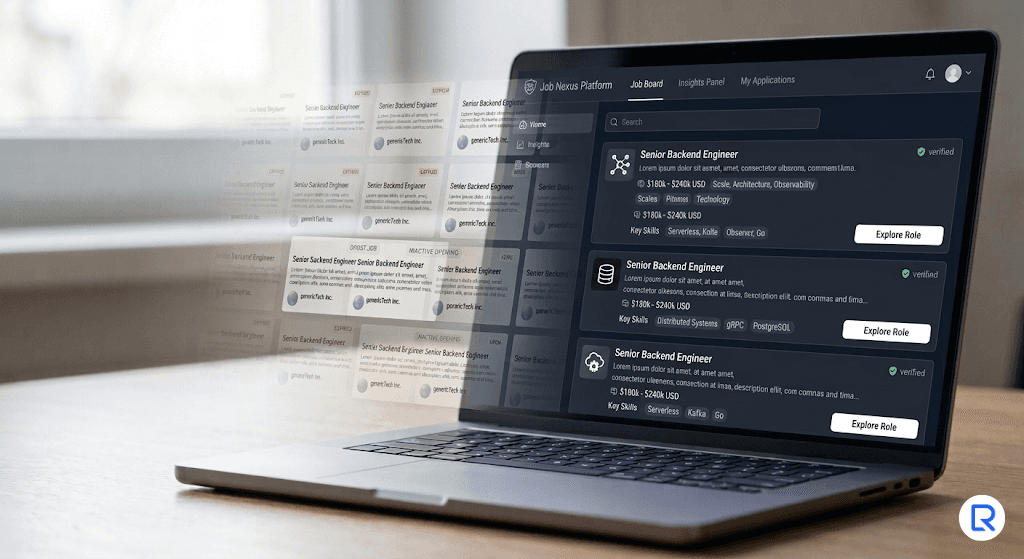
A ghost job is a job posting that looks active but is not tied to a genuine, current hiring intention. That does not always mean it is a scam in the criminal sense. Sometimes it is an employer keeping a posting live for future candidates. Sometimes it is a role that exists on paper but has no approved budget. Sometimes it is a compliance or process artifact where the company already has a likely internal candidate but still posts externally.
The important distinction is this: the posting may be real in appearance, but not real in opportunity. The employer may not be ready to hire now, may not intend to hire from the external market, or may not plan to hire at all unless conditions change.
That is why ghost jobs sit in a gray zone. They are not always outright fraud, but they can still be misleading and harmful to applicants.
A ghost job is not just a fake listing. It is any listing that consumes candidate effort without a live hiring path behind it.
Why This Matters More in 2026
In a slower, more selective hiring market, job seekers already face longer cycles, more competition, and heavier screening. That makes misleading listings more damaging. When real openings are scarcer, every wasted application matters more.
At the same time, candidates are now applying through high-volume channels like LinkedIn, Indeed, and company ATS pages, where it is easy for old listings, reposted roles, and pipeline ads to blend in with real openings. The result is a search environment where quantity can trick you into believing opportunity is stronger than it really is.
This is exactly why job seekers need better filters, better application systems, and better resume workflows. The old habit of rebuilding your resume from scratch for every posting is too slow for this market.
When the market gets tighter, misleading job ads become more expensive for candidates.
Why Companies Post Fake Job Ads
The reasons vary, and not all of them are equally malicious. But from the candidate side, the effect is the same: extra work with little or no chance of conversion.
Some companies are building a future pipeline. They want resumes on file so they can move quickly later. Others want to signal growth to customers, investors, lenders, or current employees. Some want to benchmark salaries, test market response, or see how easy it would be to replace current staff. Others simply leave old listings live because nobody closes the loop properly inside the hiring process.
Then there is the most frustrating version: the role is technically posted, but there is already a preferred internal candidate, making the external process mostly performative.
- Pipeline building for future hiring needs
- Projecting growth or business momentum
- Collecting market data on talent, pay, or availability
- Keeping a fallback pool in case budgets reopen
- Maintaining internal or external posting policies
- Leaving stale jobs online because of bad process hygiene
- Testing demand without committing to headcount
"Building a Pipeline" Sounds Strategic. For Candidates, It Often Means "Not Hiring Yet."
Recruiting teams often describe these listings as talent pipeline posts. In HR language, that means building a pool of potentially relevant candidates before a role is approved or before hiring becomes urgent. From the employer side, that can sound efficient. From the candidate side, it often means you are being asked to invest time into a role with no immediate decision behind it.
Pipeline building is one of the main reasons ghost jobs persist. The posting is not always fake in the sense that the company would never hire that profile. But it can still be fake in the sense that there is no real opening right now.
That is why candidates should care less about what the company calls the listing and more about whether there is a live requisition, budget, and timeline.
A future possibility is not the same thing as an open job.
Sometimes the Job Is Posted, but the Company Already Knows Who They Want

One reason candidates feel misled is that some roles are posted even when an internal candidate is heavily favored. In many organizations, posting rules exist to show consistency, fairness, or compliance with internal policy. That does not always mean the process is dishonest. But it can mean the external market is participating in a competition that was never truly level.
This is one of the hardest ghost-job dynamics to detect from the outside. The listing may look normal. The recruiter may even conduct initial screening. But if the company is mostly validating an internal decision, your probability of success may be low from the start.
This is another reason to avoid over-investing too early. A focused, strong application makes sense. A six-hour unpaid project before there is evidence of real mutual interest often does not.
A posted role is not proof of an open race. Sometimes it is paperwork around a decision that is already leaning internal.
Some Companies Use Job Ads as Growth Marketing
Job postings do not only speak to candidates. They also send signals to customers, competitors, investors, future hires, and current staff. A company with many visible openings can look busy, healthy, and expanding even when actual hiring is slow.
That makes hiring pages a brand surface, not just a recruiting tool. If a firm wants to appear strong, leaving jobs visible can help create that impression. The posting becomes part of employer branding and business signaling.
This is one reason ghost jobs persist even when they generate candidate frustration. The company may be optimizing for reputation, momentum, or optics rather than candidate experience.
A careers page can function like marketing. That is part of the problem.
Some Listings Are Really About Data Collection
A resume is not just a document. It is a package of personal data, career history, location, salary signals, and market intelligence. Even when a company never hires, an application can still deliver value to the organization.
That value might include contact details for future outreach, salary expectations, competitor intelligence, and a searchable talent database. In the worst cases, the process becomes a form of one-sided extraction: candidates hand over effort and information in exchange for an opportunity that never truly existed.
This is why ghost jobs are not merely annoying. They can raise privacy and fairness concerns too, especially when candidates are asked to submit detailed materials, assessments, or strategy work.
If the company gets usable data while you get no real shot at a role, the exchange is broken.
Why the Same Job Keeps Reappearing
One of the clearest signals candidates notice is the endless repost. The same title, same location, same company, same responsibilities, appearing again and again. Reposts do not automatically mean the role is fake. Sometimes a search genuinely failed, the hire backed out, or the company is expanding the search window.
But repeated reposting should change how much time you invest. If a role has been circling for months, there may be a mismatch between the company’s stated intent and its actual hiring readiness. The listing may be too broad, too underfunded, too slow-moving, or simply not active in a practical sense.
Candidates should treat reposted jobs as higher-risk opportunities. Apply only if the fit is strong and the effort is low.
- Possible real reason: the company is struggling to find the right fit
- Possible real reason: the chosen candidate dropped out
- Possible weak signal: the listing is stale or poorly maintained
- Possible weak signal: the role is pipeline-only or budget-frozen
- Best candidate response: apply selectively and avoid heavy custom work until a recruiter confirms momentum
When "Interview Process" Starts Looking Like Free Labor

Not every fake job is just a stale listing. Sometimes the problem appears later in the process. A candidate is asked for a detailed strategy, mock campaign, product teardown, design system, or writing sample that looks suspiciously close to real business work.
A reasonable skills assessment should test judgment, communication, and craft without asking candidates to produce unpaid deliverables that the company could directly use. When the assignment becomes too large, too specific, or too close to live business needs, candidates should slow down and reassess.
This is especially important in freelance and contract markets, where the line between evaluation and extraction can get blurry fast.
A good interview task evaluates skill. A bad one outsources real work for free.
How to Spot a Ghost Job Before You Waste Hours
No single clue proves a listing is fake. But patterns matter. The more warning signs you see, the more careful you should be with your time.
A smart candidate does not just ask, "Do I qualify?" They also ask, "Does this job look operationally real?"
- The job has been posted for 30+ days with no meaningful changes
- The same role is repeatedly reposted every few weeks
- The job appears on LinkedIn or Indeed but not on the company careers page
- The description is vague, generic, or oddly broad for a supposedly urgent role
- There is no clear hiring manager, team context, or business reason for the role
- The recruiter cannot explain timeline, headcount approval, or next steps
- The process asks for major unpaid work too early
- The company pushes you to join newsletters, talent communities, or social channels before any real screening
- The posting looks active, but employees online say there is a hiring freeze
Your goal is not to detect every ghost job with certainty. It is to avoid overspending time on low-signal opportunities.
Always Check the Company Website
One of the simplest filters is also one of the best: compare the job board listing with the company careers page. If the role exists on LinkedIn but not on the company site, treat it cautiously. If the dates do not match, treat it cautiously. If the company site shows the role as closed while the board still shows it as open, move on.
Third-party job boards do not always reflect real-time hiring status. Sync delays, reposting behavior, and manual process gaps can keep stale roles visible longer than candidates expect.
The company site is not perfect either, but it is usually the better source of truth.
If the company is serious about hiring, the role should usually exist on its own careers page.
The Wrong Response Is Giving Every Job Five Hours
One reason ghost jobs hurt so much is that many candidates still treat every plausible listing like a bespoke project. They rewrite the whole resume, rebuild bullets, rewrite the summary, rewrite the skills list, maybe write a custom cover letter, then repeat the entire process the next day for another role.
That approach is too slow for this market. You do need targeting. But you do not need to rebuild everything from scratch every time. What you need is a system: a strong base resume, multiple job-specific variants, fast editing, and a way to tailor without losing your previous work.
This is exactly where a modern resume builder should help.
The fix for ghost jobs is not mass applying blindly. It is reducing the cost of each high-quality application.
How Roleframe Helps You Fight Back

Roleframe is valuable in this environment because it supports the workflow ghost jobs have made necessary. Instead of creating a new resume from scratch for every application, you can keep a strong base profile and create targeted variants for different roles, seniority levels, industries, or geographies.
Branching matters because the modern search is not linear. You may be applying to three related but distinct role families at once. A generic resume is too broad. A from-scratch rewrite is too slow. Branching gives you the middle path: relevance without repetition.
That means when you find a real opening, you can move fast. Duplicate a branch, tailor the summary, swap bullet emphasis, adjust keywords, export, and apply. If the posting turns out to be a ghost job, you have not lost a full evening of work. Your tailored version still exists and can be reused for the next real opportunity.
This is the practical value of resume variation: less wasted effort, faster iteration, better targeting, and a more resilient job search system.
Ghost jobs punish candidates who rebuild from zero. Roleframe rewards candidates who work from structured variants.
Use Resume Branching, Not Resume Chaos
A strong job search today usually needs more than one version of your resume. You may need one version for hands-on execution roles, one for leadership roles, one for startup environments, one for enterprise environments, and one for contract work. That does not mean five separate documents living in random folders with names like final-final-v3.
It means having a controlled system for variants. Keep one core career record. Create branches for target paths. Reuse proven bullets. Change only what matters: summary, keyword emphasis, project order, and the top experience bullets most relevant to the role.
This makes your process faster and more consistent. It also protects you from the emotional drain of thinking every application requires a blank page.
- One master resume for your full career record
- One branch per target role family
- One quick-tailor version for each strong opening
- Reuse proven bullets instead of rewriting everything
- Track which version performed best for which type of role
A Smarter Application Workflow for the Ghost-Job Era
The goal is not just to spot fake jobs. It is to create a workflow that protects your energy even when a listing turns out to be inactive.
Here is a practical system: first verify the role. Then decide whether the opportunity deserves a fast variant, a premium tailor, or no effort at all. Reserve deep customization for the highest-signal roles.
- Check the company careers page and job date
- Search for signs of hiring freeze, layoffs, or repeated reposting
- Use your closest matching Roleframe branch as the starting point
- Tailor only the summary, top bullets, and core skills first
- Apply quickly while the role is fresh
- Only invest in extra materials after you confirm the process is moving
- Save the new version as a reusable variant for similar openings
Not every application deserves maximum effort. Your system should reflect that.
How to Protect Yourself During the Interview Process
Even after a real recruiter responds, do not assume the opportunity is healthy. You still need to protect your time and ideas.
A professional process should be able to explain scope, timeline, reporting line, and decision stages. If the company keeps asking for more work while revealing less clarity, that is a bad sign.
- Ask whether the role is budget-approved and actively hiring now
- Ask how many stages remain and who makes the decision
- Clarify whether an assignment is hypothetical or based on a live business problem
- Set boundaries on unpaid work that would take many hours
- Redact sensitive methods or proprietary frameworks from strategy tasks when possible
- Keep copies of what you submit
- If the process drifts or becomes vague, step back early
You are being evaluated, but you should also be evaluating the company.
Privacy and Data Safety Still Matter
Fake and inactive job ads are not only a time problem. They can also become a data problem. Applications often include address details, work history, phone numbers, salary information, references, and sometimes portfolio access or writing samples.
That is why it is smart to be deliberate about what you submit. Use professional contact details, avoid oversharing personal information not required for screening, and be careful with assignments that expose internal methods, client names, or proprietary materials from your current role.
You should never need to hand over banking details, identity documents, or payment information during a normal early-stage hiring process.
Treat every application like a data exchange, not just a form submission.
What Not to Do When You Suspect a Fake Job
Candidates often respond to uncertainty in ways that make the situation worse. Panic-applying, oversharing, and spending a weekend on speculative projects all increase the cost of a weak opportunity.
Your job is not to force signal out of noise. Your job is to protect your time and move toward stronger opportunities.
- Do not rewrite your entire resume before basic verification
- Do not keep reapplying to the same reposted role without new evidence
- Do not do extensive unpaid work for an unclear process
- Do not share highly sensitive personal or financial data early
- Do not assume silence means you are unqualified; sometimes the role was never truly open
Quick Red-Flag Checklist Before You Apply
- Is the role posted on the company website?
- Was it posted recently?
- Is the description specific enough to reflect a real team need?
- Does the company show signs of active hiring elsewhere?
- Does the role seem consistent with the company’s current direction?
- Would you still apply if you only spent 15 minutes tailoring instead of 5 hours?
- Do you have a matching resume branch ready to use?
A good filter does not eliminate all risk. It keeps low-quality opportunities from eating your week.
FAQ: Fake Job Ads and Ghost Jobs
Here are the questions job seekers ask most often when they start noticing ghost-job patterns.
- Are all old job ads fake? No. Some are still active, some were reposted for valid reasons, and some are simply poorly maintained. But older listings deserve lower trust.
- Why do companies leave jobs online after filling them? Common reasons include process delays, pipeline building, branding optics, and keeping fallback options open.
- Should I apply to a reposted job? Sometimes, yes. But keep the effort low unless the role is an unusually strong fit and you can verify it is active.
- Can a company post a job when they already want an internal candidate? Yes. Some organizations still post roles because of policy or process expectations.
- How can I avoid wasting time? Verify the role first, apply selectively, and use resume variants so tailoring is fast instead of exhausting.
- How does Roleframe help? Roleframe helps you create and manage resume branches so you can tailor for real roles quickly without rebuilding your application from scratch each time.
Conclusion: Job Search Smarter, Not Slower
Ghost jobs are not just a weird internet rumor. They are now part of the modern hiring environment. Some exist because companies are disorganized. Some exist because employers want optionality. Some exist because hiring pages now serve branding, pipeline, and data goals, not just recruiting goals.
You cannot control that. But you can control your response.
Verify before you invest. Treat reposted roles carefully. Protect your ideas in interviews. And most importantly, stop rebuilding your resume from scratch for every opportunity that looks promising for five minutes.
The candidates who will handle this market best are not the ones doing the most work per application. They are the ones with the strongest system. Roleframe helps you build that system through resume branching, fast variation, and a workflow designed for real-world job search friction. In a market full of false starts, speed and structure matter.
You do not need to guess perfectly which jobs are real. You need a process that keeps fake ones from draining your momentum.