

Most Candidates Already Know the Questions. They Still Blow the Interview.
Most job seekers are not failing interviews because the questions are surprising. They fail because they walk in knowing the likely questions and still answer them with vague adjectives, recycled clichés, and improvisation that goes nowhere.
They know "Tell me about yourself" is coming. They know they may be asked about strengths, weaknesses, challenges, achievements, career goals, and why they want the role. Yet when the interview starts, many candidates still give flat answers like "I am hardworking, detail-oriented, and passionate" without showing any real evidence of who they are or why they fit.
That is the core mistake. In strong interviews, the goal is not to sound polished for the sake of it. The goal is to become memorable, relevant, and easy to believe. The fastest way to do that is with structured storytelling tied directly to the role.
This guide turns that idea into a practical system. You will learn how to answer the most common job interview questions, how to build a strong origin story for "Tell me about yourself," how to connect your resume to your narrative, and how to use Roleframe to prepare targeted resume versions that support the story you tell in the room.
Preparation does not make you sound robotic. It makes you sound clear, confident, and credible.
Key Takeaways
- The most common interview questions are predictable, which means weak answers usually come from weak preparation, not bad luck.
- "Tell me about yourself" should not be a life story or a list of adjectives. It should be a focused narrative connected to the role.
- A strong interview answer blends story, proof, and role relevance.
- Behavioral questions are easier when you prepare a small bank of versatile stories in advance.
- Your resume and your interview story should reinforce each other instead of feeling like two unrelated versions of you.
- Roleframe helps you prepare faster by creating role-specific resume branches that match the message you want to deliver in each interview.
Why Prepared Candidates Look Lucky
People often look at a candidate who gets shortlisted quickly and assume they were lucky. Sometimes timing does help. But in practice, candidates who consistently create opportunities usually do one thing better than everyone else: they prepare before the opportunity arrives.
They already know their strongest stories. They already know how to explain their strengths without sounding fake. They already know how to describe a conflict, a failure, a turnaround, a leadership moment, and a major result. So when the interview begins, they do not scramble for language. They select from material they have already shaped.
That difference matters. Interview performance is often less about brilliance in the room and more about clarity under pressure. Candidates who have done the work in advance sound more natural because they are not inventing themselves live.
What looks like charisma is often preparation delivered smoothly.
The Common Interview Questions You Should Already Be Ready For
The exact wording changes, but the patterns are stable. Across industries, employers return to the same small group of questions because they reveal motivation, communication, judgment, and self-awareness.
If you want better interview outcomes, stop treating these questions like surprises and start treating them like core assets to prepare.
- Tell me about yourself.
- What are your strengths and weaknesses?
- Why do you want to work here?
- Where do you see yourself in five years?
- Why should we hire you?
- Tell me about a challenge or conflict you faced at work and how you handled it.
- What is your greatest professional achievement?
- Why are you leaving your current job?
- How do you handle stress and pressure?
- Do you have any questions for us?
If a question is common, winging it is not confidence. It is laziness disguised as spontaneity.
Why "Tell Me About Yourself" Carries So Much Weight

This question matters because it sets the frame for everything that comes next. Before the interviewer evaluates your technical depth, leadership style, or domain knowledge, they are trying to understand how you present yourself, how you think, and what themes define your career.
A weak answer makes the interview harder. A strong answer does the opposite. It gives the interviewer an easy narrative to remember: this person is an operator, this person is a builder, this person is a growth-minded manager, this person is calm in ambiguity, this person translates strategy into execution.
That is why generic answers hurt. Describing yourself as hardworking, honest, and punctual does almost nothing. Those are baseline traits, not differentiators. Interviewers need a pattern they can believe, not a list of self-assigned labels.
The first answer is not just an introduction. It is your positioning statement.
What a Strong Answer Actually Does
A strong answer to "Tell me about yourself" does four jobs at once. First, it gives a clear summary of your professional identity. Second, it offers evidence through a short story or pattern. Third, it connects that background to the role. Fourth, it gives the interviewer obvious paths for follow-up questions.
That last part is underrated. Good answers guide the conversation. If you mention a transformation project, a major product launch, a career pivot, or an unusual early interest that shaped your direction, you give the interviewer better material to explore. The interview starts feeling less like an interrogation and more like a real conversation.
That is where storytelling helps. Not because you are trying to entertain the room, but because stories organize information. A well-chosen story helps people remember what matters and understand why your experience fits the opportunity.
The best interview answers do not just describe you. They make your relevance obvious.
Use an Origin Story, But Keep It Professional
One of the smartest ways to answer "Tell me about yourself" is to use an origin story. That does not mean telling your entire life story or forcing a dramatic childhood anecdote into every interview. It means choosing one early moment, repeated pattern, or turning point that explains why you care about this kind of work.
Maybe you were the person who always automated repetitive tasks. Maybe you built and sold things online early. Maybe you kept redesigning broken internal processes until people started relying on you. Maybe you were the teammate translating between technical and non-technical people long before that became your official role.
A useful origin story does not exist to sound cute. It exists to establish continuity. It shows that the quality the company wants from you today has been visible in your behavior for years.
Then you close the loop by linking the story to the role. That is the part many candidates miss. A story without relevance is just performance. A story connected to the job becomes evidence.
Your story should explain your fit, not distract from it.
The Best Structure: Present, Past, Future
A practical way to keep your answer strong is to organize it in three parts: present, past, future.
Start with the present. What do you do now, and what are you known for? Then move briefly into the past. What path, turning point, or repeated pattern led you here? Finally, shift to the future. Why does this role make sense as the next step?
This structure works because it gives enough context without wandering. It helps you sound thoughtful without sounding scripted. And it prevents one of the most common interview mistakes: spending too long on background and not enough time on the actual role in front of you.
- Present: who you are professionally today
- Past: the key experiences or story that shaped that identity
- Future: why this specific role is a logical next step
The interviewer does not need your autobiography. They need a clear through-line.
A Better Example Answer
Here is the difference between a weak answer and a strong one. The weak version sounds like this: "I am hardworking, a fast learner, and very passionate about technology." That says almost nothing.
A stronger version sounds like this: "I am a product-minded frontend engineer who enjoys turning messy workflows into tools people actually use. That pattern started early for me because I was always the person trying to simplify things, whether that meant building small systems, reselling products online, or testing new tools before anyone else around me cared about them. Over time that turned into a real strength: I am usually at my best when I can combine curiosity, fast execution, and user empathy. In my recent work, that has shown up in the way I build interface-heavy products, improve workflows, and ship features that reduce friction for users. What interests me about this role is that it needs exactly that combination."
Notice what changed. The second version still stays concise, but it gives identity, evidence, and role alignment.
Good answers feel specific enough to trust and focused enough to remember.
What Most Candidates Get Wrong
The biggest mistake is using empty adjectives instead of evidence. Interviewers do not learn much when you say you are driven, resilient, collaborative, strategic, adaptable, or detail-oriented unless you show what that looked like in practice.
The second mistake is answering too broadly. Candidates often confuse openness with usefulness. They include personal details, old history, or unrelated background that never connects back to the role.
The third mistake is treating every interview like the same interview. A decent answer for one company can be the wrong answer for another if it highlights the wrong strengths.
- Do not start from childhood unless the story directly supports the role
- Do not speak for five minutes before becoming relevant
- Do not list traits without proof
- Do not repeat your resume line by line
- Do not give a generic answer that could fit 100 different jobs
A vague answer makes the interviewer do the work of figuring out your fit. Do not hand them that burden.
Your Resume Should Back Up the Story You Tell
A common interview problem starts before the interview. The resume says one thing, but the candidate tells a different story in person. The document emphasizes operations. The candidate talks like a strategist. The resume emphasizes technical depth. The interview answer sounds generic and managerial. The two never lock together.
Your best interview narrative should be visible in your resume before you even enter the room. If you want to be seen as a builder, your bullet points should show ownership and shipping. If you want to be seen as a leader, your bullet points should show influence, prioritization, and outcomes through other people. If you want to be seen as commercially minded, the resume should reflect measurable business impact.
This is why interview preparation and resume strategy should not be separated. They are part of the same positioning system.
If your story is true, your resume should already be hinting at it.
How Roleframe Helps You Prepare for Interviews Faster
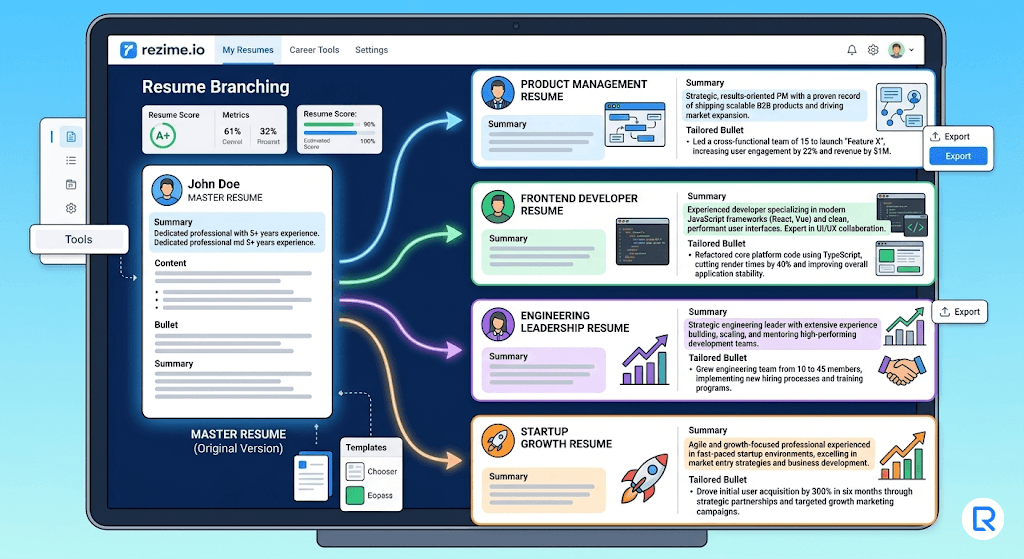
Most candidates prepare for interviews with scattered notes, multiple resume files, and a half-remembered idea of what they want to say. That creates unnecessary friction. When each opportunity requires a different emphasis, your materials should be adaptable without forcing you to rebuild everything from zero.
Roleframe helps by letting you keep a strong master resume while creating targeted variants for different role families. That means your interview story can match the version of your resume you actually sent. If you are interviewing for a startup product role, your summary, key bullets, and selected projects can emphasize speed, experimentation, and ownership. If you are interviewing for an enterprise leadership role, the emphasis can shift toward cross-functional influence, systems thinking, and scale.
That makes preparation easier because your resume stops being a static document and becomes a deliberate positioning tool. When the interview starts, you are not improvising your professional identity. You are reinforcing a version you already designed.
The fastest way to sound more confident is to remove contradiction between your resume and your interview answers.
Build a Story Bank for the Rest of the Interview
Once you understand storytelling for the opening question, apply the same principle to the rest of the interview. Most later questions are not asking for adjectives. They are asking for proof through examples.
That means you should maintain a small story bank before interviews. You do not need 20 stories. Usually six to eight strong examples are enough if they are flexible.
Choose stories that cover different dimensions of your work: conflict, leadership, failure, pressure, achievement, learning, influence without authority, and problem-solving under ambiguity. Then practice summarizing each one clearly.
- A challenge you solved under pressure
- A conflict you handled constructively
- A project or launch you are proud of
- A mistake that changed how you work
- A time you influenced a decision without formal authority
- A time you improved a process, product, or system
Interview confidence grows fast when you stop answering from memory and start answering from prepared evidence.
Use STAR for Behavioral Questions, But Do Not Sound Mechanical
For behavioral questions like "Tell me about a challenge" or "Describe a conflict at work," a structure helps. The STAR framework remains useful because it forces clarity: situation, task, action, result.
But many candidates make it sound robotic. They recite the framework like a template instead of telling a clean story. The fix is simple. Use STAR underneath the answer, not on top of it. In other words, let the interviewer feel the logic without hearing a formula.
Start by setting the context quickly. Clarify what mattered. Focus most of your time on your decisions and actions. End with a concrete result and, when relevant, the lesson you took from it.
Structure should make you clearer, not stiffer.
How to Answer Strengths and Weaknesses Without Sounding Fake
This question ruins a surprising number of interviews because candidates still answer it like they are filling a personality form. A strong strengths answer names one or two qualities that matter for the role and backs them with examples. A strong weaknesses answer shows self-awareness, real effort to improve, and no hidden red flags that destroy confidence in your fit.
Do not say your weakness is perfectionism unless you can explain it in a grounded way and show how you manage it. That answer is overused because candidates think it sounds safe. Most of the time it sounds evasive.
A better weakness answer might focus on something real but manageable, such as being too hands-on early in leadership, over-explaining in presentations, or delaying delegation before learning to trust systems and people more effectively.
Interviewers are not looking for perfection. They are looking for honesty that still signals maturity.
Why "Why Do You Want to Work Here?" Is Really a Fit Test
This question is not mainly about enthusiasm. It is about whether you understand what the company needs and whether your motivations make sense for the environment.
Weak answers focus on surface-level brand admiration. Strong answers combine three things: what the company is doing, why that matters to you, and why your background fits that context. The more specific you are, the stronger the answer becomes.
The best answers often reference product direction, team quality, market timing, mission credibility, or the type of problem the company is solving. They make it clear that you are not just seeking any job. You are responding to this one for specific reasons.
Interest without evidence sounds like flattery. Interest with context sounds like fit.
How to Answer "Why Should We Hire You?" Without Arrogance
Candidates often either undersell themselves or swing too far into self-promotion. The right answer is not chest-beating. It is a compact case for fit.
Anchor your answer around two or three job-relevant strengths, then connect them directly to the role's likely needs. For example: I combine product thinking with hands-on execution, I move quickly in ambiguous environments, and I care deeply about reducing user friction. Based on what you described, this role needs exactly that mix.
The key is to sound useful, not just impressive.
You do not need to claim you are the best possible candidate. You need to explain why you are a strong solution to this hiring problem.
How to Handle Questions About Stress and Pressure
Interviewers ask this because many roles become difficult in predictable ways: conflicting priorities, tight timelines, unclear ownership, unexpected blockers, or stakeholder pressure. They want to know whether you stay effective when conditions stop being ideal.
A good answer does not pretend you never feel pressure. It shows how you work through it. Mention how you prioritize, communicate early, break down ambiguity, protect decision quality, and keep momentum without creating chaos for everyone else.
Whenever possible, connect the answer to a real example. Pressure is not a personality test. It is an operating test.
Calm is useful, but calm with method is what employers trust.
Do Not Waste the Final Question: Ask Better Questions
One of the most common interview mistakes happens at the end. The candidate says, "No, I think you covered everything." That is a missed opportunity.
Your questions are a signal of judgment. Good questions show strategic thinking, real interest, and maturity. They also help you evaluate whether the role is actually a fit for you.
Do not ask questions you could answer in 30 seconds on the company website. Ask questions that reveal expectations, success metrics, team dynamics, and real challenges.
- What would success in this role look like in the first 90 days?
- What are the biggest challenges the person in this role would need to solve early?
- How does the team make trade-offs when priorities conflict?
- What distinguishes people who do especially well here?
- How has this role evolved over the last year?
Your final questions are part of the interview, not a formality after it.
Practice Until You Sound Natural, Not Rehearsed
Some candidates avoid preparation because they are afraid of sounding robotic. That fear is understandable, but it points at the wrong problem. Rehearsal is not what makes people sound fake. Over-scripted language does.
The solution is to practice your ideas, not memorize every word. Know your opening story. Know your strongest examples. Know the message you want them to leave with. Then rehearse out loud enough times that your answers feel stable, flexible, and conversational.
If you only prepare silently in your head, you will often discover your weak phrasing for the first time in the interview itself. That is too late.
Practice should reduce friction, not remove personality.
A Smarter Interview Prep Checklist
- Study the job description and identify the two or three strengths the role most clearly needs
- Choose the version of your resume that best matches that role
- Write a present-past-future answer for "Tell me about yourself"
- Prepare six to eight stories for behavioral questions
- Review your strengths, weaknesses, achievements, and transition narrative
- Research the company, product, and team context
- Prepare thoughtful questions to ask at the end
- Practice out loud until the answer sounds natural
A good interview is rarely built the night before. It is usually built in layers.
FAQ: Interview Storytelling and Common Questions
These are the questions job seekers ask most often when trying to improve interview performance.
- How long should my "Tell me about yourself" answer be? Usually around one to two minutes for a first screen, unless the interviewer invites a longer answer. Long enough to be meaningful, short enough to stay relevant.
- Should I use personal stories? Only when they clearly support your professional fit. A story is useful if it explains a pattern the employer should care about.
- What if I do not have impressive achievements? Focus on outcomes, decisions, learning, and ownership. You do not need a dramatic story to give a strong answer.
- Is STAR still worth using? Yes, especially for behavioral questions, but it should guide your answer quietly rather than making it sound scripted.
- What if I am changing careers? Then your narrative matters even more. Use your story to explain the transfer, the pattern, and why this new direction makes sense.
- How does Roleframe help with interview prep? It helps you keep multiple tailored resume branches so your resume, examples, and interview narrative stay aligned for each opportunity.
Conclusion: Stop Hoping You Will Think of Something Smart in the Room
The biggest interview mistake is not being nervous. It is assuming you can improvise your way into clarity when the stakes are high. Most people already know the questions that matter. They just do not prepare answers with enough structure, relevance, and proof.
You do not need a perfect script. You need a credible narrative. You need a strong opening, a bank of real stories, and a resume that supports the same positioning you are trying to communicate live.
That is how interviews become easier. Not because the questions disappear, but because you stop meeting them empty-handed.
Use storytelling carefully. Use structure intelligently. Use your resume as evidence. And if you want the fastest path to better alignment between your documents and your interview answers, build targeted resume branches in Roleframe so every application and every interview starts from a stronger foundation.
The goal is not to sound impressive for two minutes. It is to become easy to remember for the right reasons.