

The ATS Rejection Myth
You’ve probably seen the claim that “75% of resumes are rejected by applicant tracking systems before a human ever reads them.” This statistic circulates widely on social media, blogs, and even career coaching funnels, but almost always without verifiable sourcing.
To separate fact from fear, we spoke with 25 U.S. recruiters across industries including tech, healthcare, retail, and education to understand how ATS actually impacts resume visibility.
Their insights reveal a very different picture of the ATS screening process and what really determines whether a resume gets noticed.
How Common Is ATS Use?
Applicant Tracking Systems are widely used, especially at large employers. Jobscan reports detecting an ATS on 98.4% of Fortune 500 career sites in 2024.
That does not mean an ATS automatically rejects most applicants. In many teams, the ATS is a resume database that supports parsing, search, filters, and recruiter workflows.
- ATS systems store resumes and extract fields like titles, companies, dates, and skills
- Recruiters search and filter the database by job title, keywords, location, and requirements
- Some companies use knockout questions for eligibility (work authorization, required certification)
Most of the time, the ATS controls visibility and organization. Humans still decide who moves forward.
What Happens After You Click Apply? A Realistic Workflow
Hiring pipelines vary, but many follow a similar pattern. You submit an application, the system parses your resume into fields, then recruiters search and filter to find matches.
LinkedIn Recruiter documentation describes using quoted searches and Boolean modifiers inside the Keywords filter. That reflects how many teams search for exact phrases and combinations of terms.
- Knockout questions or eligibility checks (if configured)
- Parsing into fields (titles, dates, skills)
- Recruiter search and filters (keywords, titles, location)
- Shortlist creation and human review
- Interview scheduling and feedback tracking
Do ATS Systems Really Reject Resumes Automatically?
ATS (Applicant Tracking Systems) are used to collect, organize, and filter resumes. They are not inherently designed to act as automatic gatekeepers that eliminate large portions of applicants without human oversight.
Of the 25 recruiters interviewed, 23 (92%) confirmed that their ATS does not automatically reject resumes based on formatting, design, or minor content issues. Instead, the majority use ATS as a filtering and organizational tool that helps prioritize review rather than block submissions outright.
Some organizations do use configurable match scores and filters to help recruiters sort candidates, but even then, a low match score rarely leads to immediate rejection without human evaluation.
ATS Auto‑Reject Insights
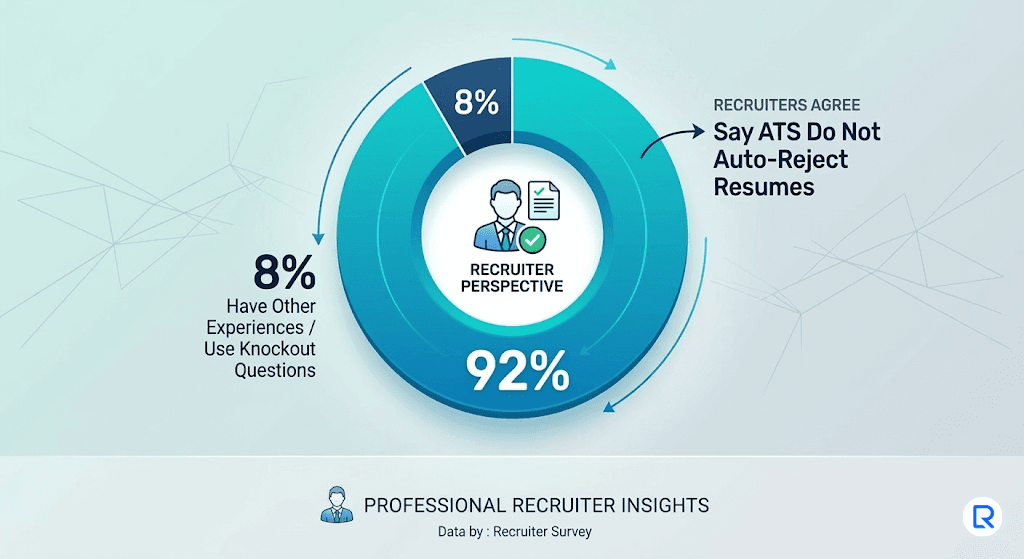
Only a small minority of recruiters reported having strict auto‑reject rules, and when they do exist, they are mostly linked to specific job requirements — such as mandatory certifications or legal eligibility — rather than general resume quality.
Key ATS Terms Explained
- Automatic rejection: The ATS marks a resume as rejected without human review, typically due to hard knockout rules.
- Match score: A relevance score that suggests how closely a resume aligns with the job criteria.
- Knockout questions: Filters used for essential requirements such as work authorization or required certifications.
What Can Trigger Auto Rejection?
Recruiters told us that strict auto rejection is uncommon for formatting. When auto rejection exists, it is usually tied to hard requirements or eligibility checks.
These are often configured as knockout questions or mandatory fields. If you fail them, the system can mark you ineligible even if your resume looks great.
- Work authorization or legal eligibility requirements
- Required certifications or licenses (for example, nursing license)
- Location requirements for onsite roles
- Minimum years of experience for regulated roles (varies by company)
- Application questions you answered incorrectly
If you keep getting rejected quickly, review the application questions first. Many rejections are driven by eligibility, not resume design.
How Recruiters Search (Keywords and Boolean)
A common myth is that resumes get rejected by a robot. In reality, many recruiters search for candidates using keywords and filters.
LinkedIn Recruiter guidance describes using quoted phrases and Boolean modifiers in keyword fields. That helps explain why exact phrases from job descriptions can matter.
- Quoted phrases: "React Testing Library" or "customer success"
- Boolean operators: AND, OR, NOT
- Grouping with parentheses to combine terms
- Example: (React OR Next.js) AND TypeScript AND (Jest OR Playwright)
Use the exact wording from the job description when it matches your real experience. Then prove it in a bullet.
Where the ATS Rejection Myth Comes From
When asked about the origins of the widely shared ATS rejection myth, recruiters pointed to social media, outdated career advice blogs, and generic mainstream media coverage. Many of these sources repeat statistics or interpretations that lack direct evidence or primary research.
Some recruiters admitted they had never encountered the specific figure until participating in this study, highlighting how myths can become ingrained through repetition rather than data.
What Recruiters Actually Say
“It’s such a false narrative — it takes advantage of job seekers' fears,” said Reggie Martin, a recruiter based in Los Angeles.
“The systems I use don’t auto‑reject — we do it manually based on how well the candidate matches the role,” explained Charkin Whitehead from Allegis Global Solutions.
“We want to review all qualified applicants,” added Crystal Hughes, Director of Talent at Accuserve Solutions.
How Recruiters Use AI Match Scores
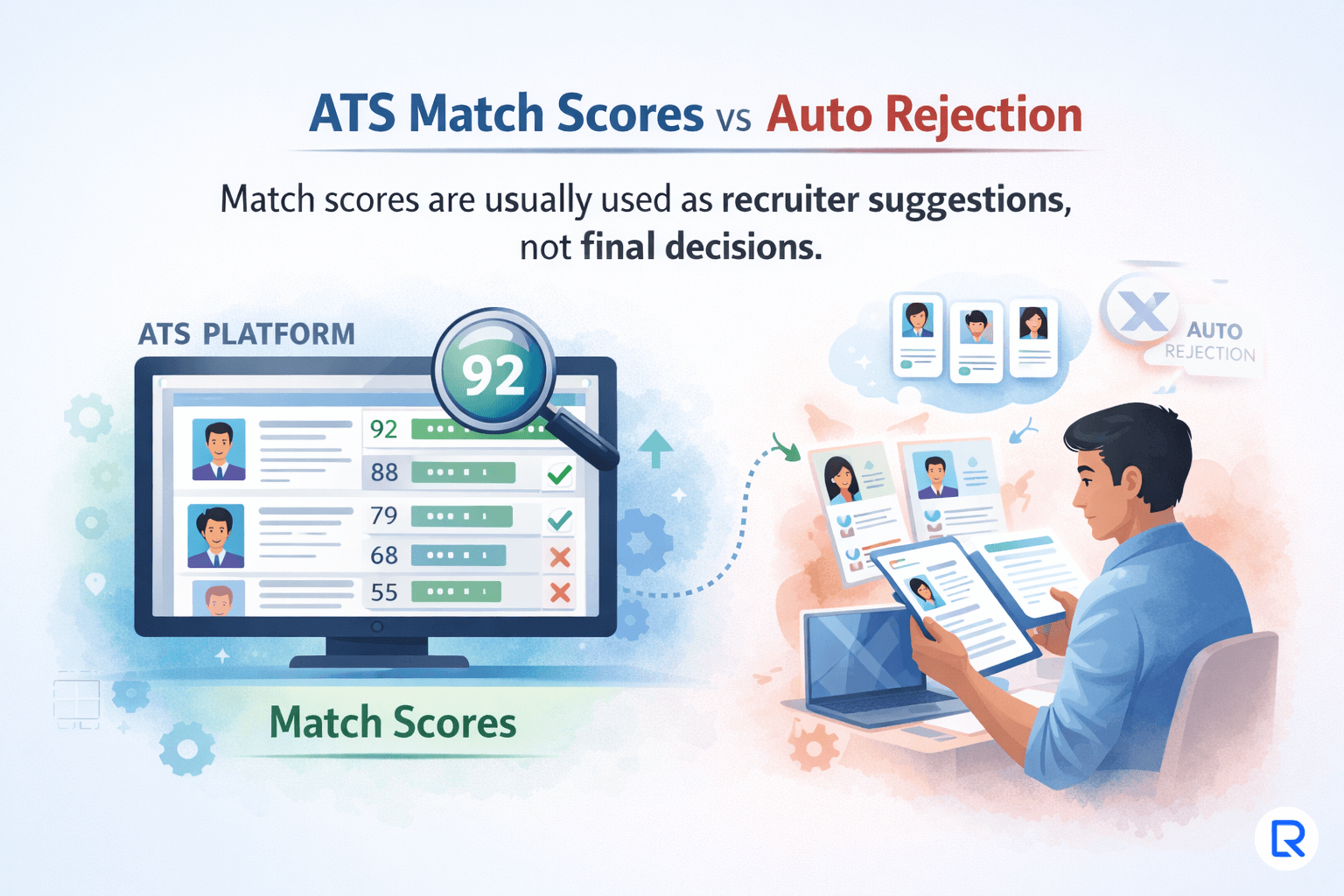
Many ATS platforms offer match score recommendations based on keyword and experience alignment. However, recruiters typically treat these scores as suggestions rather than final decisions.
Only a small minority (about 8% of recruiters) said match scores were used as a gating mechanism, and even then, this was tied to rigid job criteria rather than general formatting or resume quality.
If It’s Not the ATS, What Is It?
Recruiters consistently reported that the real reason many resumes go unseen is sheer volume. Some job postings attract hundreds or even thousands of applications within a short time, and recruiters have limited time to review each one.
Because of this volume, recruiters often build shortlists quickly and may stop reviewing once sufficient candidates are identified, leaving later applicants without detailed feedback or visibility.
The Real Reasons Resumes Go Unseen
Volume is the biggest reason, but it is not the only one. Recruiters also described common visibility problems that make strong candidates harder to find.
These issues usually come from keyword mismatch, unclear titles, or resumes that do not parse cleanly.
- Keyword mismatch: the posting uses a phrase your resume never mentions
- Unclear target role: your title and summary do not match the job you are applying for
- Parsing issues: dates, headings, or sections get scrambled or lost
- Weak evidence: bullets describe tasks but do not show outcomes
- Late applications: recruiters stop reviewing after a shortlist is formed
If you are qualified but not getting interviews, treat it like a visibility problem: titles, keywords, and proof bullets.
Applying Early: What It Means in Practice
Recruiters told us that applying early can help because it increases the chance your resume is reviewed before a shortlist is complete.
Applying early does not mean refreshing job boards all day. It means having a ready baseline resume and tailoring quickly when a relevant job appears.
- Keep a baseline resume that reflects your true experience
- Tailor 3 to 6 bullets to match the job description language
- Submit when you can still do a careful review, not rushed
- Use a clear file name so you upload the correct version
- If possible, pair your application with a referral or short message
Does Applying Early Help?
About 52% of recruiters said applying early in the job posting lifecycle improves the odds of being reviewed because the initial candidate pool gets attention before recruiter workloads increase.
About 36% said it depends on each team’s specific review timing, while others said the impact varies by role and workflow.
What Recruiters Wish Job Seekers Understood
- ATS systems are tools for organizing and filtering applications, not eliminating qualified candidates arbitrarily.
- Strong, well‑structured resumes make recruiters’ jobs easier and increase your chances of human review.
- Keyword stuffing and overly complex templates often do more harm than good.
How to Improve Your Resume for Real Results
- Use a clear, skimmable structure that emphasizes key sections.
- Show relevant experience using specific tools and methodologies.
- Use natural keyword placement tied to real achievements.
- Keep bullet points concise and outcome‑oriented.
- Maintain consistent formatting throughout.
- Highlight measurable results where possible.
ATS Friendly Formatting Rules That Usually Work
Most ATS failures are formatting and structure issues. Indeed recommends avoiding complex formatting like tables, columns, headers, and footers because information can be scattered or lost when parsed.
A clean, one-column layout with standard headings is still the safest choice for most applications.
- Use standard headings: Summary, Experience, Projects, Skills, Education
- Avoid tables, text boxes, and heavy sidebars
- Keep contact info in the document body with text labels (Email, Phone, LinkedIn)
- Use a consistent date format (Apr 2024 or 2024-04)
- Keep bullets to 1 to 2 lines when possible
Quick test: copy the exported resume text and paste into a plain text editor. The order should stay logical.
A Keyword Workflow That Works Without Stuffing
Keyword strategy works best when it is backed by proof. Put the keyword in Skills, then show it in one real bullet under Experience or Projects.
Avoid keyword stuffing. Repeating the same term everywhere can hurt readability and does not add evidence.
- Copy 10 to 15 keywords from the job description (titles, tools, responsibilities)
- Add the real ones to Skills using the exact wording
- Add 2 to 4 of the most important keywords into bullets where you actually used them
- Use the target job title once in your summary when it is accurate
- Smell test: if you cannot explain a keyword in 30 seconds, remove it
Proof Bullets That Recruiters Trust
A resume that parses cleanly still needs to convince a human. Harvard career guidance recommends starting bullets with action verbs and including details that show accomplishments.
A simple structure works: action, scope, tech, outcome. If you do not have metrics, use concrete outcomes like fewer bugs, faster delivery, improved UX, or reduced manual work.
- Weak: Worked on features in React
- Strong: Built a reusable form flow in React plus TypeScript with validation and error states, reducing duplicated code and speeding up new page delivery
- Weak: Improved performance
- Strong: Optimized images and reduced unnecessary re-renders, making key pages feel faster and improving Core Web Vitals
- Strong: Added component and end to end tests for a critical flow, reducing regressions during releases
How to Test Your Resume Before You Apply
You do not need a special tool to catch most ATS formatting failures. A few quick tests reveal whether a parser is likely to misread your resume.
These checks take five minutes and prevent common failures like missing contact info and scrambled sections.
- Plain text paste test: copy resume text from the exported file and paste into a plain text editor
- PDF selection test: open the PDF and confirm text is selectable
- Portal preview test: if the portal shows a preview, verify headings, dates, and order
- Link check: ensure LinkedIn and GitHub appear as plain text URLs
- Keyword coverage test: confirm the top role keywords appear in Skills and in proof bullets
If the portal preview looks wrong, submit a simpler one-column version.
FAQ: Does the ATS Reject Resumes?
Quick answers based on recruiter workflows and common ATS behavior.
- Does ATS automatically reject resumes? Some systems can auto reject based on knockout requirements. Most teams still rely on human review for fit.
- Do match scores decide everything? Many recruiters treat scores as guidance, not as a final decision.
- Are design templates risky? Complex layouts can cause parsing errors. One column is safest.
- How do I know parsing failed? The portal preview shows scrambled sections, missing dates, or missing contact info.
- What is the fastest improvement? Rewrite your top 3 bullets to include action, scope, and outcome.
Why the Myth Persists
Many job seekers attribute lack of responses to ATS rejection because it provides a simple explanation for a frustrating experience.
Recruiters understand that the hiring process is complex, involving human judgment, volume challenges, and evolving priorities — not automated elimination based on superficial criteria.
Essential Stats from Recruiter Interviews
- 8% of recruiters say their ATS auto‑rejects resumes for content issues.
- 84% use knockout questions to filter for eligibility criteria.
- 44% have AI match scores, but most use them as guidance.
- 56% do not rely on match scores or ignore them in practice.
Limitations and How to Use This Research
This article summarizes 25 recruiter interviews. It is directional, not a scientific survey. ATS configuration varies by company, role, and region.
Use the findings as a practical guide: focus on eligibility questions, parsing-safe formatting, keyword visibility, and strong proof bullets.
Research Methodology
These findings come from 25 in‑depth interviews with U.S.‑based recruiters across industries and company sizes. Recruiters were asked about ATS use, auto‑rejection configuration, match scores, and resume review processes.
Conclusion: The Real Story Behind ATS
The idea that Applicant Tracking Systems automatically reject most resumes is a myth that persists because it offers a simple explanation for a complex process.
In reality, most resumes aren’t rejected by automation alone. They are filtered, prioritized, and evaluated as part of broader recruiting workflows.
Focusing on clarity, relevance, personalization, and measurable impact increases your chances of getting noticed by real humans, not just machines.