

Why Good Candidates Still Get Ignored
Many candidates assume a weak job search means they are underqualified. Often that is not true. A lot of them are being filtered out because their resume makes it too hard for recruiters and hiring managers to see their value quickly.
That is the brutal part of resume writing: small mistakes create a bad first impression fast. A weak section order, vague bullet points, no measurable outcomes, generic copy, and sloppy formatting can quietly kill interest before you ever get the chance to interview.
This guide takes a personal-style case study and turns it into a professional resume framework. It breaks down five common resume mistakes that cost candidates interviews, explains why each one hurts, and shows how to fix them in a way that works for both human reviewers and modern ATS-driven hiring flows.
You will also see how networking and resume feedback fit into the bigger picture, because better resumes rarely happen in isolation. They usually improve when candidates talk to recruiters, alumni, hiring managers, and peers who can help them sharpen the story their document is telling.
A resume does not need to be fancy. It needs to be relevant, credible, and easy to scan.
Key Takeaways
- Put the most relevant information first. For most candidates with any real experience, work experience should usually come before education.
- Replace vague responsibilities with bullet points that show outcomes, scope, and contribution.
- Use metrics whenever you can, even if the numbers are small or approximate but honest.
- Tailor your resume for the role instead of sending one generic version everywhere.
- Formatting, consistency, spelling, and structure still matter because recruiters notice avoidable sloppiness.
- Networking and resume feedback often improve interview conversion more than blind applying alone.
Why These Resume Mistakes Matter More Than People Think
Hiring teams do not read resumes like novels. They scan them quickly, often looking for role relevance, evidence of impact, and signs that the candidate understands the job they are applying for. If the strongest information is buried, if the bullet points feel empty, or if the formatting looks careless, the document creates friction immediately.
That friction matters because resume review is usually comparative. Recruiters are not asking whether your resume is acceptable in isolation. They are asking whether it is easier to believe, easier to understand, and more obviously relevant than the next one in the stack.
That is why smart resume strategy is less about decoration and more about decision-making. Every section, bullet, and word either helps the reviewer understand your fit faster or slows them down.
In resume writing, clarity is not cosmetic. It is competitive advantage.
Mistake #1: Leading With Education Instead of Experience
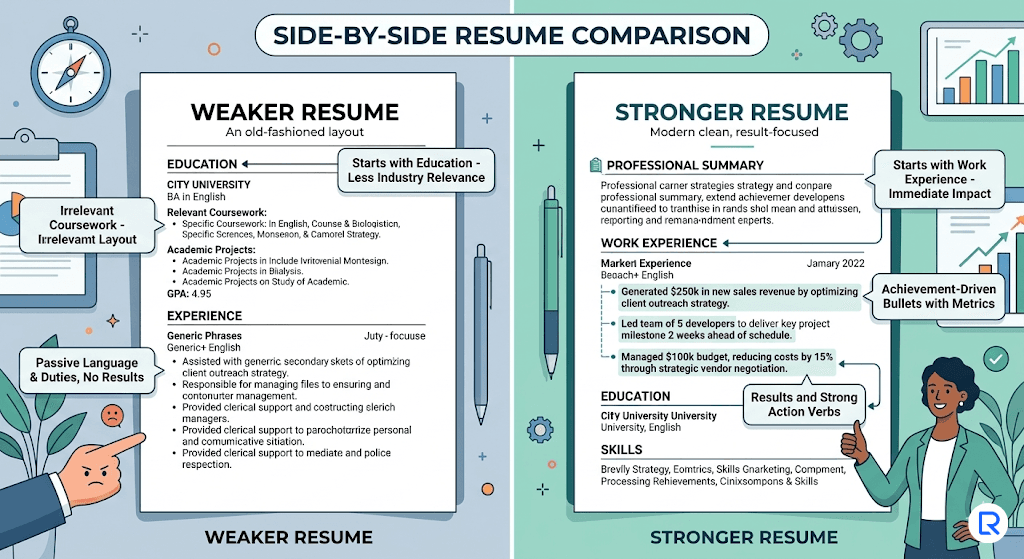
One of the most common resume mistakes among students, recent graduates, and early-career professionals is putting education at the top even when they already have internships, part-time work, freelance work, major projects, or leadership experience that is more relevant to the job.
That ordering choice sends the wrong signal. It tells the reviewer to spend their first attention on grades, classes, and academic details when what they really need is proof that you can contribute in a work setting.
This does not mean education is unimportant. It means it is often not your strongest selling point once you have any experience that maps more directly to job performance. Relevant internships, project work, student consulting, research with business outcomes, and meaningful extracurricular leadership usually translate better than course lists or older academic honors.
For most candidates, the best placement rule is simple: put first whatever gives the clearest evidence that you can do this job. If that is experience, lead with experience. If you are a true first-year student with almost no work history, education may still deserve to be higher. But once you have something stronger, your resume should reflect that.
The top of your resume should answer one question fast: why should this person keep reading?
How to Fix Section Order the Right Way
A strong resume is usually organized around relevance, not tradition. That means work experience should sit near the top for candidates who already have internships, contracts, client work, or project-based evidence of applied skills.
If you are applying to a finance role, relevant finance experience should beat a list of classes. If you are applying to software roles, shipped projects or engineering internships should beat GPA. If you are applying to consulting or operations, cross-functional project work and problem-solving experience should be visible quickly.
Education should still be clean and present, but it should not steal attention from stronger evidence. Keep it concise. Degree, school, graduation timing, and possibly honors are usually enough unless the job explicitly cares about certain coursework or academic distinctions.
- Lead with experience when you have relevant internships, projects, or work history
- Keep education concise unless it is your strongest qualification
- Do not waste premium screen space on weak or outdated academic details
- Arrange your resume to match how employers evaluate fit
Mistake #2: Describing Tasks Without Showing Impact
A lot of resume bullets sound busy but say almost nothing. Candidates use words like assisted, supported, helped, participated, collaborated, and contributed, but never explain what changed because of their work.
That is a problem because hiring teams are not just looking for activity. They are trying to understand whether your work produced useful outcomes. Did you improve something, launch something, reduce something, speed something up, increase something, or help a team reach a concrete result?
The difference between a weak bullet and a strong bullet is rarely vocabulary. It is evidence. Fancy wording without outcome still feels empty. A simpler bullet with a clear result is almost always stronger.
For example, compare these two versions: "Assisted with project governance and client research" versus "Supported project governance and market research that helped a banking client launch a new local branch." The second bullet is not magical. It is just clearer about why the work mattered.
Responsibilities tell me what you touched. Impact tells me why I should care.
How to Turn Responsibilities Into Resume Value
A useful way to upgrade a bullet point is to ask three questions. What did I do? Why did it matter? What changed because of it? That sequence forces you beyond duties and into contribution.
This is where many candidates get stuck because they think only huge wins count as impact. That is wrong. Impact can be direct revenue, but it can also be efficiency, quality, accuracy, speed, client satisfaction, risk reduction, decision support, process clarity, stakeholder alignment, or successful execution.
A strong bullet often follows a simple pattern: action plus context plus result. The result does not need to be dramatic. It needs to be believable and relevant.
- Start with a clear action verb
- Add business, team, or project context
- Show the result, outcome, or reason it mattered
- Prefer specific proof over inflated language
Mistake #3: Failing to Quantify What You Did
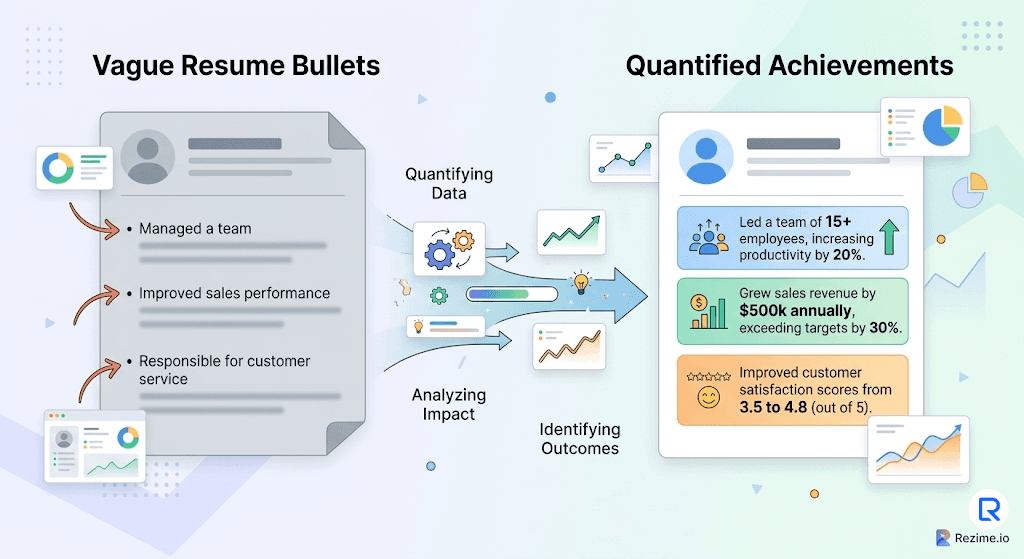
Candidates often know they should use metrics, but they avoid them because they think their numbers are not impressive enough or they do not have formal dashboards to pull from. That hesitation is understandable, but it still weakens the resume.
Recruiters usually care less about whether the number is massive and more about whether you made the effort to quantify your contribution honestly. Metrics show that you understand performance, scope, and outcomes. They make your bullets feel grounded instead of generic.
Even small or local numbers can strengthen credibility. If a presentation scored above class average, if you tutored a set number of students, if you supported a team serving a certain volume of requests, if you improved turnaround time, if you reduced error rates, if you handled recurring weekly deliverables, that is all usable proof.
The key is authenticity. Do not invent fake numbers. But do stop pretending that only giant metrics count. Honest scope is better than vague ambition.
Quantification is not about bragging. It is about making your contribution easier to trust.
How to Find Metrics When You Think You Have None
A practical method is to keep asking: so what? If you trained people, how many? If you built something, for how many users or stakeholders? If you created reports, how often? If you improved a process, by how much? If you handled requests, what volume? If you supported a launch, what outcome followed?
When direct business results are unavailable, you can still quantify scope, frequency, speed, accuracy, participation, adoption, completion, or comparison against a benchmark. Metrics do not have to be revenue metrics.
Here are categories that newer candidates often miss: team size, number of clients or users supported, turnaround time, weekly output, error reduction, satisfaction scores, acceptance rates, average improvements, percentage comparisons, event attendance, content performance, and cost or time savings.
The point is not to force every bullet into a percentage. The point is to avoid leaving all your work unmeasured when at least some of it can be made more concrete.
- Volume: number of users, clients, students, projects, tickets, or reports
- Frequency: daily, weekly, monthly, quarterly output
- Efficiency: faster turnaround, reduced manual steps, time saved
- Quality: accuracy, satisfaction, score improvement, lower error rates
- Business outcome: revenue influenced, leads generated, launch success, retention, adoption
Mistake #4: Sending the Same Resume to Every Role
This is one of the biggest reasons strong candidates still get weak response rates. They use one general resume for dozens of applications and hope it will be broad enough to work everywhere. In a tighter job market, that approach usually fails.
A generic resume forces the recruiter to imagine your fit. A tailored resume reduces that work by aligning your language, highlights, and evidence with the role in front of them. That does not mean lying or rewriting your history. It means selecting and emphasizing the parts that matter most for that job.
Tailoring matters for two reasons. First, human reviewers notice when the resume clearly reflects the job. Second, ATS-driven workflows often rely on matching relevant keywords, skills, and role language from the description. If your resume never speaks the same language as the role, you make yourself harder to surface and easier to skip.
Candidates sometimes resist tailoring because it feels like too much work. But the better answer is not to apply blindly to everything. It is to narrow your focus to a smaller set of role families and build targeted versions that match them well.
Resume tailoring is not extra polish. It is the difference between generic interest and obvious fit.
How to Tailor a Resume Without Rewriting Everything From Scratch
The smartest way to tailor is to work from a strong base resume and create focused variants for role clusters. For example, one version might emphasize product and growth work, another operations and analytics, and another client-facing project execution.
Start with the job description. Identify the repeated themes: required tools, functional strengths, business problems, and expected outcomes. Then adjust your summary, top skills, keyword choices, and bullet ordering so the most relevant material rises to the top.
This does not require 50 completely new resumes. It requires a few strategic versions and disciplined editing. The more similar the jobs are, the more reusable your tailored version becomes.
- Copy the job description into your notes and highlight repeated skills or priorities
- Match your strongest relevant achievements to those needs
- Move the most relevant bullets and sections higher
- Adjust wording to reflect the language of the role honestly
- Keep a master resume plus targeted variants for recurring job types
Mistake #5: Overlooking Small Errors That Damage Trust
Candidates love to debate strategy and ignore execution. That is a mistake. Inconsistent dashes, mixed date formats, bad spacing, grammar problems, typo-level sloppiness, and broken formatting all create an impression, and usually not a good one.
No recruiter says, "This hyphen inconsistency alone disqualified the candidate." But they do form broader judgments from signals like that. Careless formatting can suggest rushed work, low attention to detail, or a lack of professionalism, especially when the role requires communication, documentation, or client-facing polish.
This is even more important when you consider ATS compatibility. Overdesigned templates, inconsistent headings, weird symbols, or formatting choices that break parsing can make an otherwise strong resume harder to read by both software and humans.
Small issues are rarely the main problem, but they are often the unnecessary problem. There is no good reason to lose credibility over something you could catch in one serious review pass.
A polished resume will not save weak content, but sloppy presentation can absolutely weaken strong content.
A Better Proofreading and Formatting Checklist
Most candidates proofread too casually because they already know what they meant to write. That makes them bad judges of their own errors. A stronger process is to review the resume at multiple levels: language, layout, consistency, and parsing simplicity.
Read it once for content, once for formatting, and once as if you were a recruiter scanning for 15 seconds. Then send it to other people. Fresh eyes catch what familiarity hides.
If you want an easy system, use a checklist before every send. It sounds simple because it is. But it works.
- Consistent date formats across every role
- Consistent dash, spacing, and punctuation style
- No spelling or grammar mistakes
- Standard section headers such as Work Experience, Education, Skills
- Readable font, clean spacing, no overcrowding
- No tables, columns, or graphics that may confuse ATS parsing unless you know the target system can handle them
- File exported cleanly as PDF if appropriate and text remains selectable
The Part Most Resume Advice Misses: Networking and Feedback
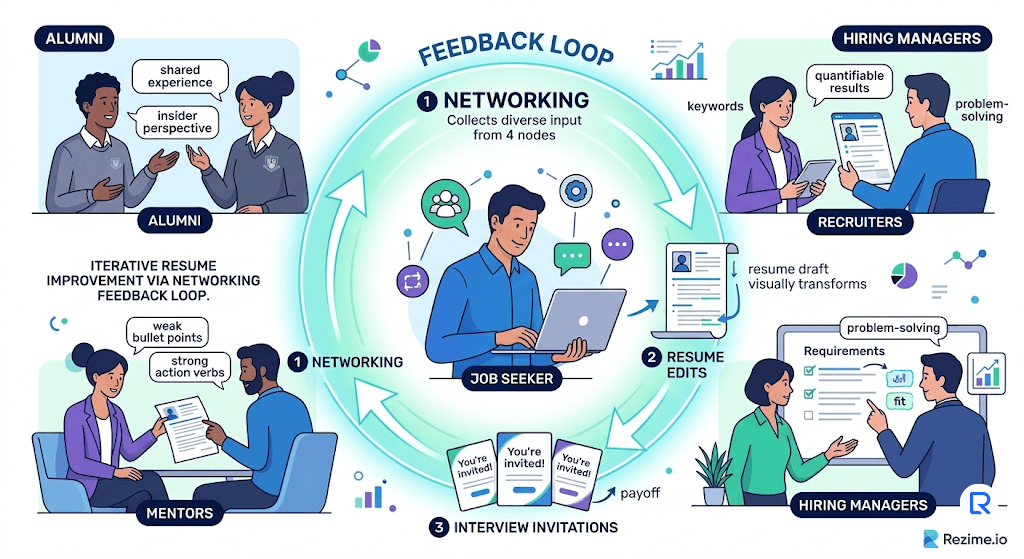
One of the most useful parts of the original story is not just the resume edits. It is the process behind them. Better results came after networking harder and editing the resume based on actual feedback from people closer to hiring.
That matters because resumes improve fastest when they are tested against reality. Recruiters can tell you whether the story is clear. Alumni can tell you whether the positioning fits the role. Hiring managers can reveal what they actually notice first. Even peers can catch whether your bullets sound empty or convincing.
Blind applying has limits. Feedback shortens the loop. The more quickly you learn what is not landing, the more intelligently you can adjust. That can improve interview conversion far more than sending another 50 untouched applications.
A strong resume is usually rewritten through feedback, not written perfectly on the first try.
How Roleframe Helps Fix These Problems
The real challenge in resume writing is not knowing the advice. It is applying it consistently across multiple roles without creating chaos. That is where a resume system helps more than a static file.
Roleframe is useful here because it lets candidates keep a strong base resume while creating targeted variants for different job tracks. That makes tailoring easier, not heavier. You can refine section order, rewrite bullets with better outcomes, store multiple versions for different roles, and keep cleaner control over what changes from one application to the next.
That matters especially when you are networking and receiving feedback from different people. Instead of losing track of edits across scattered files, you can treat resume optimization more like a structured workflow.
A resume is not one frozen document. It is a living career asset that should evolve with the role.
Before You Send Another Resume, Do This
If your current application strategy is mostly apply, wait, repeat, stop and audit the resume first. Ask yourself whether the strongest information appears early, whether the bullets show impact, whether there are enough metrics, whether the resume sounds tailored to the role, and whether the formatting looks clean enough to trust.
Then ask one more uncomfortable question: have I actually put this in front of people who understand hiring? Because the fastest way to improve is still feedback.
A resume does not need to tell your entire professional story. It needs to create enough confidence, fast enough, that the next step feels justified. That is the standard. Build for that.
The goal of the resume is not to say everything. It is to earn the interview.
FAQ: Common Resume Questions Behind These Mistakes
These are the practical questions candidates usually ask once they start fixing their resume seriously.
- Should education ever go first? Yes, if you are very early in your career and education is still your strongest or most relevant qualification. But once you have stronger applied experience, that usually deserves the top spot.
- What counts as impact on a resume? Impact can be revenue, efficiency, accuracy, speed, client outcomes, project success, process improvement, adoption, or anything that shows your work mattered beyond the task itself.
- Do small metrics still help? Yes. Honest small metrics are still better than vague claims because they show scope and credibility.
- How many resume versions should I have? Usually one master resume plus a few tailored versions for your main role categories is enough for most candidates.
- How important is formatting really? Very. Good formatting will not rescue weak content, but bad formatting can absolutely lower trust and readability.
- What improves resumes faster than blind applying? Real feedback from recruiters, hiring managers, alumni, mentors, and peers who can tell you what is unclear or unconvincing.
Conclusion: Strong Resumes Are Built on Relevance, Not Buzzwords
A lot of resume advice gets lost in templates, aesthetics, and surface-level wording. But the fundamentals are still the real differentiators. Put the strongest evidence first. Show impact. Quantify what you can. Tailor for the role. Eliminate avoidable sloppiness.
None of this is glamorous. It is just effective. And in a crowded hiring market, effective beats clever every time.
If your resume is not converting, do not assume the answer is to apply harder. Fix the document first. Then get feedback. Then tailor intelligently. That is how candidates move from silence to interviews.
And if you want to make that process easier, build your resume in Roleframe so you can keep a clean base version, create targeted branches, and turn feedback into a better application system instead of another messy file on your desktop.
The candidates who get more interviews are not always more qualified. Often, they just make their value easier to see.