
How to Write a Fullstack Engineer Resume That Gets Interviews
Fullstack resumes are harder to write well than many people expect. The danger is sounding broad but shallow: too many tools, too little proof. Hiring managers do not want a list of frontend and backend buzzwords. They want evidence that you can own complete workflows, make good tradeoffs across layers, and ship features that work in production.
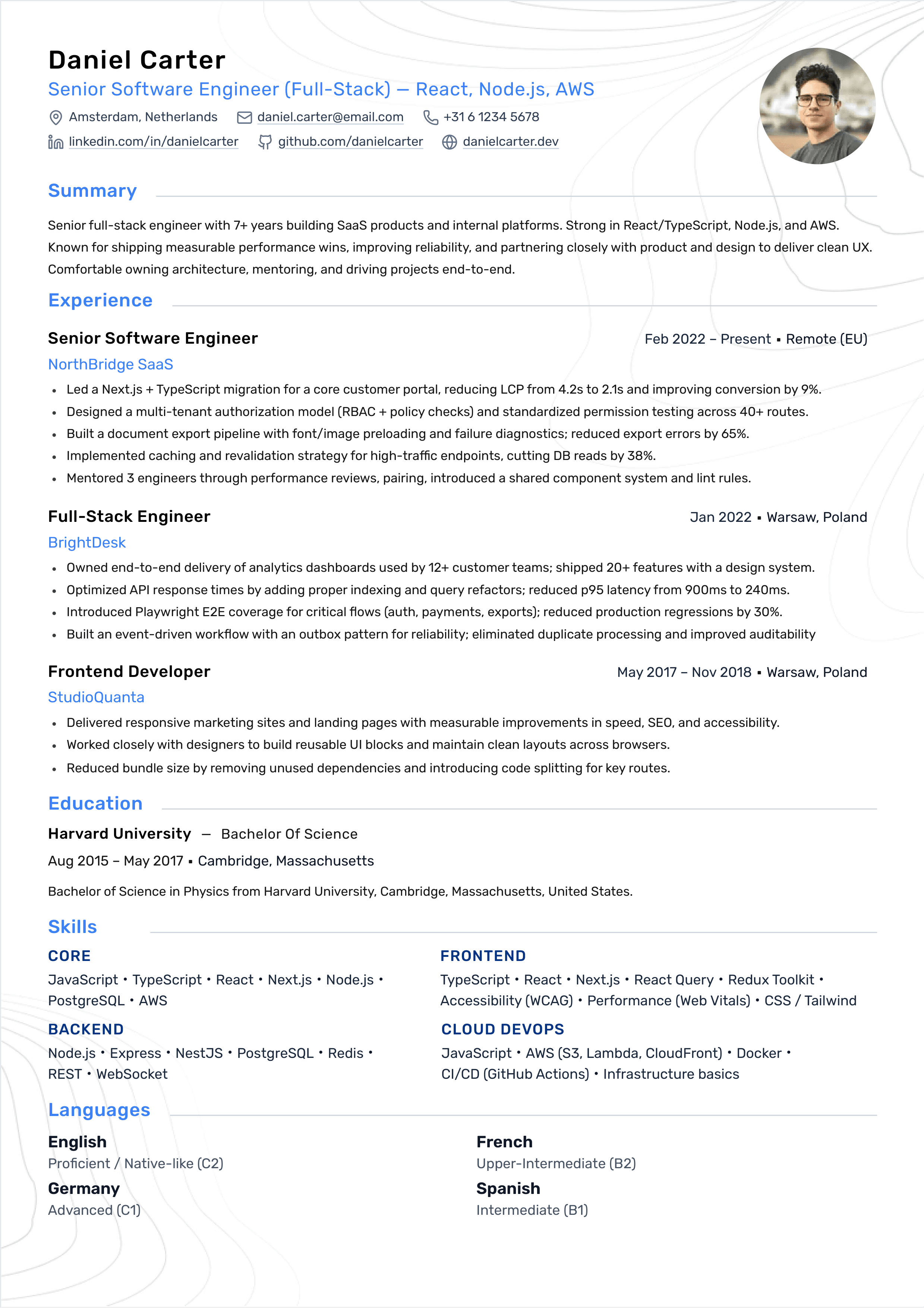
A strong fullstack resume shows where you add value across the stack. That usually means combining UI implementation, API design, data flow, authentication, testing, and deployment into a coherent delivery story. The more your bullets sound like shipped product outcomes instead of disconnected tasks, the stronger your resume becomes.
This guide shows how to structure your summary, skills, projects, and experience so your resume reads like end-to-end product engineering instead of a technology inventory.
The biggest fullstack resume mistake is sounding like you touched everything but owned nothing.
Skills & Keywords
Top Fullstack Engineer Skills Recruiters Look for in 2026
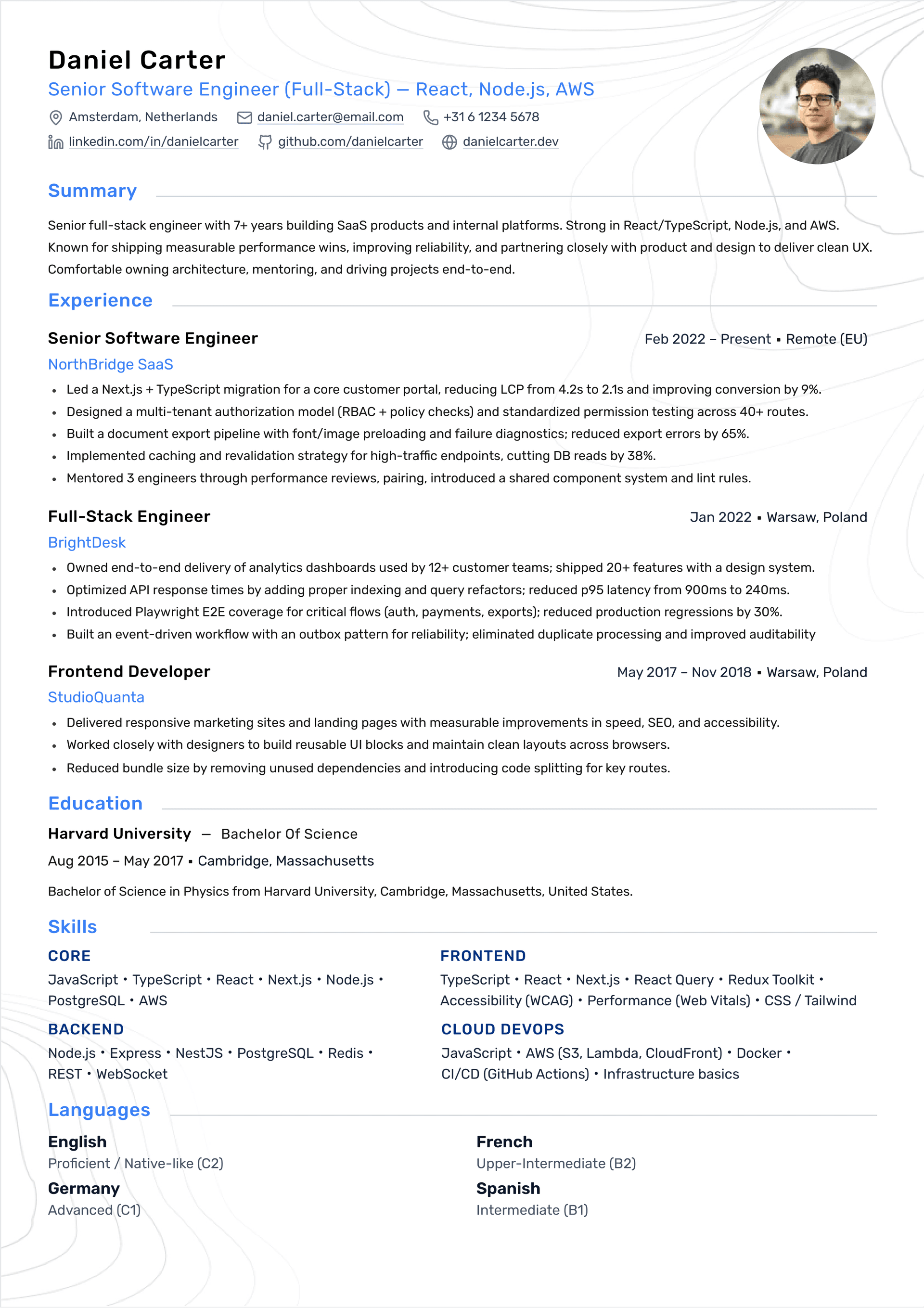
Strong fullstack roles typically span modern component-based frontend work, API and backend logic, database access, and delivery infrastructure. React and Next.js remain highly visible frontend signals, especially in product teams that expect developers to move between client and server boundaries. React’s official docs continue to center modern development around reusable components and Hooks, which is why those concepts still matter heavily in interview and resume evaluation. citeturn0search0turn0search4turn0search16
Next.js is also increasingly relevant in fullstack hiring because its App Router, server and client component model, caching, and deployment flexibility make it a common choice for teams building integrated product applications. The official docs still emphasize server/client composition, caching, revalidation, and deployment options across Node.js servers and Docker containers. citeturn0search1turn0search5turn0search9turn0search13
On the backend side, employers still care about APIs, databases, auth, and production visibility. Observability is now a major cross-stack signal because fullstack engineers increasingly need to debug issues that cross browser, API, and infrastructure boundaries. OpenTelemetry continues to define observability around traces, metrics, and logs, which makes it a strong modern keyword when it reflects real work. citeturn0search2turn0search10turn0search14turn0search22
- Frontend: React, Next.js, TypeScript, state management, responsive UI, accessibility
- Backend: Node.js, API routes or services, validation, auth, background work, caching
- Data: PostgreSQL or MySQL, ORM usage, query tuning, schema design, migrations
- Testing: unit, integration, component, and end-to-end coverage for full workflows
- Delivery: Docker, CI/CD, cloud deployment, environment configuration
- Observability: logs, traces, metrics, dashboards, production debugging
- Security: authentication, authorization, session handling, API risk awareness
- Performance: rendering strategy, caching, network efficiency, database optimization
The best fullstack skill sections show breadth, but your experience bullets still need to prove depth.
How to Write Fullstack Experience Bullets That Sound Real
Weak fullstack bullets often read like job descriptions. They mention React, Node.js, and PostgreSQL, but say nothing about what changed for users or the business. Stronger bullets connect the layers: what UI you built, what API or data work supported it, what constraints you handled, and what result you achieved.
A useful formula is: Action verb → end-to-end feature or system → stack or technical constraint → measurable product or engineering outcome. This structure helps you sound like someone who shipped a product flow rather than someone who completed isolated tickets.
If your work spanned multiple layers, make that explicit. That is the core advantage of a strong fullstack resume.
- ❌ "Worked on frontend and backend features using React and Node.js"
- ✅ "Built an end-to-end onboarding flow across React UI, validation APIs, and PostgreSQL-backed account setup, reducing drop-off during registration and cutting support requests tied to onboarding issues"
- ❌ "Improved application performance"
- ✅ "Reduced dashboard load time by combining route-level caching, smaller API payloads, and query optimization, improving responsiveness for high-use customer accounts"
- ❌ "Added authentication"
- ✅ "Implemented role-based authentication across frontend routes, backend handlers, and admin APIs, closing unauthorized access paths and simplifying permission logic across the product"
A good fullstack bullet shows how the frontend, backend, and data layer worked together.
Frontend Signal Still Matters: UI Quality, Accessibility, and Product Thinking
A fullstack engineer still needs credible frontend signal. That does not mean claiming deep visual-design expertise. It means proving you can build maintainable, responsive, accessible interfaces that connect cleanly to backend systems and product requirements.
React remains a core hiring signal because teams rely on reusable components, composable state, and predictable UI logic. A good fullstack resume should show that you can do more than wire buttons to APIs. Mention reusable UI patterns, form handling, accessibility, client-server boundaries, or rendering strategy when they mattered.
This is especially important if your product work involved user-facing dashboards, account management, editor experiences, e-commerce flows, or internal tooling used daily by teams.
Fullstack does not mean mediocre frontend. It means strong enough frontend work to ship product, not just prototypes.
Backend Signal: APIs, Data, and Business Logic
The backend half of a fullstack role is usually where hiring managers test technical seriousness. They want to see whether you understand API design, validation, authentication, authorization, database modeling, caching, and reliability well enough to support real product behavior.
OWASP’s API Security Top 10 still highlights issues like broken object level authorization and other common API risks, which is why auth and API safety remain important fullstack resume signals. If you worked on role checks, secure resource access, validation, or abuse prevention, include that work clearly. citeturn0search3turn0search7turn0search11
Backend bullets are strongest when they go beyond CRUD and show product constraints: performance, consistency, permissions, async workflows, or integrations with external services.
- REST or route-handler APIs used by web or mobile clients
- Validation and business rules enforced on the server
- Role-based access control or session-based security
- PostgreSQL or MySQL schema design and query improvements
- Caching, queues, or background jobs when synchronous requests were not enough
Your backend signal should prove you can support product behavior safely, not just return JSON.
What Fullstack Hiring Teams Actually Want: Complete Workflow Ownership
The highest-value fullstack bullets usually describe a user workflow from start to finish. For example: sign-up, billing, document editing, notifications, search, dashboard analytics, or admin moderation. These kinds of features show that you can think across user experience, backend behavior, and operational consequences.
That is why fullstack candidates often stand out most when they describe how a single feature touched UI state, validation, APIs, data persistence, permissions, and deployment. This reads much stronger than splitting each layer into separate vague bullets.
If you led or owned a feature end to end, make that unmistakable.
Fullstack hiring is often less about knowing both sides in theory and more about proving you can ship a whole user journey.
Testing Across the Stack
Testing is one of the clearest signals that a fullstack engineer understands quality beyond happy-path coding. The best resumes mention the types of tests that match the kinds of systems built: component tests for UI behavior, integration tests for APIs and databases, and end-to-end tests for critical product journeys.
This matters because fullstack bugs often appear at the boundaries between systems. A form works in the browser but fails against API validation. A backend change breaks a dashboard query. An auth condition blocks a route only in production. Testing across those boundaries is valuable signal.
You do not need a giant testing section. Even one or two good bullets about reducing regressions or protecting critical workflows can raise your resume level meaningfully.
Good fullstack testing signal shows you protect workflows, not just functions.
Delivery, Deployment, and Production Readiness
Fullstack roles often overlap with delivery ownership. Many teams expect engineers to understand how code gets built, tested, configured, deployed, and monitored once it leaves local development. That includes Docker, CI/CD, environment variables, cloud deployment, and rollback awareness.
This does not mean every fullstack engineer needs to be a platform specialist. But when you have delivery experience, it belongs on the resume because it proves you can help ship real systems rather than just hand code to someone else.
Next.js deployment options still include Node.js servers and Docker containers, so deployment knowledge remains relevant for many modern product teams using integrated frontend-backend frameworks. citeturn0search13turn0search1
- Dockerized application services or local environments
- CI/CD checks for tests, linting, builds, and safe deploys
- Cloud deployment on Vercel, AWS, Azure, GCP, or similar
- Environment-specific configuration and secrets handling
- Production monitoring and rollout confidence
Shipping code is not the finish line. Production readiness is part of the job.
Observability and Debugging Across Layers
Fullstack engineers are increasingly expected to debug problems that cross browser state, network requests, APIs, databases, and infrastructure. That is why observability now matters for more than just backend or platform roles.
OpenTelemetry defines telemetry around traces, metrics, and logs, and that model maps directly to how modern teams debug fullstack systems in production. If you added traces, improved structured logs, built dashboards, or reduced time to diagnose failures, include it. citeturn0search2turn0search10turn0search14turn0search22
This is especially strong when your product involved multiple services, external integrations, or heavy user workflows where problems could surface in many places.
The stronger signal is not the tool name. It is what became easier to detect, debug, or recover.
For Junior & Mid-Level
Projects Section: How to Prove Real Fullstack Depth
A great fullstack project is not just a pretty frontend attached to a simple CRUD API. It should prove that you understand how product features move through the entire system: interface, validation, backend logic, data, auth, testing, and deployment.
The best projects often solve a realistic problem: SaaS account workflows, collaborative editors, dashboards, e-commerce, booking systems, internal admin tools, or AI-assisted product features. What matters is not buzz, but whether the project demonstrates architecture and product thinking.
Treat projects like shipped case studies. Show the problem, the stack, the architecture, what you owned, how it was deployed, and what technical tradeoffs you made.
- Include 2 to 3 strong projects maximum
- Prefer real deployed products over tutorial clones
- Show auth, data persistence, validation, and deployment when possible
- Mention tests, performance, or observability if present
- Link GitHub and live demo when available
A small but real end-to-end product is stronger than a dozen disconnected stack demos.
Writing a Strong Fullstack Engineer Summary
Your summary should position you quickly. In two or three lines, the reader should understand your fullstack scope, your strongest technical center, and one piece of proof about the kind of product work you have done.
Avoid empty phrasing like passionate developer, results-driven engineer, or team player. A good summary names your main frontend and backend stack, your type of product ownership, and one strong signal like performance, delivery speed, architecture, or scale.
If you are fullstack but stronger on one side, that is fine. Just frame it clearly. Fullstack with a frontend focus or backend focus still reads well when it is honest.
- Open with your level and role: Fullstack Engineer, Senior Fullstack Engineer, or Fullstack Product Engineer
- Name your strongest stack: for example React + Next.js + Node.js + PostgreSQL
- Add one proof point: shipped SaaS features, built internal platforms, improved performance, or owned delivery
- Optionally mention your preferred product environment: SaaS, marketplaces, internal tools, document workflows, or analytics
Example: 'Fullstack Engineer with 4+ years building SaaS products using React, Next.js, Node.js, and PostgreSQL. Owned end-to-end workflows across UI, APIs, and deployment, with a strong focus on performance, maintainability, and production quality.'
ATS Optimization for Fullstack Engineers
Fullstack resumes still need to parse cleanly before a recruiter or hiring manager reads them. Use a simple one-column layout with standard headings and avoid decorative layouts that make the content harder for Applicant Tracking Systems to extract accurately.
Because fullstack roles vary by company, it helps to mirror the job title and key stack terms naturally. Some companies search for Fullstack Engineer, others use Full Stack Developer, Software Engineer, Product Engineer, or Frontend/Backend-heavy variants.
Keep the structure simple and let the wording carry the signal. Strong role titles, grouped skills, and clear end-to-end bullets are far more important than design tricks.
- Use standard headings: Summary, Experience, Projects, Skills, Education
- Mirror the target title accurately when it matches your experience
- Spell out important acronyms once when useful: CI/CD, RBAC, SSR
- Avoid charts, proficiency bars, and icon-only skill labels
- Use a clear file name such as FirstName-LastName-Fullstack-Engineer-Resume.pdf
ATS optimization is mostly about clarity, consistency, and real keywords tied to real work.
Common Fullstack Resume Mistakes
Fullstack resumes often fail for one of two reasons: they are too broad and shallow, or they are too fragmented. The first type lists every framework in the world. The second separates frontend and backend work so completely that the reader never sees true end-to-end ownership.
The fix is to make the resume more coherent. Show how systems connected, how features moved through the stack, and what result your ownership delivered.
- Listing too many tools without proving ownership or depth
- Describing frontend and backend tasks separately instead of as complete workflows
- Ignoring testing, deployment, or production debugging completely
- Claiming fullstack breadth without showing real shipped features
- Using generic bullets like 'built APIs' or 'worked on UI components'
- Failing to explain which part of the stack is your strongest area
A strong fullstack resume reads like someone who can take a product requirement from interface to production.