
How to Write a Backend Engineer Resume That Gets Interviews
Backend hiring is less about fancy wording and more about proof. Your resume needs to show that you can design reliable services, model data correctly, ship APIs other teams can depend on, and reason about performance, security, and failure modes like an engineer who has worked in production.
Recruiters and engineering managers usually scan for four things first: your main language and platform, the kinds of backend systems you worked on, the data and API complexity you handled, and whether you can talk about production reliability instead of only implementation details.
This guide explains what to include in each section, which backend keywords matter today, and how to write bullets that sound like real engineering work instead of a list of routine tasks.
The fastest way to improve a backend resume is to replace vague 'built APIs' bullets with proof of scope, tradeoffs, and measurable outcomes.
Skills & Keywords
Top Backend Engineer Skills Recruiters Look for in 2026
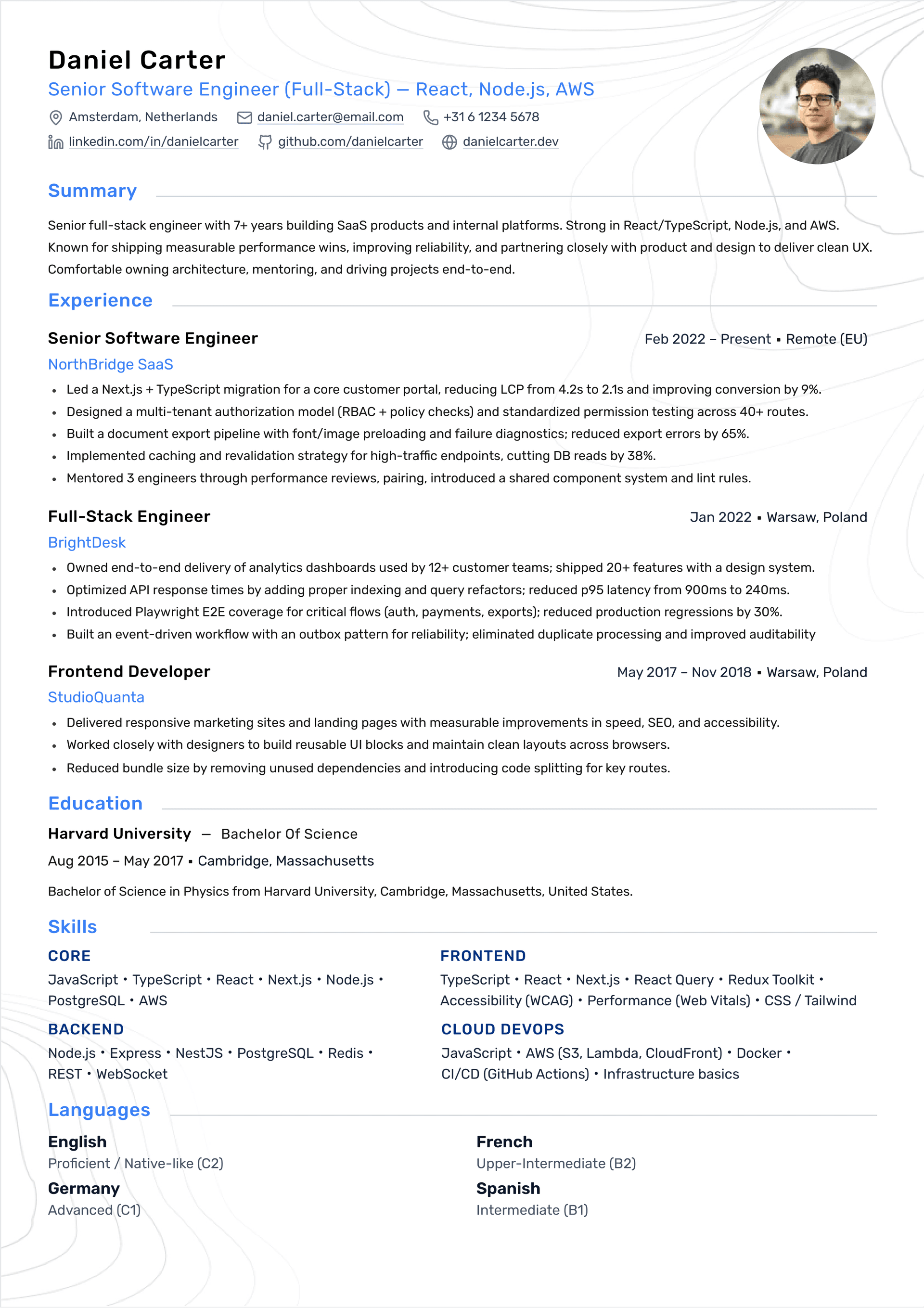
A strong backend resume starts with a clear technical center of gravity. Most employers first want to know your main language, your database experience, your API design ability, and whether you have touched the infrastructure needed to run services reliably in production.
Modern backend roles often extend well beyond writing route handlers. Strong candidates usually show some combination of API contracts, query tuning, caching, background jobs, observability, safe retries, authentication, and delivery workflows.
Organize skills into logical groups instead of dumping a long flat list. That makes the section easier to scan for humans and easier to parse for ATS systems.
- Languages: Node.js, TypeScript, Python, Go, Java, C#
- API Design: REST, HTTP semantics, OpenAPI, versioning, pagination, idempotency
- Databases: PostgreSQL, MySQL, transactions, indexing, query tuning, schema migrations
- Caching: Redis, TTLs, invalidation strategy, hot-path optimization
- Async Systems: background jobs, queues, retries, dead-letter handling
- Reliability: logs, metrics, traces, incident debugging, health checks
- Security: authentication, authorization, rate limiting, secrets, API risk awareness
- Delivery: Docker, CI/CD, cloud deployment, environment configuration
- Testing: unit, integration, API, contract, and migration testing
Backend recruiters are not just hiring for code output. They are hiring for safe systems, solid data decisions, and production judgment.
API Design and Contracts: What Hiring Teams Want to See
API work is still one of the clearest backend signals on a resume, but the bar is higher than simply saying you built endpoints. Strong backend candidates show that they understand HTTP semantics, versioning, request validation, pagination, filtering, retries, and how to design APIs that other systems can safely depend on.
OpenAPI is especially useful resume signal because it shows contract thinking, not just implementation. If you worked with API specs, generated docs, client contracts, or standardized request and response behavior, include that clearly.
Strong API bullets are even better when they explain who consumed the interface: web app, mobile app, internal admin tools, partner integrations, or public third-party clients. That context helps the reader understand the stability and scope of your work.
- Versioned REST APIs for web, mobile, or internal tooling
- OpenAPI or Swagger-based contracts and documentation
- Pagination, filtering, validation, and error design
- Idempotent handlers for payments, retries, webhooks, or job scheduling
- Authentication, authorization, and rate limiting at API boundaries
An API bullet is strongest when it shows contract quality and production safety, not just that you wrote controller code.
Databases, Indexes, and Query Performance
Backend resumes get much stronger when they prove database judgment. Many engineers say they know PostgreSQL or MySQL, but hiring managers want to see whether you actually reasoned about schema design, indexing, transactions, migrations, and query behavior under load.
Good backend bullets mention what changed in the data layer and why. That could mean composite indexes, partial indexes, index-only scan improvements, query-plan analysis with EXPLAIN, or schema changes that reduced contention or improved correctness.
You do not need to sound like a database specialist. But you should show that you understand that backend performance is often limited by data access, not only by application code.
- Schema design for business entities and relationships
- Targeted index selection and query optimization
- Transactional workflows and consistency guarantees
- Migrations, backfills, and rollout discipline
- EXPLAIN-based investigation of slow queries
- Knowing when cache or async processing is a better fix than more DB load
If you mention PostgreSQL, prove it with indexing, transactions, migrations, joins, or query tuning — not just the database name in a skills list.
Caching, Background Jobs, and Async Workflows
Modern backends often move heavy or failure-prone work out of the request-response path. That means caching, background jobs, queues, retries, and dead-letter handling are valuable resume signals, especially for mid-level and senior roles.
This matters because async systems introduce real engineering tradeoffs: duplicate delivery, ordering problems, retry storms, job visibility, and eventual consistency. Once your resume shows that kind of work, it starts sounding much closer to production engineering than to simple CRUD development.
If you used Redis, Kafka, RabbitMQ, BullMQ, Celery, Sidekiq, or similar tools, explain what problem they solved: report generation, emails, integrations, billing, webhooks, search indexing, or media processing.
Async experience is strong signal because it shows you have handled systems where latency, retries, and failure modes matter.
Observability and Production Debugging
As systems get more distributed, observability becomes a major differentiator on backend resumes. Logs alone are often not enough. Teams increasingly expect engineers to understand metrics, traces, and correlated production telemetry well enough to diagnose issues across multiple services or layers.
If you instrumented services, improved dashboards, added distributed tracing, structured logs more clearly, or shortened time to diagnose incidents, say so. That tells hiring managers you think about runtime behavior, not just local implementation.
You do not need formal SRE ownership to benefit from this. Even one strong bullet about improving production visibility can raise the level of your resume noticeably.
- Structured logging for faster root-cause analysis
- Metrics and dashboards for latency, error rate, queue depth, or throughput
- Distributed traces across services or workflows
- Correlation between traces, metrics, and logs
- Production debugging improvements tied to mean-time-to-detect or mean-time-to-diagnose
Feature work gets attention. Observability work makes you look like someone trusted with production systems.
Backend Security Basics That Matter on a Resume
A backend resume does not need to read like a security specialist profile, but weak security awareness is a real red flag. Modern backend roles often expect engineers to understand authentication, authorization, secret handling, API abuse prevention, and practical risks like broken object-level access control.
If you implemented role checks, session handling, signed URLs, token validation, rate limiting, webhook verification, or tenant boundaries, include it. These are practical signals that you did more than ship happy-path business logic.
Security bullets are strongest when tied to a real risk. For example: preventing duplicate payment execution, closing unauthorized admin access, hardening uploads, or fixing tenant-isolation gaps.
Security on a backend resume should sound practical: who could access what, what risk existed, and how you reduced it.
Delivery, Docker, and Production Readiness
Backend roles increasingly overlap with delivery ownership. Many teams expect engineers to understand how services are containerized, tested, configured, deployed, and rolled back once they leave local development. That includes Docker, CI/CD, environment management, and cloud deployment basics.
You do not need to sound like a platform engineer if that was not your role. But if you containerized services, improved build and release steps, added deployment checks, or helped standardize environments, that belongs on the resume because it proves you can help ship real systems.
The strongest delivery bullets tie setup work to outcomes: safer releases, fewer manual steps, faster rollbacks, or better consistency across environments.
- Dockerized services for consistent local and production environments
- CI/CD workflows for tests, builds, migrations, and deployment gates
- Environment-specific configuration and secrets handling
- Cloud deployment across staging and production
- Release safety through checks, rollback awareness, or gradual rollout practices
Shipping code is not the finish line. Production readiness is part of the job.
How to Write Strong Backend Experience Bullets
The most common weak backend bullet says what you coded but not why it mattered. A line like 'Built APIs in Node.js' tells the reader almost nothing about system value, complexity, or results.
Strong bullets usually combine four things: the system or capability you owned, the technologies or constraints involved, the change you delivered, and the measurable engineering or business outcome.
Use this formula: Action verb → system or component → technical context → measurable result or product outcome. Even when exact metrics are unavailable, concrete scope still beats vague language.
- ❌ "Worked on backend services using Java and PostgreSQL"
- ✅ "Designed and maintained Java services backed by PostgreSQL, introducing tracing and query tuning that reduced p95 latency across critical checkout flows"
- ❌ "Improved database performance"
- ✅ "Added composite and partial indexes, removed N+1 query patterns, and rewrote slow joins, reducing the heaviest reporting endpoint from 12s to 1.9s"
- ❌ "Built a background worker"
- ✅ "Implemented queue-based background processing with retry and dead-letter handling for invoice generation, reducing timeouts and improving job completion reliability during traffic spikes"
Great backend bullets sound like someone who understands scale, failure modes, and tradeoffs — not someone listing tutorial steps.
For Junior & Mid-Level
Projects Section: How to Prove Backend Depth Without Big-Name Employers
A strong backend project can carry far more weight than many candidates expect. If you have limited professional experience, a deployed service with authentication, data persistence, tests, observability, and real tradeoffs can be stronger than vague internship bullets.
The key is avoiding toy-project framing. A shallow CRUD clone is weak unless you add real engineering depth: auth, background jobs, caching, query tuning, API contracts, observability, or a clean deployment story.
Treat projects like production case studies. Name the problem, the stack, the architecture, what you owned, how it was deployed, and which reliability or performance decisions you made.
- Include 2 to 3 strong projects maximum
- Prefer deployed services over local-only demos
- Show auth, persistence, validation, async work, and deployment when possible
- Mention tests, performance, and observability if present
- Link GitHub and live docs or demo when available
A boring but well-built backend with docs, auth, query optimization, and telemetry is stronger than a flashy but shallow clone.
Writing a Strong Backend Engineer Summary
Your summary should position you in two or three lines. The reader should quickly understand your backend scope, your strongest stack, and one proof point about the kinds of systems you have built or operated.
Avoid generic phrases like passionate, hardworking, or team player. Strong backend summaries are specific, technical, and short enough to scan quickly.
A good summary usually names your main language, your data or API comfort zone, and one real signal such as performance work, system ownership, or production reliability experience.
- Open with your level and role: Backend Engineer, Senior Backend Engineer, or Software Engineer (Backend)
- Name your strongest stack: for example Node.js + PostgreSQL + Redis
- Add one proof point: API ownership, latency improvements, system scale, or reliability work
- Optionally mention your target environment: SaaS, fintech, internal systems, or data-heavy products
Example: 'Backend Engineer with 4+ years building Node.js and PostgreSQL services for SaaS products. Designed internal and public APIs, optimized data-heavy endpoints, and improved production visibility through tracing and structured logs.'
ATS Optimization for Backend Engineers
Applicant Tracking Systems still matter for backend roles, especially at larger companies and recruiting-heavy pipelines. Your resume needs to parse cleanly before a human decides whether your experience looks strong enough for the role.
Use a simple one-column layout with standard section headings. Avoid tables, text boxes, heavy sidebars, and visual skill ratings. Backend resumes sometimes get overdesigned even though engineering readers care more about content than decoration.
The safest ATS strategy is simple: use clear role titles, grouped skills, and bullets that naturally include real backend terms without stuffing them.
- Use standard headings: Summary, Experience, Projects, Skills, Education
- Mirror the target title when accurate: Backend Engineer, Software Engineer (Backend), Platform Engineer
- Spell out important acronyms once when helpful: CI/CD, RBAC, JWT
- Avoid charts, proficiency bars, and icon-only skill labels
- Use a clear file name such as FirstName-LastName-Backend-Engineer-Resume.pdf
ATS optimization is not about gaming the parser. It is about making your real backend strengths easy to extract and easy to trust.
Common Backend Resume Mistakes
Backend resumes often undersell strong work because they describe output at the wrong level. Instead of showing what system changed, what risk or bottleneck existed, and what improved, they list implementation details with no context. Others do the opposite and hide all technical substance behind buzzwords.
The fix is balance: enough technical detail to prove depth, enough plain English to show product or engineering impact.
- Listing tools without proving you used them in meaningful work
- Describing only responsibilities, not system outcomes
- Claiming distributed-systems depth when the work was basic CRUD
- Ignoring performance, reliability, or security improvements
- Stuffing too many frameworks into the skills section
- Forgetting to mention API consumers, service ownership, or production impact
The best backend resumes feel concrete. They name real systems, real constraints, and real outcomes.